


Francis Alexander's Story.
Francis Alexander Burnet was born on January 4th, 1892, in Haddington, Scotland, the youngest son of James Stuart Burnet, a writer or scribe, and Euphemia Scott. Francis was educated at John Watson's Institution in Edinburgh and the Knox Institute, Haddington, and served as a commissioned officer in the 1/8th Bn. of the Royal Scots until 2nd April 1908, when his term of engagement ended and he would have been placed on the reservist list. In 1911 he was working as a seedsman at Dod's in Haddington, a firm providing farm supplies in the area since 1782. It was at this time he was involved in the founding of the Haddington Rugby Football Club of which he was to become Captain. According to the Haddingtonshire Courier, he also played senior cricket, tennis and golf. Rugby had been played in the town prior to 1911 and in May 1910 a team had been due to play at the official opening of the town's Neilson Park, but this was cancelled due to the death of King Edward VII.
On 7th June 1915 he received a commission as Second Lieutenant in the 8th Bn. Royal Scots and on 16th December he went to France. In May 1916 he was part of the Divisional Bomb School which, according to the Haddingtonshire Chronicle, received the 'Divisional General's congratulatory remarks upon the smart work of a platoon under Lieutenant Burnet at a rehearsal of the blowing up of a mine and subsequent rapid wiring display'. After a period of illness in early September, Burnet rejoined his battalion on 14th September and on 21st November was part of a wiring party at Beaumont Hamel, which had been retaken by the allies a week earlier. Two days later he gave a demonstration on rapid wiring to BHQ. After a further spell in hospital at the end of the year, Second Lieutenant Burnet returned to duties on 16th January 1917 and was again involved in wire cutting duties such as at Kliest Wood in July before a period of home leave in August. By October he was back on the front line again, with a promotion to Lieutenant. He was again involved in laying wire on the front-line, an extremely dangerous job and it was probably for this work that he was mentioned in dispatches on 6th January 1918.
Francis Burnet must have been given leave again in March 1918 as it was on the 22nd of that month that he married Nanette, or Nancy Harris at St Barnabas Church, Bromborough. Nancy was the eldest daughter of William Harris, a corn merchant, and Elizabeth Cathe Howden, who had lived at Ravensheugh, Old Chester Road (now Spital Road) since 1890. Nancy's mother was also from the Haddington area and maybe this was how Nancy and Francis had met.
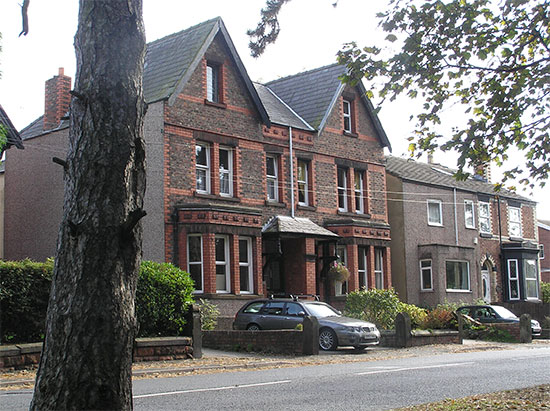
Ravensheugh.
Ravensheugh.
Sadly, they were married for only a few short weeks. Francis returned to the front line and on 11th April the 8th Bn. Royal Scots, under the command of the 1/7th Black Watch, were holding up the Germans at Paradis Church. There was heavy fighting and a total of sixteen officers, including Lieutenant Burnet, were injured, killed or missing over a two-day period. A fellow teammate from Haddington, George Reid, went forward to find Second Lieutenant Burnet and his men, but he also was never seen again. Francis Burnet's body was never found, and he is remembered on the memorial at Ploegsteert, Belgium and on the memorial in his hometown of Haddington.
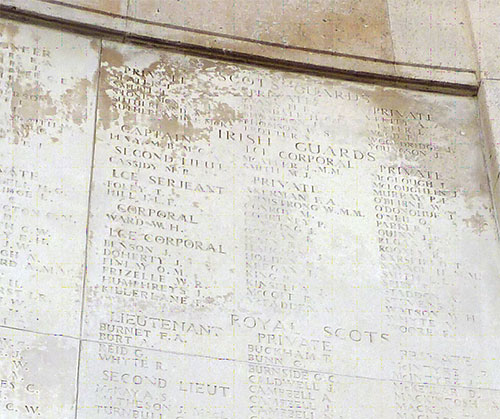
Ploegsteert Memorial.
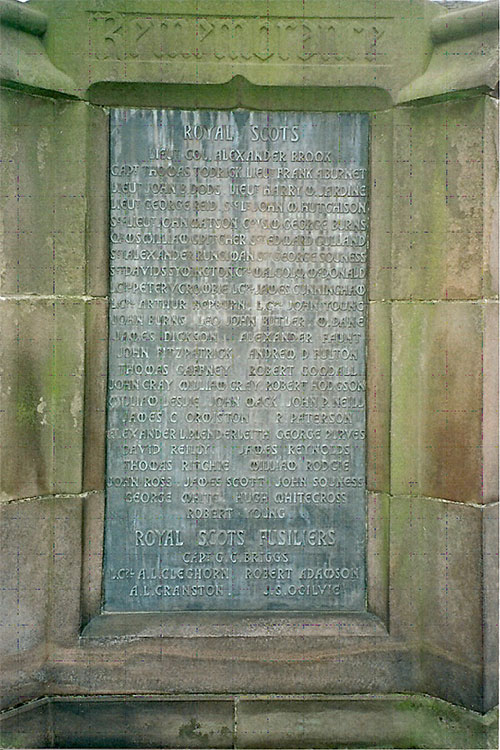
Haddington War Memorial.
Ploegsteert Memorial.
Haddington War Memorial.
His older brother David Scott Burnet, born 1884, served with the 1st Bn. Royal Scots.
His medal entitlement was Memorial Plaque, British War Medal and Victory Medal.
Researched and compiled by Judith Beastall.
Researched and compiled by Judith Beastall.