


Thomas William's Story.
Thomas William Bell was born on 1st January, 1897, in Bromborough, the second of six children, one of whom died in infancy, born to Thomas and Mary Ann Bell. In 1911 Thomas lived with his parents, brother James (born 1901), and sisters Annie (born 1895), Florence (born 1899) and Daisy (born 1903) at 59 The Rake, Bromborough and was employed as a gardener.
On 16th November 1915, Thomas travelled to Liverpool to enlist in the Royal Marine Light Infantry, probably to H.M.S. Eagle, his papers state that he was 5' 2¼'', with a fresh complexion, brown hair and brown eyes. He was then sent to the Reserve Depot at Deal from 16th November to 23rd, before moving to Portsmouth to continue his training from 24th November 1915 to 25th September 1916, and it was probably at this stage that he was given the number PO/1026S. The following day he embarked for France.
The 2nd Bn. Royal Marine Light Infantry was part of 188th Brigade, 63rd Royal Naval Division and had been in France since May 1916. Prior to this, the division had seen action at Gallipoli and in the Salonika campaign. The first major action in which Thomas Bell would have almost certainly taken part, was on 13th November 1916 when the division took part in the attack on the village of Beaucourt-sur-Ancre, in which 3 officers and 84 other ranks were killed. After a two month rest out of the line, they returned to action in February 1917, in the area around St Pierre Divion and during that month they had 48 men killed.
On 17th February 1917, Private Bell took part in an action to take German positions in front of Baillescourt Farm, on the banks of the River Ancre. His battalion had 48 men killed.
During March and early April 1917, Private Bell and his battalion provided working parties and carried out training. On 22nd April, they moved into the support line at the Pont Du Jour, in preparation for an attack on Gavrelle. 188th Brigade were in reserve for the attack, which took place the following day. They then took over front line positions from the 4th Bn. Bedfordshire Regiment on the 24th. On 25th April 1917, the Germans launched a counter attack, which was dispersed by British artillery fire, the 2nd Bn. had three other ranks killed and eight wounded. The following day, they were shelled throughout the day and had one officer missing, three other ranks killed and 30 wounded. On 27th, they moved to new positions in preparation for an attack on the 28th. During this move they had eight other ranks killed, fourteen wounded and nine missing. The 2nd Bn. attacked the enemy trenches to the north-east of Gavrelle, in four waves. One platoon was detailed to take the Windmill, which was reached and held, but casualties were very heavy. one officer and 25 other ranks were killed, 72 other ranks were wounded and eight officers and 387 other ranks were missing. It was probably during this action that Private Bell was wounded. He was invalided back to the UK. on 1st May 1917.
After recovering from his injuries, Private Thomas Bell returned to his Bn. on 17th June 1917. At that time they were in training at Moroeuil, north-west of Arras. They returned to the front line in mid-July, in the area around Oppy Wood. On 9th September 1917 the 2nd Bn. Royal Marine Light Infantry relieved the 1st Bn. R.M.L.I in the front line. During their time in the line they were providing working parties, possibly on the repair of trenches and parapets. On 11th September, the battalion war diary states that there were two casualties, one of those was Private Thomas Bell.
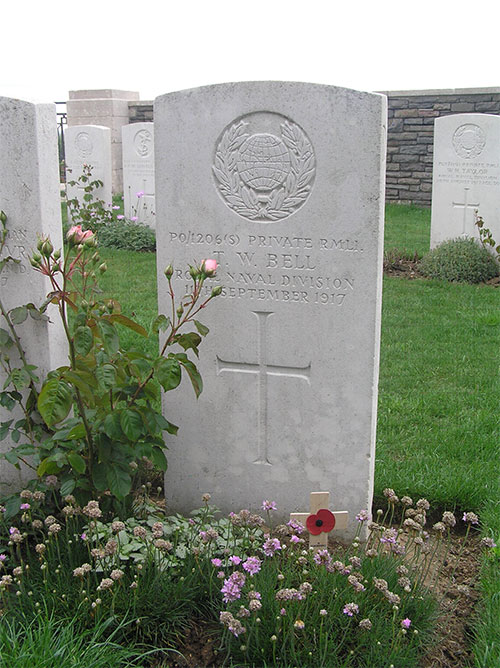
According to his service papers his body was buried in an isolated area and the details noted. In March 1919, his body was exhumed and reburied in Row D, Grave 14, Naval Trench Cemetery, Near Gavrelle. He is also commemorated on the family grave in St Barnabas churchyard, Bromborough.
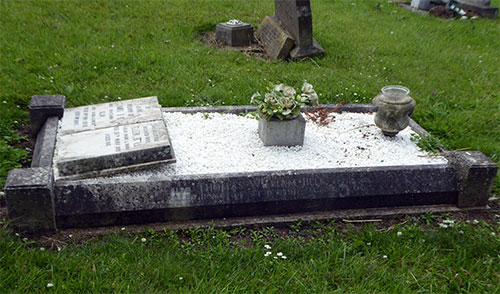
Family grave St Barnabas churchyard, Bromborough.
According to his service papers his body was buried in an isolated area and the details noted. In March 1919, his body was exhumed and reburied in Row D, Grave 14, Naval Trench Cemetery, Near Gavrelle. He is also commemorated on the family grave in St Barnabas churchyard, Bromborough.
Family grave St Barnabas churchyard, Bromborough.
His medal entitlement was the British War Medal and Victory Medal.
Researched and compiled by Judith Beastall
Researched and compiled by Judith Beastall