


Horace's Story.
On the 29th June 1893 Mary Alice Swindells, unmarried, had a child. She registered her new-born as Horace Moss, indicating no father. She had to leave her home and managed to get a position in service with Mr John Beard and his wife Ann Beard.
She later married John Beard on the 18th October 1894 at Stockport Register Office, following the death of his first wife Ann, and Mary Alice’s son now became Horace Beard. His surname was changed and his second ‘given’ name no longer mentioned.
Horace had two siblings through his mother’s first marriage, Edith Beard born 1899 and John Beard born 1901.
By 1911 Mary was a widow, the census shows the family living at Market Place, Compstall. Horace is listed as Assisting in Business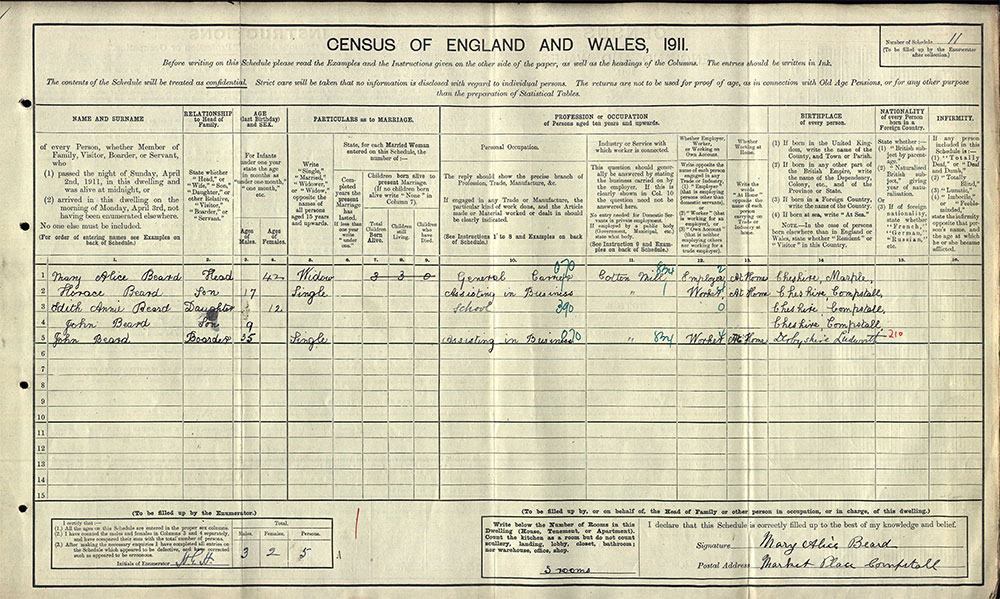

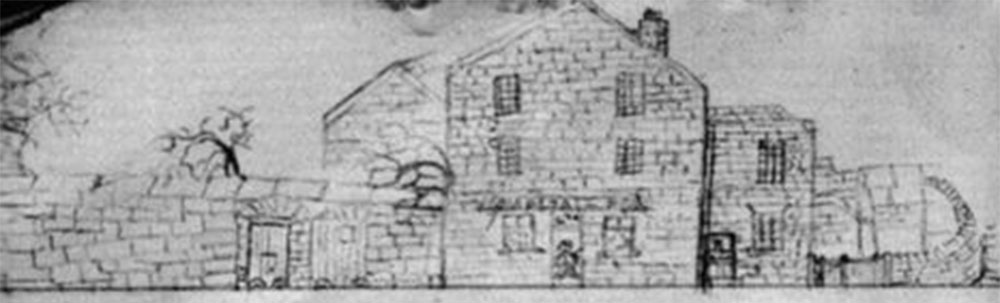
A drawing of Compstall Post Office by Horace Beard
Horace joined the 5th East Cheshire Regiment in September 1911 at the age of 18 but bought himself out the following year. In September 1913 he again joined H. M. Forces at Preston, in the Royal Field Artillery. (R.F.A). The Christmas following, he came home for a few days leave. August 1914 when war was declared his brigade was sent to Flanders, arriving in France 19th August, he would visit home only once, the first week in December 1915 for 7 days.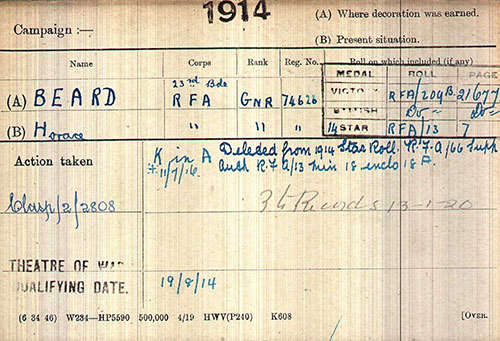
During his time on the Western Front Horace wrote many letters
He wrote home “Tell Thomas Green that when we are charging the enemy I shall think of our veterans and of the country I serve and the fair little peaceful village I have left behind.”
Again, he wrote “I am marching far away my thoughts are always turning to my little village, where the church bells ring in peace. I fancy sometimes I can hear them chiming and amidst their echo the clattering of clogs and the mingling of voices.”
In another letter he says “It was my wish to see active service and I do hope fate will be kind to me and let me live to tell the tale. When you receive this we shall be mobilised entirely.”
He was sent out to Flanders and was in the retreat from Mons and spoke of the terrible sights he saw both among the wounded English soldiers and the refugees, “That their plight was terrible, indeed.”
He told of having offered to take one of his officers his dinner, he had to cross a piece of ground under the constant firing of a German sniper, taking cover whenever he could.
He also wrote about coming out of their dugout because of German gas, and the terrible pain in his head and eyes, whilst getting his breath was almost impossible. He told of his being in the battles of Marne and Aisne, of this latter battle he wrote in October 1914 “but I thought we had finished when you got to the Aisne. Our right section was put out of action in quick style. A shell hit our wagon and ignited some of our shells. One I had just set at the time went off and filled the trench with flames; it burned my hair and injured the sergeant with me. He went to hospital and left me alone. In the meantime, my detachment had all been wounded and I was the only one left. Sometime afterwards my section officer came and told me to run for it and I was not long about it.”
He came home for 7 days leave in December 1915, his last visit to his home and to his school he afterwards wrote: “I thoroughly enjoyed my short stay with you all, it was a glorious pleasure to come again to the old Sunday School and to sing again a few more glad hymns to our Maker, but oh! the horror of returning I would not care to experience again. That hymn that they sang on Wednesday night ‘God be with you till we meet again’ made me realise that I should very soon be gone again from your midst.”
The Brigades war diary has no details of the day, it is likely that their position was targeted by enemy artillery and that he was killed by their shellfire .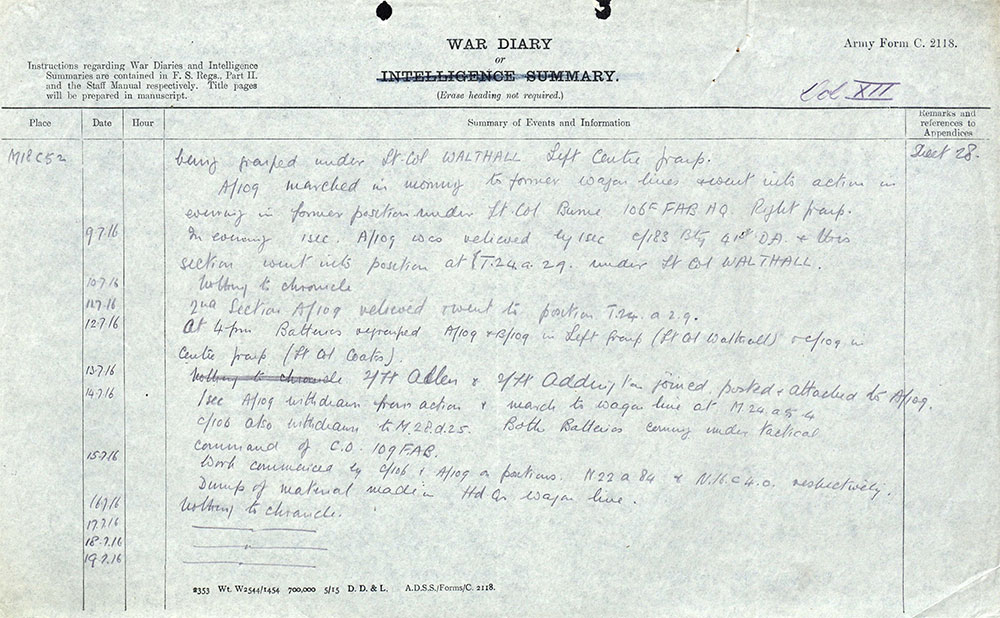
Extract from the Reporter Saturday 2nd September 1916
Seldom in its history has Compstall seen anything approaching the scenes which took place Sunday evening 27th August 1916 when a solemn memorial service was held in honour of the memory of Fred Hallam, R.N. Gunner Horace Beard, who passed right through the war from Mons until recently, when he lost his life on the battlefield : Lance Corps, Harry Yarwood, of Brabyns Brow, Marple, whose death was recently reported, and Private James Butterworth, the only son of a widowed mother, all of whom were associated with and had attended the Compstall Wesleyan School.
The proceedings commenced with a procession from the Windsor Castle, Rose Brow to the Wesleyan Chapel in Compstall. Blinds were drawn en-route and the roads lined with people. Compstall Band came first and were followed by the Compstall Platoon of the Cheshire Volunteer Regiment and members of the Compstall Sons of Temperance, of which Gunner Horace Beard and Lance Corpl. Harry Yarwood were members, the band playing “Farewell, My Comrade”.
The service in the chapel was of a most impressive character. The sacred edifice was packed to its utmost character. The relatives of the departed heroes occupied seats at the front of the chapel. The service ended with the congregation singing “Lead Kindly Light,” the favourite hymn of Horace Beard.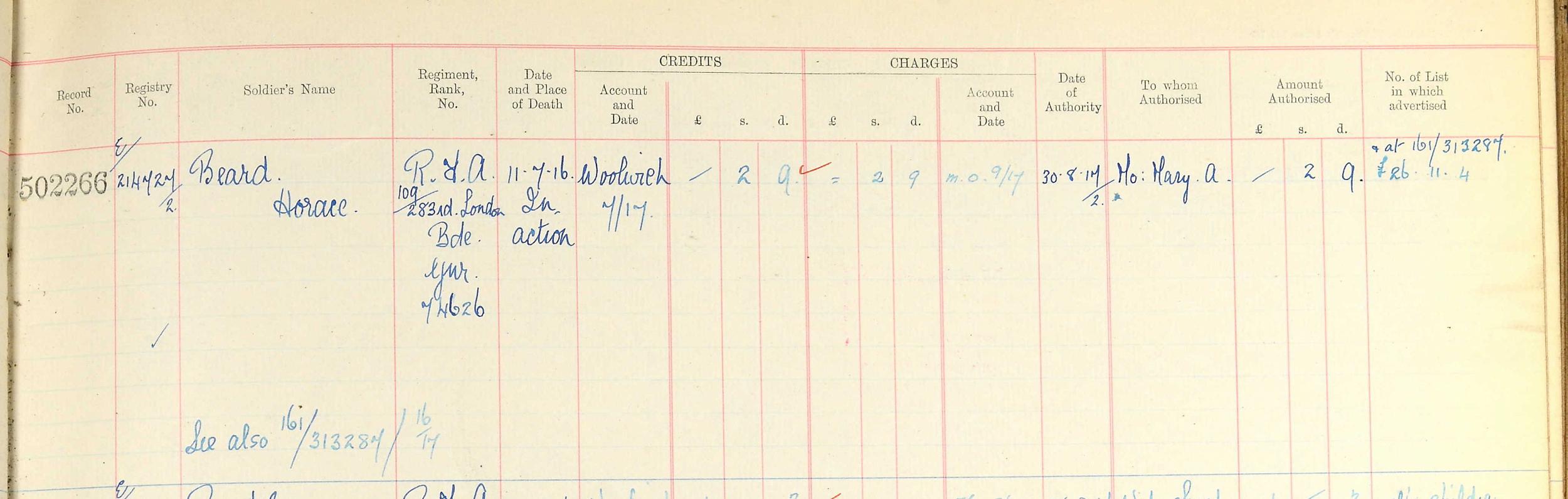
After the War Mary recieved this small gratuity
The Cheshire Roll of Honour would like to thank Janet Beard for the information about Horace.