


Richard James's Story.
Born April 25, 1892 , Richard James Tipton was the third son of John and Mary Tipton of Birkenhead. Richard was educated at Birkenhead, he was a school prefect and played rugby, he went on to play for Birkenhead Park.
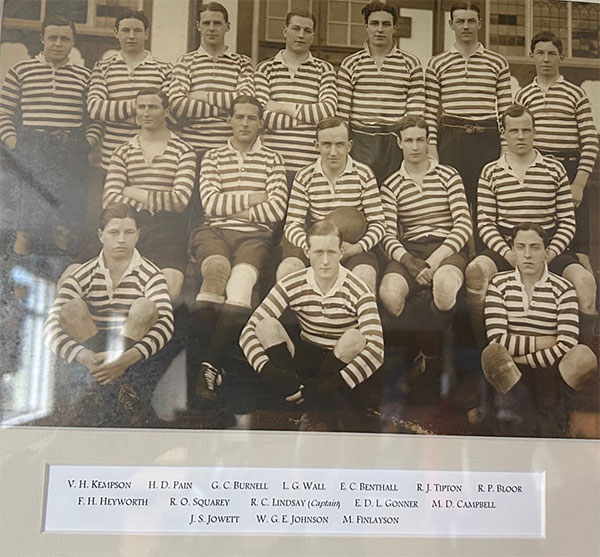
Before the war he was training in the 3rd West Lancashire Royal Field Artillery, in May 1916 he transferred to the Royal Flying Corps (R.F.C.) and went to Egypt with the 14th Squadron, he was twice mentioned in despatches.
18 June 1916 during a bombing raid on El Arish he was forced down behind the lines and was taken prisoner. For fourteen months he was a prisoner at Kastamuni, (now known as Kastamonu) in Asia Minor, (Turkey) In August 1917 Richard with three others effected an escape and made a 49-day journey to freedom, crossing the Back Sea to Russia before making it back to England. The story of the escape appeared in Blackwoods Magazine written by Captain E.H. Keeling, below is a brief extract.
Keeling refers to one of the escapees as S, this officer was captured on the coast when they tried to get a boat and at the time this article was produced, he was still a prisoner.
Extract from Blackwoods Magazine May 1918, An Escape from Turkey in Asia. By Captain E. H. Keeling.
The escapees
Captain R J Tipton
Captain E. H. Keeling
Lieutenant H.C.W. Bishop
S was recaptured and at the time of writing was still a prisoner.
The camp held around 120 British officers with around 50 other ranks. Kastamuni had a population of around 40,000, its 260 miles east Constantinople and lies in a fertile valley nearly 3,000 feet above sea level. The Black Sea in a straight line is about 40 miles away, at the time the nearest railway station was Angora a seven-day journey on foot. Captain Keeling describes the term prisoner camp as a misnomer, they were quartered in private houses which had belonged to Armenians and Greeks which had been cleared for their use. They were supplied with money and made their own arrangements for food of which there was no shortage. They were able to play football, go for walks and were generally well treated.
During 1917 various routes had been discussed for an attempt to join the Russians. Only three seemed viable, two of which involved a land journey of between 300 and 400 miles across mountainous country. The third was to find a boat on the coast of the Black Sea and make for either Tireboli or Crimea. They learnt that the best chance of finding a boat was in the town of Bafra a distance of 110 miles in straight line across the mountains to the east of Kastamuni and around 15 miles from the mouth of Kizil Irmak.
Owing to the mountainous terrain they had to cover they knew it would be much more than 110 miles, therefore weeks before the attempt they started strict training. They each made a rucksack and built-up rations that each man had to carry this consisted of.
11lb of biscuits, made from flour, sugar and butter.
2 ¾ lb of cheese
2 ¾ lb of dried meat
1 ¼ lb of chocolate
1 ½ lb of Horlicks malted milk
Some soup squares
Some meat lozenges
Some salt
3 boxes of matches
Compass
Knife and Spoon
Spare socks
Cardigan jacket
£20 in Turkish paper money
Soap and toothbrush
Water bottle
Two of the four were smokers, so they also carried a few cigarettes, in addition to the above between them they also carried the following.
A sail in two sections to measure 10 x 10 x 7 ½ feet when put together
Rope for rigging
Axe head for cutting a mast
Air cushion for holding extra drinking water in the boat.
Box of Bengal lights
Two canteens for cooking, and a frying pan
Cup
Tea tabloids and cocoa
Several tines of meat and condensed milk
Candle
Towel
Fishing Tackle
Needles and thread for boots, clothes and sail.
Beeswax
Nails for boots and boat
Scissors
Shaving tackle
Quinine and Vaseline
Turkish map showing the Black Sea
The sail was a patchwork of sheets a towel and two Wolseley grips. On the first night of their journey each man was carrying 30 to 35lbs on their backs.
Clothing was an issue; they knew they could not pass as Turkish in the daytime so to move at night was the best policy, they took fezzes with them to wear at night to support their silhouette from a distance. They decided to wear their uniforms, if stopped they hoped to pretend to be German and to assist with this, they forged a document in Turkish that stated.
To all Turkish Civil and Military Officers.
Give every assistance to the bearer, Captain Hermann Von Bellow, and the three soldiers, who are doing survey work.
The date fixed for the escape was August 8, 1917. On August 16 after a stiff climb, they reached a cliff above the bank of the river Guek Irmak a tributary of the Kizil Irmak. They reckoned they were nearly halfway between Kastamuni and Bafra. During this period Richard had been ill and in pain but had kept going. On August 22, they found themselves about 3 miles from the coast, Captain Keeling estimated that during the 14 days of their journey they had covered about 200 miles.
At this point they attempted to obtain a boat but were captured by Turkish soldiers. The officer known as S was taken away separately. On August 26 the remaining three started their journey back to captivity in Kastamuni, a journey that was going to take about a week, Richard was still ill, and he was provided with a horse, on the second day however while on a lonely stretch of road the guards were attacked by Armenian rebels, all nine of guards surrendered without firing a shot. It came out that the rebels had a group of others who were preparing to leave for Russia and the three remaining officers were invited to join them. After a 78-hour sailing and 49 days after leaving Kastamuni they reached Aloupka on the Crimean Coast.
Richard’s journey home from there was first to Yalta then Sebastopol and eventually reached England via Odessa, Kieff, Petrograd, Finland, Stockholm.
When Richard arrived back in England he met the King at Buckingham Place. He was offered three months leave but he decided to rejoin the R.F.C., and shortly afterwards he was posted to France. During a dog fight with German aircraft on 11 March 1918 he was hit by a bullet, though wounded he managed to fly back and land. He died of the wound the next day.
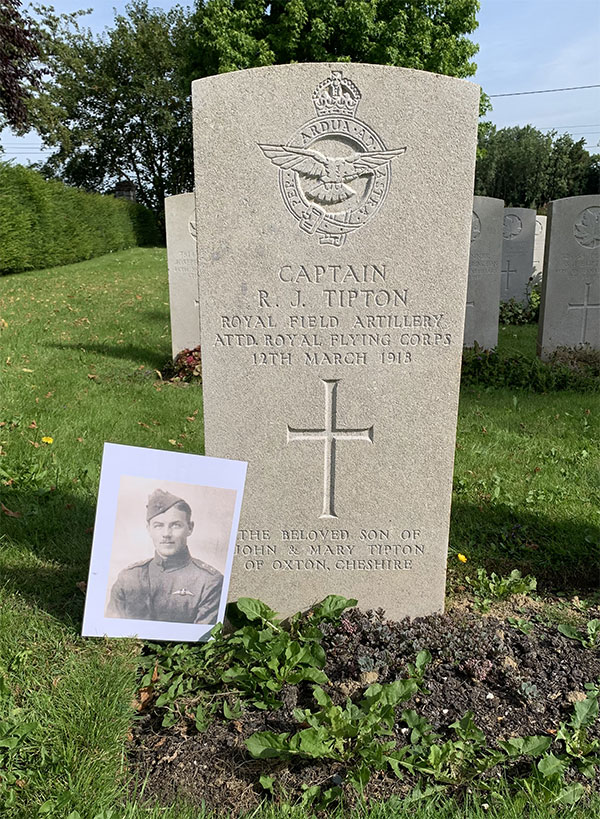
Richard is buried at Barlin Communal Cemetery, the epitaph on his headstone reads
‘The beloved son of John & Mary Tipton of Oxton, Cheshire.’
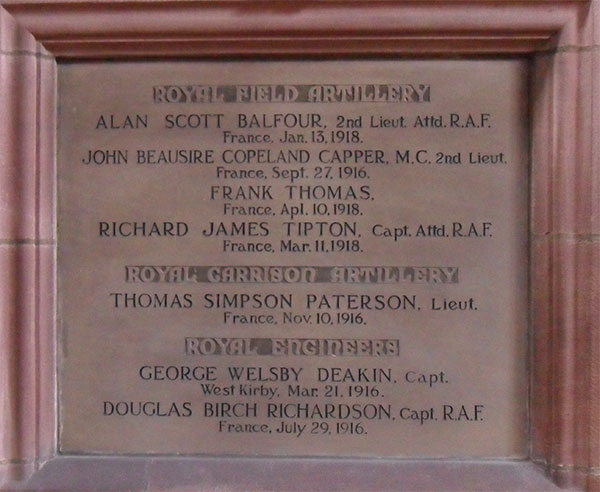
Plaque at St. Saviour's Church, Oxton.
Plaque at St. Saviour's Church, Oxton.