


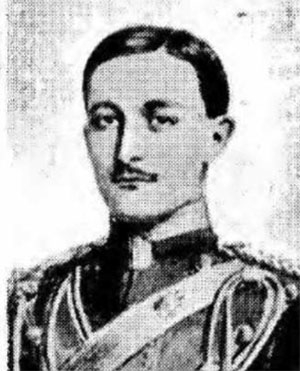
William Hubert's Story.
COURT, WILLIAM HUBERT ROYLANCE (ALGY), Capt., 9th (Queen’s Royal) Lancers, only s. of William Roylance Court, of Manor House, Middlewich, co. Chester, J.P., Barrister-at-Law, by his wife, Mary Carlaw, eldest dau. of Sir Andrew Barclay Walker, 1st Bart., of Osmaston Manor, co. Derby;
William was born at Osmaston Manor, Derbyshire, 26 Sept. 1885; educ. Wixenford Preparatory School and at Eton; gazetted 2nd Lieut. from the Royal Garrison Artillery Militia to the 9th Lancers, 6 July, 1907; became Lieut. 4 March, 1910, and Capt. 23 April, 1913, and was for a lengthy period stationed with his regt. at Potchefstroom, South Africa. When the war broke out in August the 9th Lancers were at Mooltan Barracks, Tidworth, from whence they proceeded direct to France, being among the first contingent of the British Army to take part in the fighting in Belgium. It will be remembered that in the early stages of the war in particular the 9th Lancers did splendid work, and in his letters home Capt. Roylance Court related some stirring incidents. About Dec. he was wounded in the foot by shrapnel, and after being in hospital for a short time came home for a few days. On 24 May, 1915 (the day he fell), Capt. Roylance Court was second in command of B Squadron, the senior officer being Capt. Francis O. Grenfell, V.C. The force occupied trenches near Hooge, some 60 to 80 yards from those of the enemy. Capt. Court was in the act of communicating by telephone with the Base regarding the enemy’s gas attack and the general situation, when he was shot through the head and killed instantly. Capts. Grenfell, Noel Edwards and many men fell that day. The Adjutant of the 9th Lancers, when writing to a friend some time after the 24th, referred to the incidents and said: “It certainly was a bad day, but the regt. came out with much praise from everybody. This is some consolation to us for the loss of a great many friends, and in spite of losses the reputation of the regt. increases. ‘Algy’ did a particularly gallant thing on the day he was killed. When reinforcements were required he went down from the fire trenches through a terrific shell fire (any messengers we sent on this day were killed or wounded) and led up a company of the Buffs, showed them where they were wanted. They suffered severely on the way, having to cross about 2,000 yards of very open ground, which was swept by an absolute curtain of shell fire.”
Capt. Roylance Court was buried during the night after the battle in the churchyard at Vlamertinghe, in Flanders, close to the grave of Capt. Grenfell, whose remains were interred at the same time. He was a very capable officer and a thorough sportsman, and when on leave was a familiar figure in the Cheshire Hunt, of which his father was joint-Master for four years. He was an enthusiastic polo player, and won several point-to-point races for his regt. and several of his friends. Golf was another sport of which he was very fond.
William was born at Osmaston Manor, Derbyshire, 26 Sept. 1885; educ. Wixenford Preparatory School and at Eton; gazetted 2nd Lieut. from the Royal Garrison Artillery Militia to the 9th Lancers, 6 July, 1907; became Lieut. 4 March, 1910, and Capt. 23 April, 1913, and was for a lengthy period stationed with his regt. at Potchefstroom, South Africa. When the war broke out in August the 9th Lancers were at Mooltan Barracks, Tidworth, from whence they proceeded direct to France, being among the first contingent of the British Army to take part in the fighting in Belgium. It will be remembered that in the early stages of the war in particular the 9th Lancers did splendid work, and in his letters home Capt. Roylance Court related some stirring incidents. About Dec. he was wounded in the foot by shrapnel, and after being in hospital for a short time came home for a few days. On 24 May, 1915 (the day he fell), Capt. Roylance Court was second in command of B Squadron, the senior officer being Capt. Francis O. Grenfell, V.C. The force occupied trenches near Hooge, some 60 to 80 yards from those of the enemy. Capt. Court was in the act of communicating by telephone with the Base regarding the enemy’s gas attack and the general situation, when he was shot through the head and killed instantly. Capts. Grenfell, Noel Edwards and many men fell that day. The Adjutant of the 9th Lancers, when writing to a friend some time after the 24th, referred to the incidents and said: “It certainly was a bad day, but the regt. came out with much praise from everybody. This is some consolation to us for the loss of a great many friends, and in spite of losses the reputation of the regt. increases. ‘Algy’ did a particularly gallant thing on the day he was killed. When reinforcements were required he went down from the fire trenches through a terrific shell fire (any messengers we sent on this day were killed or wounded) and led up a company of the Buffs, showed them where they were wanted. They suffered severely on the way, having to cross about 2,000 yards of very open ground, which was swept by an absolute curtain of shell fire.”
Capt. Roylance Court was buried during the night after the battle in the churchyard at Vlamertinghe, in Flanders, close to the grave of Capt. Grenfell, whose remains were interred at the same time. He was a very capable officer and a thorough sportsman, and when on leave was a familiar figure in the Cheshire Hunt, of which his father was joint-Master for four years. He was an enthusiastic polo player, and won several point-to-point races for his regt. and several of his friends. Golf was another sport of which he was very fond.