


Joseph's Story.
Joseph Armstrong was born in Tranmere, Birkenhead, in 1887, and after leaving school he became a Dock Labourer, and was serving with the 3rd(Special Reserve) Bn Cheshire Regiment.
On 19th April 1904, Joseph Armstrong travelled to Chester, and enlisted into the Regular Army, aged 18 years 5 months. At his medical he was recorded as being 5ft 9in tall, weighing 137lbs, and with a fully expanded chest of 37 ½ in. His complexion was described as being sallow; his eyes as being brown, and with brown hair. Joseph Armstrong was noted as being of the Church of England religious denomination. On his back he had what was described as a large circular patch of pigment, and that he had scars on his right shin bone and behind the right knee. He was noted as having an anchor and cross tatoo’ed on his right forearm. On 20th May 1904, he was transferred to the 2nd Bn Cheshire Regiment, which was followed by another transfer to the 1st Bn Cheshire Regiment, on 12th November 1904. He went absent on 20th April 1905, but returned to duty on 30th April 1905. Private Armstrong arrived in India on26th December 1905, and on 26th January 1906, was transferred back to the 2nd Bn Cheshire Regiment. He left India on 5th April 1907, and transferred to the Army Reserve on 18th April 1907.
Joseph Armstrong married Miss Ellen Owens, who was 7 months pregnant, at St. Nicholas Parish Church, Liverpool, on 14th December 1908. By 1911, the couple had 2 children: Joseph Armstrong (born 21st February 1909), and Angelina Armstrong (born 21st August 1910), and were living at 10, St. Mary’s Gate, Birkenhead. Joseph (Snr) was then employed as a Shipyard Labourer.
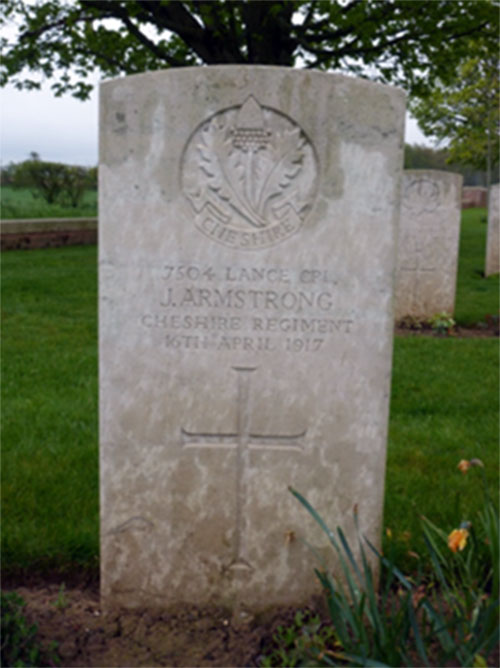
On 5th August 1914, as an army reservist, Joseph Armstrong was mobilzed, and was posted to the 1st Bn Cheshire Regiment, on the following day. He was sent with 556 other reservist’s over to Londonderry, Northern Ireland, on 8th August 1914, where they joined 1st Bn Cheshire Regiment, which had been stationed there on the outbreak of the Great War. On 14th August 1914, the battalion was entrained for Belfast, and on their arrival, were marched to York Docks, where they embarked on board the S.S. Massilia. The battalion’s destination wasn’t revealed as France, until they were at sea. They disembarked at Havre, France, on 16th August 1914. On 21st August 1914, Private Armstrong was admitted to No.7 General Hospital, Amiens, with gonorrhoea, and on the following day was transferred to a Base Depot at Rouen. He returned to England, on board the S.S. Palm Branch on 23rd August 1914. Private Armstrong returned to France, on 18th December 1914, and re-joined 1st Bn Cheshire Regiment. He was admiited to No.15 Field Ambulance with P.U.O. (Pyrexia Unknown Origin), but subsequently returned to duty and appointed as Paid Lance Corporal on 28th August 1915, and promoted to Acting Corporal on 7th September 1915. However, on 1st October 1915, he reverted to Paid Lance Corporal at his own request. From 25th January 1917 – 4th February 1917, he was granted leave to England. Private Armstrong continued to serve with his battalion until 16th April 1917, when he and 49744 Private Robert George Davidson, were taking up rations on a mule when a shell landed and killed both men and the mule. Both men were buried side-by-side in Plot 8, Row A, Grave 2 (Lance Corporal Armstrong), and Grave 3 (Private Davidson), Villers Station Cemetery, France.
Lance Corporal Armstrong’s medal entitlement consisted on Memorial Plaque, 1914 Star, British War Medal, and Victory Medal.
By August 1922, his widow had re-married, and became Mrs Campbell.

Family application form requesting Joseph to be added to the Birkenhead War Memorial.
Researched and compiled by Peter Threlfall.
Birkenhead News 09 May 1917
“DIED AT THE POST OF DUTY.”
A Well Known Birkenhead Man
Mrs. Armstrong, 11, St. Mary’s Avenue, has been officially intimated of the death in action on April 16th of her husband, Lance Corporal Joseph Armstrong. The deceased soldier was called up on the outbreak of the war, and had been in France for two years and eight months. At the time of his death he had just completed 13 years’ faithful service in H.M. Forces. Before the outbreak of hostilities he was employed at the Woodside Ferry goods stage. It may be remembered that two years ago he was awarded the life-saving medal with the bar attached for rescuing drowning persons from the Mersey. Lance Corporal Armstrong was well-known and respected by a number of Liverpool as well as Birkenhead people. It appears that Lance Corporal Armstrong, who was attached to the Cheshire Regt., was one of a party taking rations to his companions in the trenches when a shell burst and killed him instantaneously together with one of his friends. They are buried side-by-side in a little cemetery surrounded by other brave English heroes. “He was taken while doing his duty, a time when every good man would like to go.” Thus writes the dead soldier’s chaplain, and what grander epitaph would a man wish to have? Lance Corporal J. Armstrong leaves a wife and two little children to mourn his loss.
Joseph's photograph and Birkenhead News article by Chris Booth.
Joseph's photograph and Birkenhead News article by Chris Booth.