


Albert's Story.
Lance Corporal Albert Emmett of the 86th Field Company, Royal Engineers, was killed in action in the Battle of Thiepval Ridge, Somme, France on Wednesday 27th September 1916. He was 23 years old, and left his widowed mother Margaret Ann Emmett, and a fiancee, Ethel Steele.
He is remembered on the memorial at Thiepval.
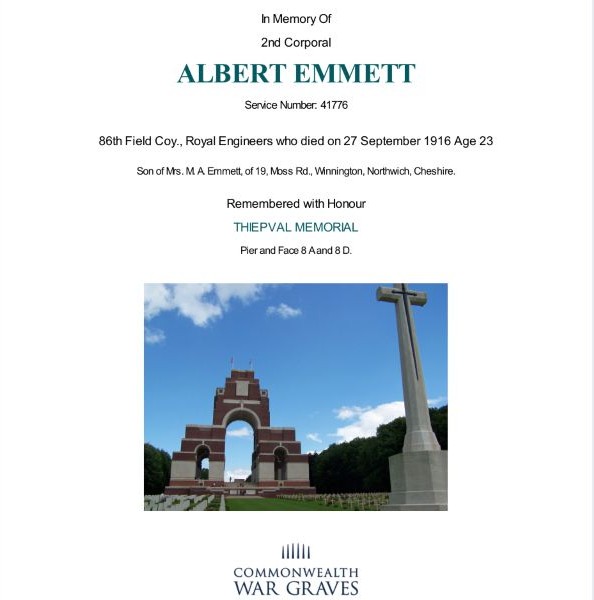
Albert was born on 24th May 1893 in Winnington, near Northwich, Cheshire, the third son of James Emmett (1861–1910) and Margaret Ann Parkinson (1862–1942). His parents and older siblings had been born in Longridge Lancashire, but had moved to Winnington before Albert was born. He grew up in Winnington at 15 Moss Road, with his three brothers (Ernest, Harold and Harry) and four sisters (Beatrice, Ethel, Doris and Maud), attending Winnington Park School. His father, who had been manager of the Winnington, Northwich and District Co-operative Society, died in March 1910 when Albert was sixteen years old.
In April 1911, Albert aged 17 was living with his widowed mother and his siblings at 19 Moss Road, Winnington, Northwich. His occupation was shown as Engine Fitter (Apprentice). (That census shows his mother did indeed have two sons called Harold (22) and Harry (14)) In 1913, Albert passed his 3rd Year course in Engineering Drawing at Verdin Technical School in Northwich. He then worked in the Brunner, Mond & Company at Winnington Park. This company produced alkali products, using ammonia soda and salt,
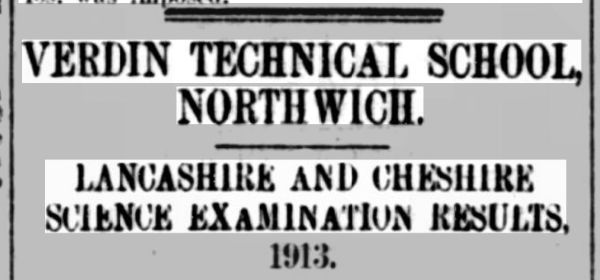
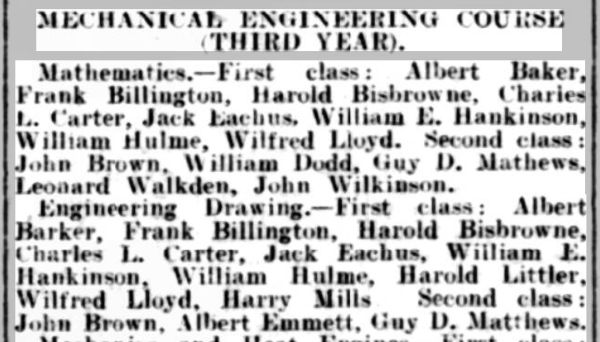
Northwich Guardian - Friday 18 July 1913
He enlisted into the Royal Engineers on 30th August 1914, and served in Gallipoli and in France. He was promoted to Second Corporal, which was an NCO rank in the Royal Engineers and the Army Service Corps only. The rank of Second Corporal was abolished in 1920.
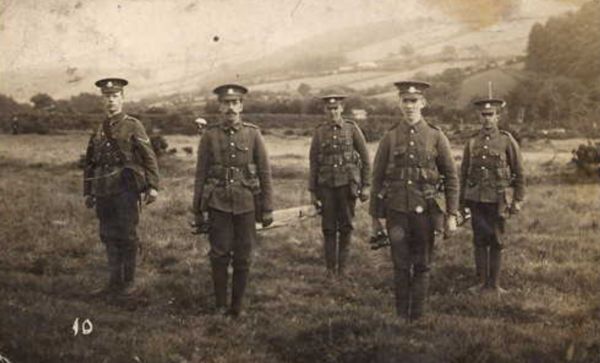
Albert is in the centre of this group, date and location unknown
Albert was born on 24th May 1893 in Winnington, near Northwich, Cheshire, the third son of James Emmett (1861–1910) and Margaret Ann Parkinson (1862–1942). His parents and older siblings had been born in Longridge Lancashire, but had moved to Winnington before Albert was born. He grew up in Winnington at 15 Moss Road, with his three brothers (Ernest, Harold and Harry) and four sisters (Beatrice, Ethel, Doris and Maud), attending Winnington Park School. His father, who had been manager of the Winnington, Northwich and District Co-operative Society, died in March 1910 when Albert was sixteen years old.
In April 1911, Albert aged 17 was living with his widowed mother and his siblings at 19 Moss Road, Winnington, Northwich. His occupation was shown as Engine Fitter (Apprentice). (That census shows his mother did indeed have two sons called Harold (22) and Harry (14)) In 1913, Albert passed his 3rd Year course in Engineering Drawing at Verdin Technical School in Northwich. He then worked in the Brunner, Mond & Company at Winnington Park. This company produced alkali products, using ammonia soda and salt,
Northwich Guardian - Friday 18 July 1913
He enlisted into the Royal Engineers on 30th August 1914, and served in Gallipoli and in France. He was promoted to Second Corporal, which was an NCO rank in the Royal Engineers and the Army Service Corps only. The rank of Second Corporal was abolished in 1920.
Albert is in the centre of this group, date and location unknown
He wrote to his family and his fiancee, telling them of his experiences. This is part of a letter written to his mother in March 1916.
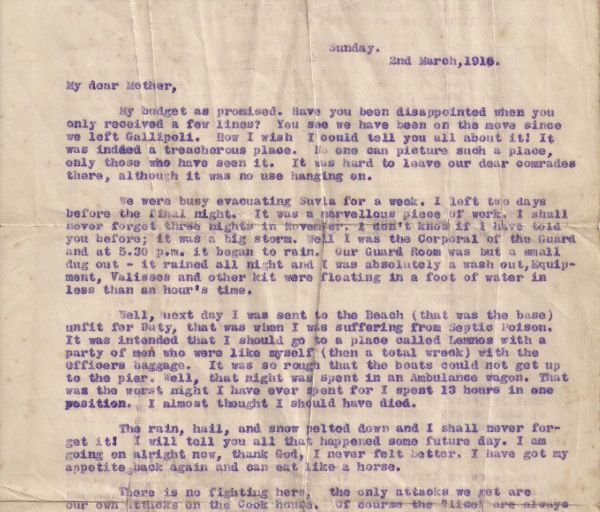
These newspaper accounts include a letter he wrote in 1915, from the Dardanelles, in Turkey:
These newspaper accounts include a letter he wrote in 1915, from the Dardanelles, in Turkey:
STRENUOUS WORK IN GALLIPOLI - LETTER FROM LANCE-CORPORAL ALBERT EMMETT
An account of the experiences of our brave lads in the Dardanelles is given by Lance-Corporal Albert Emmett, of Winnington, who is with the 86th Field Company of the Royal Engineers. In a letter to the “Guardian,” Lance-Corporal Emmett writes:
“Our division has been on the Peninsula now for 37 days. There are three Northwich boys in the 67th Field Company, viz., Corporal Robinson, of Winnington, Sapper J. Price, Lostock, and Sapper J. Cowley, Leftwich. I often see them, and may add that they are going on A1. We had quite a rough time when we made this new landing, but things are getting all right now. The heat is terrible out here in the day time, and quite the reverse at night. Water is very scarce, and sometimes one may go out for hours without getting any. Flies are a great source of trouble, and I am at present in my dug-out with a veil around my face to keep them off. We are doing a lot of our work at night-time, and it is chiefly making roads up to the firing-line, preparing dug-outs, trenching, sinking wells, etc. Our Navy have done some fine work here, and the Turks would tell you more about that if you could only have a chat to them. The Turkish snipers have accounted for quite a large number of men, but the other day I had the pleasure of seeing one of these snipers brought down from a tree.
How sad it was to read about Bert Wallis. He was a scholar, who, like myself, attended Winnington Park School.
How sad it was to read about Bert Wallis. He was a scholar, who, like myself, attended Winnington Park School.
Northwich is well represented wherever you go. On the boat, by which I travelled, I met three Northwich men - Sergeant Taylor is a postman, of the RAMC.; Private Littler, RAMC.; and Driver Ford, of the 11th Signal Company, RE. The country here is very rough, and we found it hard marching to the different zones. Trenching, too, is hard work, as the hills are all rock. The Turks bury their dead in the trenches if they cannot possibly get them out. We have come across a dead Turk’s hand or foot occasionally, when we have been deepening trenches, and the smell is not at all pleasant. The Turkish shells are not so effective as ours. I have been close to bursting shells. I was in our reserve trench when there was a very big bombardment, and shells were flying everywhere. It was just before the British tried to make a big advance. Our country lost some fine boys that day, and I shall never forget it, for it was almost like murder charging up the steep hills.”
(Published in the Northwich Guardian on Friday 12 November 1915.)
(Published in the Northwich Guardian on Friday 12 November 1915.)
News of his death
Albert was killed in action at the Battle of Thiepval Ridge, Somme, France.
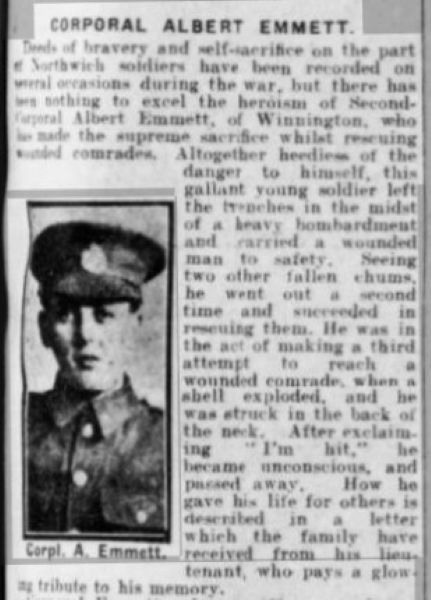
CORPORAL ALBERT EMMETT
Deeds of bravery and self-sacrifice on the part of Northwich soldiers have been recorded on several occasions during the war, but there has been nothing to excel the heroism of Second-Corporal Albert Emmett, of Winnington, who has made the supreme sacrifice whilst rescuing wounded comrades. Altogether heedless of the danger to himself, this gallant young soldier left the trenches in the midst of a heavy bombardment and carried a wounded man to safety. Seeing two other fallen chums, he went out a second time and succeeded in rescuing them. He was in the act of making a third attempt to reach a wounded comrade, when a shell exploded, and he was struck in the back of the neck. After exclaiming “I’m hit,” he became unconscious, and passed away. How he gave his life for others is described in a letter which the family have received from his lieutenant, who plays a glowing tribute to his memory.
Corporal Emmett, who was 23 years of age, was the third son of the late Mr James Emmett, for many years manager of the Winnington, Northwich and District Co-operative Society. His widowed mother resides at 19, Moss Road, and it was to her that Lieutenant Little conveyed the sad news of her son’s death in a letter as follows:
“May I, as your son’s section officer, offer you my very deepest sympathy in your sad loss. Your son was a great friend of mine, and I had a great admiration for him, especially under fire. He never knew what fear meant, and by his example of cheerfulness kept the men around him cheerful. I can’t tell you how very valuable a man is who keeps the boys cheerful when they are under fire. He had been with me three successive nights on rather trying work. We then had a day’s rest before going up on one of the ‘pushes’. We went up in the afternoon and worked that night and the next morning.
“While I was giving the section a rest your son saw a wounded man out in the front and asked me if he might go out to fetch him in. When out he found two more wounded men, so altogether he brought in three, thus saving their lives. It was during the afternoon that he was hit in the back of the neck with a piece of shell. He just remarked ‘I’m hit,’ and then fell unconscious and died almost at once. I am glad to say he can have felt no pain. I took his belongings out of his pockets and they will be sent to you through the Records Office. I am enclosing a little horseshoe that was in his purse, as I believe you will get it quicker this way. I hope it will be some slight consolation to you to know how deeply I and the rest of the company sympathise with you. If there is anything else I can tell you please write and ask me.”
Corporal Emmett was in the employ of Messrs. Brunner, Mond and Company as a fitter when the war broke out, and on August 30th, 1914, he enlisted in the Royal Engineers. After eleven months’ training he was drafted to Gallipoli, and whilst there he sent several interesting letters to the “Guardian,” and gave a graphic description of his experiences. He was present at the evacuation of the Dardanelles, and afterwards served in another theatre of the war. Four months ago he was moved to yet another front and as recently as Thursday of last week his fiancée (Miss Steele) received a letter from him in which he enclosed an enemy letter card and field card which he had picked up on the battlefield. He had not been home on furlough since Whitsuntide, 1915, and in recent letters had stated how eagerly he was looking forward to a brief rest after such a long spell of warfare.
Corporal Emmett was educated at Winnington Park School under Mr. Caress, and he is remembered there as a bright and intelligent scholar, and a smart all-round boy. Quite early in his life he began to show a keenness for athletic pursuits and was prominent in all the school games. He had the distinction of being in the swimming team which won for Winnington Park School the “Howitt” Swimming Shield. In later years hockey occupied much of his attention, and for several seasons he was a regular player with the Winnington Hockey Club. He also interested himself in bowls, and was amongst the promising young players connected with the Recreation Club. Whether at work or play, he was thorough in everything he undertook, and he possessed a genial disposition which gained for him a host of friends.
His older brother, Ernest Emmett, is in the Royal Naval Air Service, and another brother, Harry, was for some time with the Cheshire Regiment, but has returned to work on munitions.
(Published in the Northwich Guardian on Friday 13 October 1916)
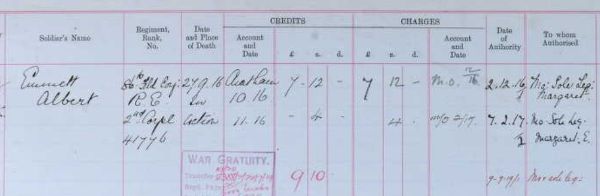
Deceased Soldier's Effects
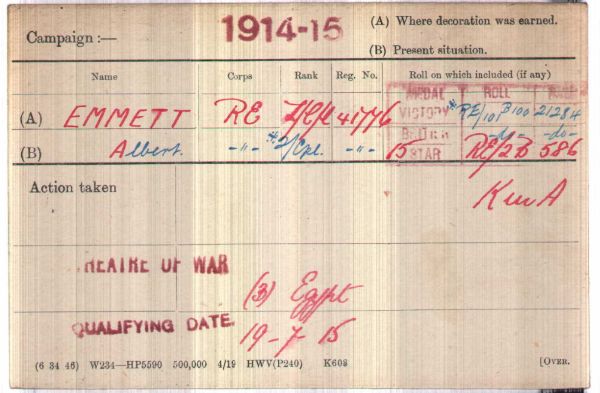
Medal card
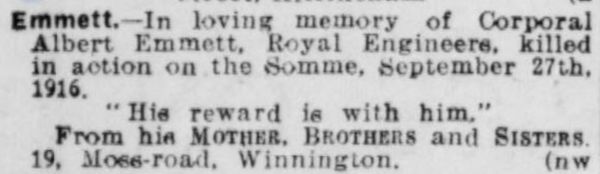
Northwich Guardian - Friday 28 September 1917
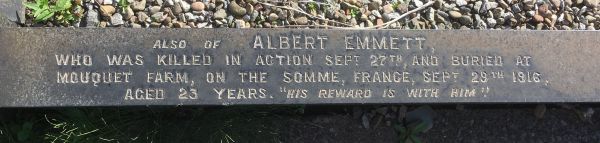
Albert is remembered on a family gravestone in Witton St Helen, Northwich
His fiancee, Ethel
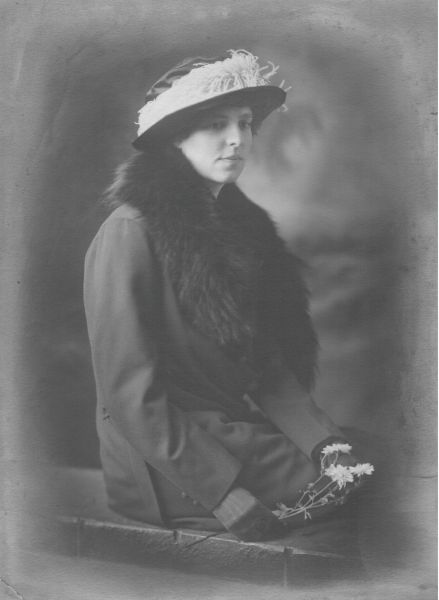
His fiancee Ethel went on to marry William Hornby (the son of Charles Hornby, botanical brewer) on 15th September 1919.
RISEN FROM THE RANKS
It has been our pleasure on several occasions to refer to cases of Northwich soldiers rising from privates to commissioned rank, and this week we published two further instances.
Second-Lieutenant William Hornby, who has just been posted to the King’s (Liverpool Regiment), has recently been gazetted. He is the second son of Mr Charles Hornby, a well-known Northwich tradesman, and member of the Constitutional Club. When the war broke out, Second-Lieutenant Hornby was 20 years of age, and engaged at Morton, but within five weeks he was in the Cheshire Regiment. He rose to the rank of sergeant, and in this capacity he went out to the front, and after thirteen months’ active service he returned on December 20th last to undergo a course of training for a commission. He has another brother who has served for over two years with the RAMC.
(Northwich Guardian, Friday 6 July 1917)
Information contributed by Ethel's granddaughter Lorna Byrne (11th November 2025) with additional research by Shena Lewington
(Published in the Northwich Guardian on Friday 13 October 1916)
Deceased Soldier's Effects
Medal card
Northwich Guardian - Friday 28 September 1917
Albert is remembered on a family gravestone in Witton St Helen, Northwich
His fiancee, Ethel
His fiancee Ethel went on to marry William Hornby (the son of Charles Hornby, botanical brewer) on 15th September 1919.
RISEN FROM THE RANKS
It has been our pleasure on several occasions to refer to cases of Northwich soldiers rising from privates to commissioned rank, and this week we published two further instances.
Second-Lieutenant William Hornby, who has just been posted to the King’s (Liverpool Regiment), has recently been gazetted. He is the second son of Mr Charles Hornby, a well-known Northwich tradesman, and member of the Constitutional Club. When the war broke out, Second-Lieutenant Hornby was 20 years of age, and engaged at Morton, but within five weeks he was in the Cheshire Regiment. He rose to the rank of sergeant, and in this capacity he went out to the front, and after thirteen months’ active service he returned on December 20th last to undergo a course of training for a commission. He has another brother who has served for over two years with the RAMC.
(Northwich Guardian, Friday 6 July 1917)
Information contributed by Ethel's granddaughter Lorna Byrne (11th November 2025) with additional research by Shena Lewington