


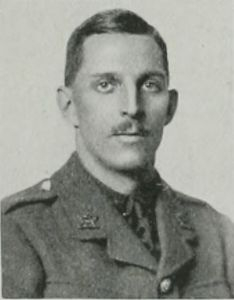
Edwin Scott's Story.
BAMFORD, EDWIN SCOTT, Capt. and Adjutant, 1st Battn. York and Lancaster Regt., yst. s. of the late Arthur Bamford, of Misterton Hall, Lutterworth, by his wife, Annie (who re-m. Capt. the Hon. Harold Brooke Hawke), dau. of John Nash, of Chicago;
b. Bromborough, co. Chester, 23 April, 1885; educ. Uppingham and afterwards in Switzerland, and joined the 3rd (Militia) Battn. Leicestershire Regt., from which he passed into the York and Lancaster Regt. 6 July, 1907, becoming Lieut. 1 Feb. 1909. In that year he passed the Signalling Course at Poona, and obtained a certificate for Field Telephoning; in 1911 he took the Musketry and Machine Gun Course at Satara, and in 1912 the Physical Training and Swordsmanship at Poona, where he was Gymnastic Superintendent for eight months, serving altogether seven years (1908–14) in India.
On 12 March, 1913, he was appointed Adjutant of his battn. with which he joined the Expeditionary Force in France in Jan. 1915. He had been promoted Capt. 5 Sept. 1914, and was mortally wounded in action on his birthday, 23 April, 1915, during a charge at the second Battle of Ypres, and d. at the Poperinghe Clearing Station the following day.
The following abbreviated account of the circumstances attending his death was received from a brother officer: “On the morning of April 22 the battn. was resting—the men playing football—when the French troops came hurrying back completely overcome by asphyxiating gases. Immediately, on their own initiative without any command, our men fell in and moved off by companies from trenches near St. Jean, with fixed bayonets, across open country in broad daylight, with only two guns to support them, to fill in the gap left by the French, which the Canadians were unable to protect with their flank. They made the attack through a hail-storm of high velocity shell fire and machine guns at short range, which nearly wiped out the whole battn., leaving 300 out of the original 1,200. In spite of the heavy casualties, they pushed on, as a Canadian officer remarked: ‘As if they were on parade,’ and eventually reached a field which was under still heavier fire. At the top of the field was a hedge on which the enemy’s fire was concentrated; very few of the battn. got past it. It was here that the Colonel was killed outright and Capt. Bamford, having done magnificent work during the whole attack, was mortally wounded. Some days after, Gen. Plumer came to see the few survivors and congratulated them on their gallant attack. Had it not been made the Germans would have broken through. To use the General’s own words: ‘They had saved the situation.’”
Capt. Bamford was a keen sportsman and a first-class shot. He m. London, 1 Jan. 1913, Lulu, only dau. of the late Edwin Whitney Smith, of Bath;
b. Bromborough, co. Chester, 23 April, 1885; educ. Uppingham and afterwards in Switzerland, and joined the 3rd (Militia) Battn. Leicestershire Regt., from which he passed into the York and Lancaster Regt. 6 July, 1907, becoming Lieut. 1 Feb. 1909. In that year he passed the Signalling Course at Poona, and obtained a certificate for Field Telephoning; in 1911 he took the Musketry and Machine Gun Course at Satara, and in 1912 the Physical Training and Swordsmanship at Poona, where he was Gymnastic Superintendent for eight months, serving altogether seven years (1908–14) in India.
On 12 March, 1913, he was appointed Adjutant of his battn. with which he joined the Expeditionary Force in France in Jan. 1915. He had been promoted Capt. 5 Sept. 1914, and was mortally wounded in action on his birthday, 23 April, 1915, during a charge at the second Battle of Ypres, and d. at the Poperinghe Clearing Station the following day.
The following abbreviated account of the circumstances attending his death was received from a brother officer: “On the morning of April 22 the battn. was resting—the men playing football—when the French troops came hurrying back completely overcome by asphyxiating gases. Immediately, on their own initiative without any command, our men fell in and moved off by companies from trenches near St. Jean, with fixed bayonets, across open country in broad daylight, with only two guns to support them, to fill in the gap left by the French, which the Canadians were unable to protect with their flank. They made the attack through a hail-storm of high velocity shell fire and machine guns at short range, which nearly wiped out the whole battn., leaving 300 out of the original 1,200. In spite of the heavy casualties, they pushed on, as a Canadian officer remarked: ‘As if they were on parade,’ and eventually reached a field which was under still heavier fire. At the top of the field was a hedge on which the enemy’s fire was concentrated; very few of the battn. got past it. It was here that the Colonel was killed outright and Capt. Bamford, having done magnificent work during the whole attack, was mortally wounded. Some days after, Gen. Plumer came to see the few survivors and congratulated them on their gallant attack. Had it not been made the Germans would have broken through. To use the General’s own words: ‘They had saved the situation.’”
Capt. Bamford was a keen sportsman and a first-class shot. He m. London, 1 Jan. 1913, Lulu, only dau. of the late Edwin Whitney Smith, of Bath;