Edward Kinder's Story.
Edward Kinder was the only son of the late Judge James Kinder Bradbury J.P, fellow of Caius College, Cambridge and his wife Grace, Daughter of Rev Edward Dowling.
Edward was born on the 16th August 1881, Parkfield, Altrincham. The 1891 Census shows the family living at 193 Church Bank, Edward age 9 is at school. He was also educated at St Ninians Moffat, Marlborough College and Woolwich.
He was gazetted 2nd May 1900 and promoted to Lieutenant 3rd April 1901 and then to captain on the 4th February 1910, he joined the 125th battery in Ireland and in the later stages of the South African War obtained a commission in Fincastle’s Horse which he served on active service obtaining the Queens medal and two clasps. After the close of the South African Campaign he returned to Ireland but in 1905 he went to Uganda and served with the 4th Battalion Kings African Rifles until 1906 when he was invalided home after severe fever. He was then transferred to the Royal Horse Artillery and on the outbreak of the war went to France with the Expeditionary Force.
The Action at Néry In the aftermath of the Battle of Mons, which took place on 23 August 1914, the British forces, along with their French allies, began retreating south west toward Paris. By the evening of 31 August, most British units had crossed the Aisne between Soissons and Compiègne and halted for the night on the south banks of the river. The men of the 1st Cavalry Brigade bivouacked in and around the village of Néry with orders to begin moving again at first light. The Brigade numbered almost 2,000 men and consisted of three cavalry regiments which were supported by L Battery of the Royal Horse Artillery. The cavalry were stationed in Néry while L Battery was billeted in a sugar factory just south of the village. A heavy mist hung in the valley and visibility was poor as the sun rose on 1 September. The Brigade had awoken at 4.30 but a decision was made to delay departure for an hour and a half until the weather cleared. As they waited, officers and men busied themselves watering the horses and preparing breakfast. At approximately 5.30 a.m. a unit of the 11th Hussars which had been patrolling the woods outside Néry dashed into the village and reported that they had sighted a large enemy force. Just minutes after the patrol arrived on the scene, the Brigade came under heavy shell, machine-gun and rifle fire from the heights overlooking the village to the east. The attack caught the Brigade almost completely by surprise and the effect of intense fire from above the village was devastating. The horses of L Battery bolted and several gunners were killed or wounded as they tried to take cover. Despite the chaos caused by the attack, Captain Edward Bradbury immediately began issuing orders and managed to get three of the battery’s six guns moved into firing positions. Two of these were soon put out of action by German shell fire, but Bradbury, along with Sergeant David Nelson and two gunners, manned a third gun and kept up a steady rate of fire against the German lines. The gun continued firing for over two hours, and successfully drew German artillery fire away from the British cavalry. The Brigade was able to hold its position and engage the attackers until reinforcements from III Corps arrived and forced the German units on the heights to retreat. The German force that launched the attack at Néry amounted to over 5,000 men of the 4th Cavalry Division and thus outnumbered the 1st Cavalry Brigade by more than two to one. L Battery was almost completely destroyed during the fighting, but casualties in the rest of the brigade were relatively light. Captain Bradbury was fatally wounded while fetching ammunition and posthumously awarded the Victoria Cross. Sergeant-Major George Dorrell and Sergeant Nelson both survived the fighting and were awarded Victoria Crosses. The Commander-in-Chief of the BEF, Sir John French, formally mentioned the Brigade in dispatches on 14 September.
De Ruvigny’s Roll reads
At Nery near Compiegne on the last day of the retreat from Mons, L Battery while covering the retreat was attacked by a large force of Germans with ten field guns and two Maxims, Three British guns were brought into action, but two were quickly silenced, Captain Bradbury and his men served the remaining gun so well that all but one of the German guns were silenced, and when L battery was relieved this remaining gun was captured.
An artillery officer wrote: “Bradbury was the real hero, he got the gun into action and gave out the orders, Mindy knelt on the side and did the ranging, Brad, Campbell and Giffard with the battery Sergt Major, Gunner and driver served the gun, Brad had one leg taken off above the knee but still went on, Campbell was killed and Mundy was hit in both legs, the major as he was coming back was hit the throat, Giffard was badly wounded and still they kept firing then Bradbury had his other leg taken off, when the rest of L battery came up they found the Germans had left their guns and bolted”
Captain Edward Kinder Bradbury was posthumously awarded the Victoria Cross for his actions this day, gazetted on the 14th October 1914, the citation reads:
“For gallantry and ability in organising the defence of L Battery against heavy odds at Nery on 1st September”
His commanding officer wrote to his mother saying;
“Your son was simply beloved by all of us, from me his General down to the last joined subaltern. He was very nearly four years under my command, and looked upon him as one of the most brilliant officers I had ever come across, one who had God willed it, had a great career in front of him, and the manner in which he met his death fighting a single gun to the end after the loss of one leg was worthy of him”
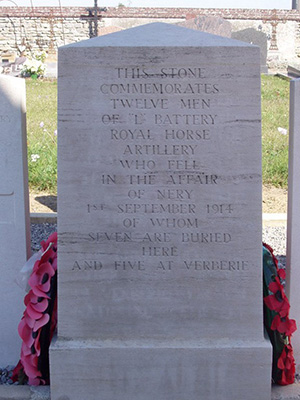
Edward is buried at Nery Communal Cemetery, France. There is also a separate stone here commemorating the 12 men of L battery that fell that day.