


John's Story.
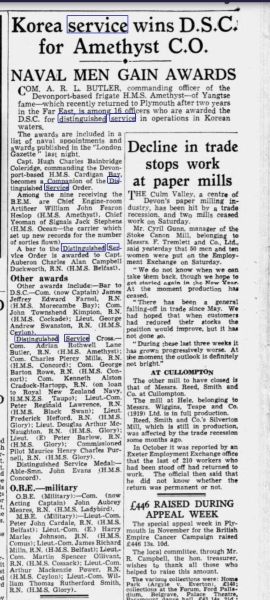
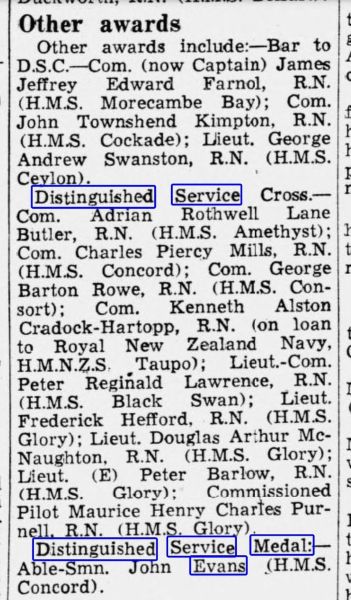
John Evans, from Middlewich, was awarded the Distinguished Service Medal in December 1952. His name appears on the War Memorial in Middlewich, under the section Korea.
The Korean War (25 June 1950 – 27 July 1953) was an armed conflict fought on the Korean Peninsula between North Korea (Democratic People's Republic of Korea; DPRK) and South Korea (Republic of Korea; ROK) and their allies. North Korea was supported by China and the Soviet Union, while South Korea was supported by the United Nations led by the United States under the auspices of the United Nations Command (UNC). Allied ships were mainly involved in supporting ground troops by bombardment and supporting landings. HMS Concord’s operations were in the main giving support to the US ships. The Royal Navy ships spent weeks and weeks at sea, firing hundreds of shells at targets ashore. The very cold winters often iced up the decks and superstructure and ice axes were in continual use to retain the balance of the ship.
Able Seaman John Evans (Service Number P/SSX.845913 was a member of the Royal Navy who served aboard the C-class destroyer H.M.S. Concord. The prefix "P/SSX" indicates his official service record designation. "P" signifies that he was drafted out of the Portsmouth home port, and "SSX" was the Royal Navy prefix for Short Service Seamen (Seaman/Communication branch).
The Korean War (25 June 1950 – 27 July 1953) was an armed conflict fought on the Korean Peninsula between North Korea (Democratic People's Republic of Korea; DPRK) and South Korea (Republic of Korea; ROK) and their allies. North Korea was supported by China and the Soviet Union, while South Korea was supported by the United Nations led by the United States under the auspices of the United Nations Command (UNC). Allied ships were mainly involved in supporting ground troops by bombardment and supporting landings. HMS Concord’s operations were in the main giving support to the US ships. The Royal Navy ships spent weeks and weeks at sea, firing hundreds of shells at targets ashore. The very cold winters often iced up the decks and superstructure and ice axes were in continual use to retain the balance of the ship.
Able Seaman John Evans (Service Number P/SSX.845913 was a member of the Royal Navy who served aboard the C-class destroyer H.M.S. Concord. The prefix "P/SSX" indicates his official service record designation. "P" signifies that he was drafted out of the Portsmouth home port, and "SSX" was the Royal Navy prefix for Short Service Seamen (Seaman/Communication branch).
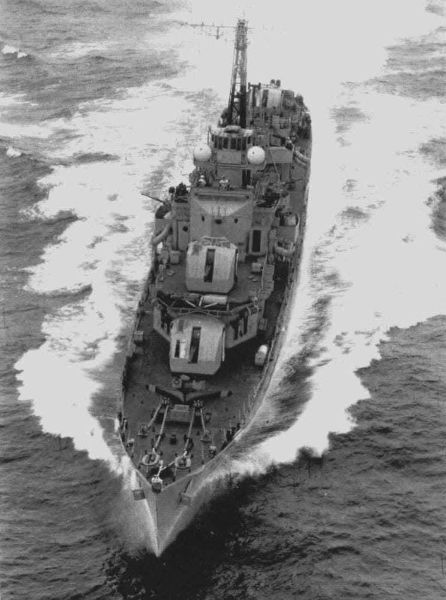
Memories of life aboard HMS Concord in 1952
Some memories of life aboard HMS Concord during the Korean War are shown in letters home to his parents by Lieutenant Rodney Agar (Gunnery Officer) in 1952. John Evans may have been well-known to Lieutenant Agar.
7th March 1952
We are due back in Sasebo tomorrow so we will get some more mail which I am looking forward to. I transferred at sea successfully and it really is most interesting here, and it will be even more so on our next patrol which is inshore work. This ship is undoubtedly jolly good, with a very nice crowd in the wardroom and I’m thoroughly enjoying life! The next two years should be great fun and a great experience. Last night we did a short bombardment of an enemy held village, and boarded a couple of junks. Not very important incidents but my baptism!! It is really rather fascinating creeping in and out between these masses of small islands in narrow channels, all of which are continually being captured and re-captured by the enemy ah-jong s. Apparently the possession of these islands are pawns in the truce talks game, and are the stepping stones for spies and intelligence officers. The guerrillas creep about in junks and set up gun positions ashore and it is our job to continually harass them, and prevent them from capturing islands and also bombard them out of the islands they have already captured. During the day we have been escorting one of the American carriers, who flies off strikes from dawn till dusk. We also go to action stations every dawn at 0630, irrespective of what’s been going on the night before! This the last day of the present patrol, and tomorrow we are due in at Sasebo till March 12th.
8th March 1952
I am continuing this to-day as I didn’t have time to finish it last night. We have gone to the help of a Chinese ship carrying the Chinese Ambassador that has run aground, and have been delayed as we shall have to tow her off! They ran slap up the beach on a large island, I have now taken over as Ship’s Gunnery Officer and Divisional Officer and there is plenty of work to do, so will be very busy. We also keep watch on the bridge 1 in 3, which means 4 hrs on, 8 hrs off all round the clock except from 1600 – 2000 when it is split into dog watches...I have started to grow a beard and it’s doing quite nicely I think! I shall send you a photograph when it’s properly established and trimmed.
29th April 1952
Well, at the moment we are just north of Formosa on our way down to Hong Kong, having finished with Korea for about two months! Our last patrol, which lasted 21 days, was just about long enough, and the last week was particularly eventful, when we were fired at quite a lot and eventually were hit by a small 75mm shell, which I gather you have heard about! However, nothing to worry about as it did very little damage and the only very sad tragedy was the two poor chaps getting killed. Most of the days when they fired at us they were very inaccurate, except for the one day when they seemed to get the range! The patrol as a whole was quite interesting; though I think everyone had had enough after three weeks and now is in need of a rest. We fired 2,700 rounds which isn’t bad going, most of our targets being railway lines and installations. We only hit one train, but hardly had any to fire at which was bad luck! Otherwise the weather on the whole was good and the food not too bad, so it could have been worse! We only stopped at Sasebo for a few hours on our way down here to refuel and collect mail, and then pressed on being due in Hong Kong on 1st May.
Rodney Agar provided more information on his experiences aboard HMS Concord in another account:
29th April 1952
Well, at the moment we are just north of Formosa on our way down to Hong Kong, having finished with Korea for about two months! Our last patrol, which lasted 21 days, was just about long enough, and the last week was particularly eventful, when we were fired at quite a lot and eventually were hit by a small 75mm shell, which I gather you have heard about! However, nothing to worry about as it did very little damage and the only very sad tragedy was the two poor chaps getting killed. Most of the days when they fired at us they were very inaccurate, except for the one day when they seemed to get the range! The patrol as a whole was quite interesting; though I think everyone had had enough after three weeks and now is in need of a rest. We fired 2,700 rounds which isn’t bad going, most of our targets being railway lines and installations. We only hit one train, but hardly had any to fire at which was bad luck! Otherwise the weather on the whole was good and the food not too bad, so it could have been worse! We only stopped at Sasebo for a few hours on our way down here to refuel and collect mail, and then pressed on being due in Hong Kong on 1st May.
Rodney Agar provided more information on his experiences aboard HMS Concord in another account:
In 1952 we were hit in a gun duel during one of our patrols off the East Coast of Korea. Tragically two members of ‘Y’ guns crew were killed, and four wounded when a 105mm shell ripped through the side of the turret. On this occasion we had just started hitting a troop train from about 300 yards offshore when we were straddled while proceeding slowly towards inshore. By the time we had turned 180 degrees and worked up speed we had over 30 straddles and were lucky not to have been further hit. Our guns were in direction
control and firing back as fast as they could including the bofors. This was the third shore gun duel which we experienced, the other two being at greater range and we were not hit, but our American chummy ship the USS ‘Endicott’ was hit up the stern.
On the west coast of Korea as one of the bombarding ships we would creep in at night among the islands, or by day carry out air-spotted shoots, in support of the Army’s flanks. We eventually wore out our gun barrels and when the Gunner passed the ‘plug bore’ tests the plug just fell out of each barrel! As an escort we also screened the carriers Ocean and Glory and an American whose name I forget. A typical carrier duty would be to fly operations for 4 days – then one day’s replenishing – then a further 4 days and back to Japan. The Poor Bloody Escorts i.e. Concord and 2 others then took over the next carrier!
The British flew Sea Furies and Fireflies, aiming for seventy sorties a day. The Americans flew Marine Corsairs, Panthers and Banshee Jets. The routine for us in the Concord was approx. 3 weeks on patrol followed by 7 days in Japan and so on, rotating 3 months in Korea and 3 months in Hong Kong. In the event, no allied ships were attacked by enemy aircraft or submarines during the war but one never knew what was round the corner. Like most patrol work, busy periods were interspersed with routine – uncomfortable but never dull. We relieved some of the quieter moments by ‘self help’ and once had an impromptu pulling regatta against our chummy ship Charity whilst at anchor inshore north of the 38” parallel on Korea’s west coast.
Rodney Agar Lt. 1952-53
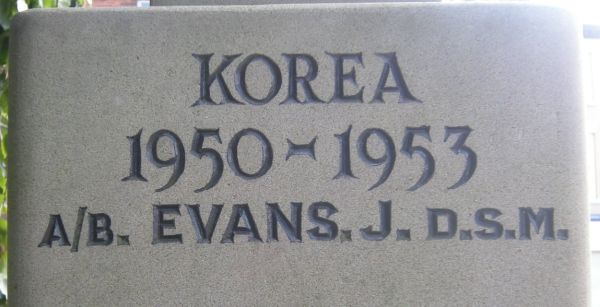
Who was John Evans and why is he commemorated in Middlewich?
Unfortunately, at present we are not able to give detailed information on John's identity. Perhaps you can help?
1. We know that he was not one of the two crew members who died on 23rd or 26th April 1952 aboard HMS Concord.
1. We know that he was not one of the two crew members who died on 23rd or 26th April 1952 aboard HMS Concord.
On April 23, 1952 (St. George's Day), while operating during the Korean War, HMS Concord was hit by enemy shore batteries firing 75mm guns from the Songjin-Chongjin area. The incoming rounds struck the ship's stern near the "Y" gun turret, killing the two sailors and wounding four others. They were buried at sea the following morning.
The two sailors who died have been identified as BRAVINGTON, John, Able Seaman, SSX 847311, Concord, date of death recorded as 26th April 1952, killed by shore gunfire, and GREENWOOD, Alan B F, Able Seaman, SSX 836486, Concord, 26 April 1952.
2. A/B J Evans is unlikely to be the same person as Private 22607876 James Evans, 1st Kings Regiment, who died in 1952, aged nineteen. James was born 14th September 1933 and died on 18th November 1952. He is buried in grave 39, Pusan Cemetery, Korea.
3. Neither is he Able Seaman John Evans, 61096, attached to HMS Victory, who died on 9 November 1963, also aged nineteen. He was born in 1944, so would only have been 8 years old in 1952.
If you have any information about Able Seaman John Evans (DSM), please contact Cheshire Roll.