


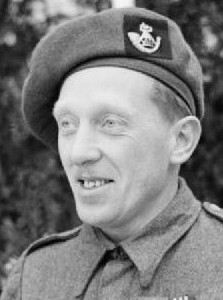
George Harold's Story.
George Harold Eardley, aged 32, was an Acting Sergeant in the King's Shropshire Light Infantry on 15th October 1944 (wrongly recorded in the citation as 16th October) when he undertook the courageous actions for which he was awarded the Victoria Cross, the highest award for gallantry in the face of the enemy that can be awarded to British and Commonwealth forces. His platoon was ordered to clear some orchards east of Overloon, in the Netherlands, where a strong opposition was holding up the advance. 80 yards (73 m) away from the objective, the platoon was halted by automatic fire from machine-gun posts. Sergeant Eardley spotted one of these posts and moving forward under heavy fire killed the occupants at the post with a grenade. He went on to destroy two more posts single-handedly, under fire so intense that it daunted those who were with him, but his action enabled the platoon to achieve its objective and thus ensured the success of the whole attack.
The citation for his VC reads as follows:
"In North-West Europe, on 16th* October, 1944, during an attack on the wooded area East of Overloon, strong opposition was met from well sited defensive positions in orchards. The enemy were paratroops and well equipped with machine guns. A platoon of the King’s Shropshire Light Infantry was ordered to clear these orchards and so restore the momentum of the advance, but was halted some 80 yards from its objective by automatic fire from enemy machine gun posts. This fire was so heavy that it appeared impossible for any man to expose himself and remain unscathed. Notwithstanding this, Sergeant Eardley, who had spotted one machine gun post, moved forward, firing his Sten gun, and killed the occupants of the post with a grenade. A second machine gun post beyond the first immediately opened up, spraying the area with fire. Sergeant Eardley, who was in a most exposed position, at once charged over 30 yards of open ground and silenced both the enemy gunners. The attack was continued by the Platoon but was again held up by a third machine gun post, and a section sent in to dispose of it, was beaten back, losing four casualties. Sergeant Eardley, ordering the section he was with to lie down, then crawled forward alone and silenced the occupants of the post with a grenade. The destruction of these three machine gun posts singlehanded by Sergeant Eardley, carried out under fire so heavy that it daunted those who were with him, enabled his Platoon to achieve its objective, and in so doing, ensured the success of the whole attack. His outstanding initiative and magnificent bravery were the admiration of all who saw his gallant actions."
(Fifth Supplement to The London Gazette of 29 December 1944. 2 January1945, Number 36870, p. 139) NB *15th October 1944
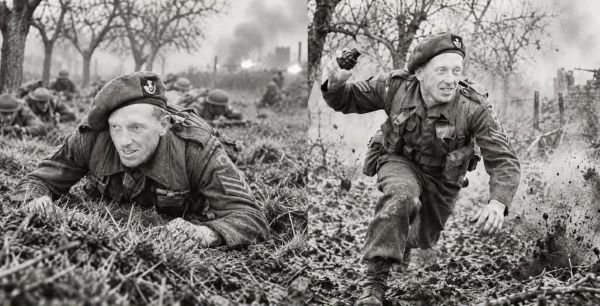
(The images above may have been created by AI)
George Harold Eardley was born in Congleton on 6th May 1912, the son of John Harold Eardley (1889 - 1968) and Zillah nee Hibbert (1883 - 1955). His father was a litho-printer and compositor. In April 1911, when George was aged nine, the family was living at 4 New Street, Congleton. He attended the local school in Wagg Street, and followed his father into the occupation of litho-printer, working for the Congleton Chronicle.
George married three times. His first marriage was to Gladys Ethel Bowyer (1916–1984) on 4th July 1936 when he was 27 years old. Three years later, the 1939 Register shows Gladys living in Congleton at 17 Lion Street, while George was working as an electrician at Wakefield Prison in Yorkshire. After the war, in 1952, George, by then divorced from Gladys, married Winifred Mary Goodier nee Rathbone (1910–1964). In 1964, after Winifred's death, he married Nancy Evelyn Hodgekinson nee Barnett (1912 - 2003)
George enlisted into the Territorial Army on 29th March 1940. His address then was 17 Lion Street, Congleton. He was posted to the Queen's Royal Regiment (West Surreys) and joined his battalion for duty in Guildford on 18th April. He was appointed Acting Unpaid Lance Corporal on 18th July and Paid Acting Corporal on 23rd December of that year. He was based at a number of Infantry Training Centres until he was posted to the 13th Battalion of the Queen's Royal Regiment on the 30th May 1944. By this time he held the rank of Corporal. George was transferred to the 4th Bttn King's Shropshire Light Infantry on 30th July 1944, the battalion forming part of the 159th Brigade of the 11th Armoured Division. He served with the KSLI in North West Europe until the end of the war.
Military Medal
George's gallantry was first formally recognised in August 1944 during the battalion's fighting advance as part of the initial Bluecoat "break out" operations. The battalion captured St. Martin des Besaces on 31st June, took the Souleuvre Bridge on the same day and continued towards the village of Le Beny Bocage, which they liberated on 1st August.
It was during the fighting that day that Corporal Eardley stalked and destroyed a German machine-gun post. The 4th KSLI was ordered to seize the highpoint on the ridge north-east of Le Beny Bocage and from there, pass down the Souleuvre Valley."A" and "D" Companies under Major Maddocks and Major Thornburn were to secure the ridge and "B" and "C" Companies would then continue along the valley. As "A" Company under Major Maddocks set off up the slope, it ran into strong opposition, so Maddocks sent out a Recce Patrol to test the strength of the enemy positions. It was during this action that George Eardley won the M.M. - though it was not published in the London Gazette until 1st March 1945, after his Victoria Cross had been awarded.
He actually received, in error, two MMs, one awarded separately and the other presented with his VC when he was invested by the King at Buckingham Palace on 6th January 1945. One of the two MMs remains with his original medal group, now in the Ashford collection; the other was eventually sold and was put on display in the Shropshire Regimental Museum in Shrewsbury Castle. George was promoted to Sergeant on 11th December 1944.
Victoria Cross
George Harold Eardley was the first NCO of the 11th Armoured Division to receive the VC and notification of the award was published in the 11th Armoured Division's Bulletin on 1st January 1945. His wife received notification by telegram on 2nd January 1945 that her husband had been awarded the Victoria Cross. George received the ribbon of the VC "in the field" from Field Marshal Montgomery, and the actual medal from the hands of the King at an investiture at Buckingham Place. On that occasion, the King expressed his pleasure at meeting a living VC winner when so many other awards were posthumous.
Following his investiture in February 1945, George returned to Congleton to receive a hero's welcome from his home town. The Congleton Chronicle reported that a “wildly enthusiastic” welcome was given to Sgt (“Killer”) George Harold Eardley, VC, MM. There were “memorable scenes” as the “gallant soldier”, wearing battle dress, and standing by his wife in an American command car, rode triumphantly through streets lined with cheering crowds to his home in Lion Street.
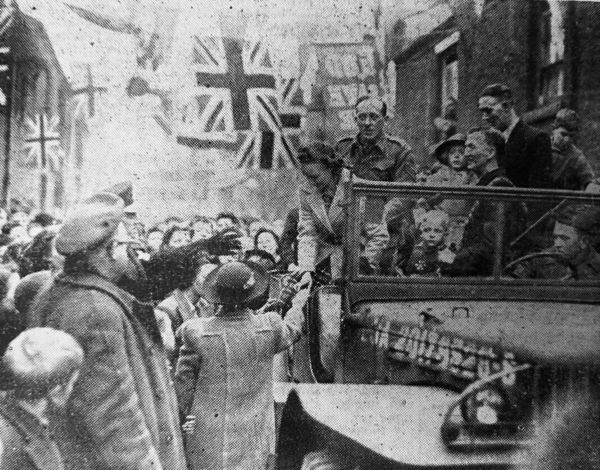
“Excited and jubilant onlookers packed the road in Lion Street from end to end as Sgt Eardley’s car drew up before his home. Neighbours at every window and door demonstrated their welcome, and Sgt Eardley greeted many of them by name. Amid rousing cheers, he helped his wife and family down from the car, stood for some moments hand-shaking and acknowledging the great ovation."
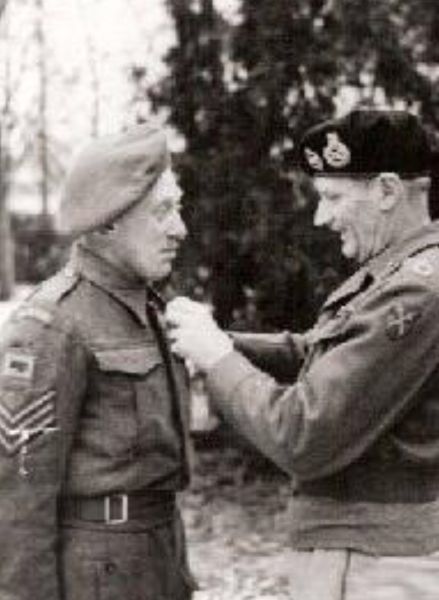
A photograph of Field Marshal Montgomery pinning the VC ribbon on Sergeant Eardley was exhibited in the Red Cross Office, High Street, Congleton.
After the war, Eardley remained in the army for another five years. He was posted to various Training Centres and in January 1947 to the Royal Military Academy, Sandhurst, as Assistant Instructor in Drill. Eardley was discharged from the T.A. in February 1947 to re-enlist on a short-service engagement as a Regular in the KSLI, with the rank of Sergeant.
He remained at Sandhurst until 27th February 1947, when he was posted to the KSLI Depot at Shrewsbury. After brief postings to the O.C.T.U. Battle Camp and the Army Apprentices' School at Arborfield, he joined the 1st KSLI on 13th July 1949 and served with the battalion in Hong Kong. He was finally discharged on 26th February 1950. His final rank was Company Sergeant Major.
George then qualified as an electrical engineer and worked for Rolls Royce in Crewe until his retirement. His first marriage having ended in divorce in 1950, he married Winifred Mary Goodier nee Rathbone (1910–1964) in 1952.
Here, on the left of the picture, together with another VC holder, Sergeant Harold Whitfield (centre) he is attending a ceremony at Copthorne Barracks.
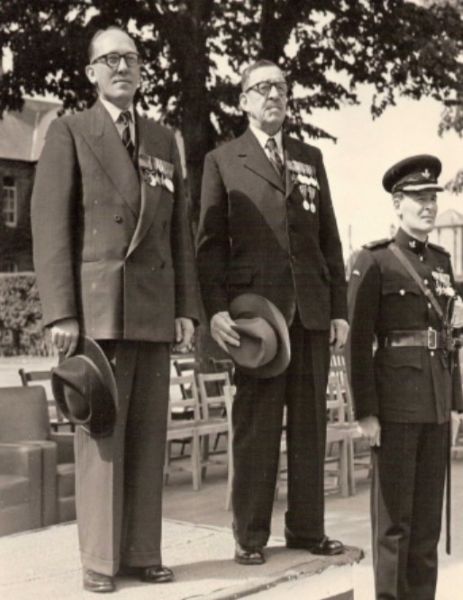
On 25th June 1964, he and his wife, then living in Readesdale Avenue, Crewe, were invited to another ceremony at Copthorne Barracks at which the Princess Royal was to present new Colours to the 4th KSLI. Their car was hit by an express train on Nantwich level-crossing. Winifred died three days later in hospital, and George lost the lower part of his left leg, amputated on the scene of the crash without anaesthetic.
Later that year, on 9th December 1964, George married a childhood friend, widowed Nancy Evelyn Hodgekinson nee Barnett (1912 - 2003) and lived in retirement in Southbourne in Dorset. His house was named "Overloon", the name of the location in Holland where his VC was earned. He eventually moved back to Cheshire, to Meakin Close, Mossley, Congleton, in August 1991. He died there a few weeks later, on September 11th 1991, at the age of 79. His funeral was held at the United Reform Church in Congleton, and his ashes were scattered in the Garden of Remembrance at Macclesfield Crematorium.
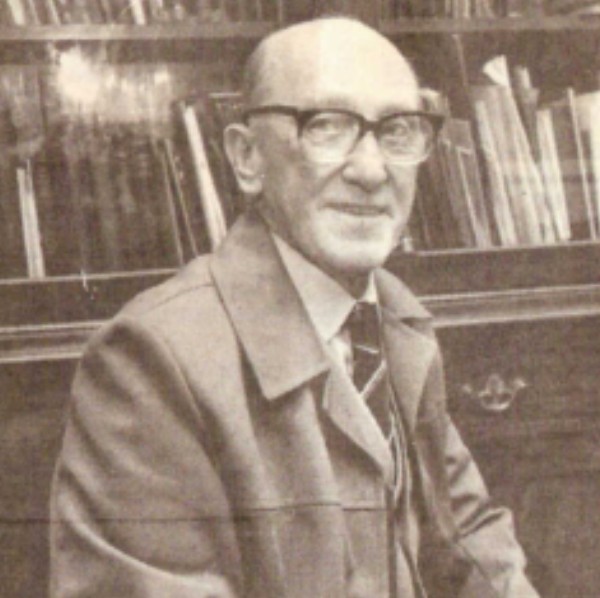
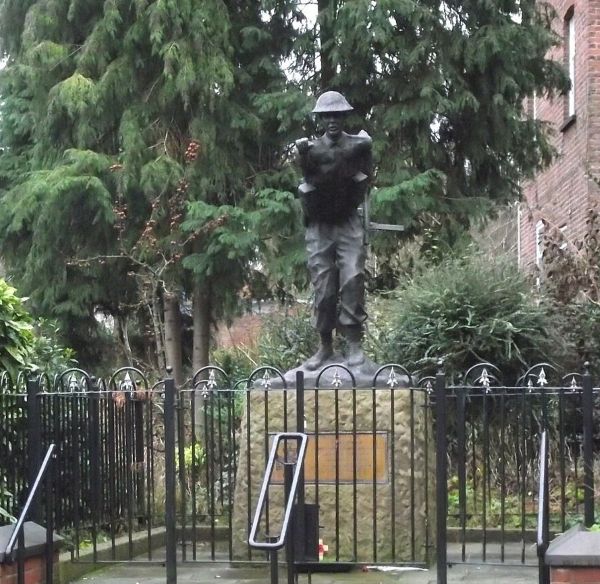
A bronze statue of George stands in Congleton, installed in 2004, and a road in the town is named in his memory (Eardley Crescent).
Information compiled by Shena Lewington (September 2026)
Please contact Cheshire Roll if you can provide more information about George Harold Eardley.
The citation for his VC reads as follows:
"In North-West Europe, on 16th* October, 1944, during an attack on the wooded area East of Overloon, strong opposition was met from well sited defensive positions in orchards. The enemy were paratroops and well equipped with machine guns. A platoon of the King’s Shropshire Light Infantry was ordered to clear these orchards and so restore the momentum of the advance, but was halted some 80 yards from its objective by automatic fire from enemy machine gun posts. This fire was so heavy that it appeared impossible for any man to expose himself and remain unscathed. Notwithstanding this, Sergeant Eardley, who had spotted one machine gun post, moved forward, firing his Sten gun, and killed the occupants of the post with a grenade. A second machine gun post beyond the first immediately opened up, spraying the area with fire. Sergeant Eardley, who was in a most exposed position, at once charged over 30 yards of open ground and silenced both the enemy gunners. The attack was continued by the Platoon but was again held up by a third machine gun post, and a section sent in to dispose of it, was beaten back, losing four casualties. Sergeant Eardley, ordering the section he was with to lie down, then crawled forward alone and silenced the occupants of the post with a grenade. The destruction of these three machine gun posts singlehanded by Sergeant Eardley, carried out under fire so heavy that it daunted those who were with him, enabled his Platoon to achieve its objective, and in so doing, ensured the success of the whole attack. His outstanding initiative and magnificent bravery were the admiration of all who saw his gallant actions."
(Fifth Supplement to The London Gazette of 29 December 1944. 2 January1945, Number 36870, p. 139) NB *15th October 1944
(The images above may have been created by AI)
George Harold Eardley was born in Congleton on 6th May 1912, the son of John Harold Eardley (1889 - 1968) and Zillah nee Hibbert (1883 - 1955). His father was a litho-printer and compositor. In April 1911, when George was aged nine, the family was living at 4 New Street, Congleton. He attended the local school in Wagg Street, and followed his father into the occupation of litho-printer, working for the Congleton Chronicle.
George married three times. His first marriage was to Gladys Ethel Bowyer (1916–1984) on 4th July 1936 when he was 27 years old. Three years later, the 1939 Register shows Gladys living in Congleton at 17 Lion Street, while George was working as an electrician at Wakefield Prison in Yorkshire. After the war, in 1952, George, by then divorced from Gladys, married Winifred Mary Goodier nee Rathbone (1910–1964). In 1964, after Winifred's death, he married Nancy Evelyn Hodgekinson nee Barnett (1912 - 2003)
George enlisted into the Territorial Army on 29th March 1940. His address then was 17 Lion Street, Congleton. He was posted to the Queen's Royal Regiment (West Surreys) and joined his battalion for duty in Guildford on 18th April. He was appointed Acting Unpaid Lance Corporal on 18th July and Paid Acting Corporal on 23rd December of that year. He was based at a number of Infantry Training Centres until he was posted to the 13th Battalion of the Queen's Royal Regiment on the 30th May 1944. By this time he held the rank of Corporal. George was transferred to the 4th Bttn King's Shropshire Light Infantry on 30th July 1944, the battalion forming part of the 159th Brigade of the 11th Armoured Division. He served with the KSLI in North West Europe until the end of the war.
Military Medal
George's gallantry was first formally recognised in August 1944 during the battalion's fighting advance as part of the initial Bluecoat "break out" operations. The battalion captured St. Martin des Besaces on 31st June, took the Souleuvre Bridge on the same day and continued towards the village of Le Beny Bocage, which they liberated on 1st August.
It was during the fighting that day that Corporal Eardley stalked and destroyed a German machine-gun post. The 4th KSLI was ordered to seize the highpoint on the ridge north-east of Le Beny Bocage and from there, pass down the Souleuvre Valley."A" and "D" Companies under Major Maddocks and Major Thornburn were to secure the ridge and "B" and "C" Companies would then continue along the valley. As "A" Company under Major Maddocks set off up the slope, it ran into strong opposition, so Maddocks sent out a Recce Patrol to test the strength of the enemy positions. It was during this action that George Eardley won the M.M. - though it was not published in the London Gazette until 1st March 1945, after his Victoria Cross had been awarded.
He actually received, in error, two MMs, one awarded separately and the other presented with his VC when he was invested by the King at Buckingham Palace on 6th January 1945. One of the two MMs remains with his original medal group, now in the Ashford collection; the other was eventually sold and was put on display in the Shropshire Regimental Museum in Shrewsbury Castle. George was promoted to Sergeant on 11th December 1944.
Victoria Cross
George Harold Eardley was the first NCO of the 11th Armoured Division to receive the VC and notification of the award was published in the 11th Armoured Division's Bulletin on 1st January 1945. His wife received notification by telegram on 2nd January 1945 that her husband had been awarded the Victoria Cross. George received the ribbon of the VC "in the field" from Field Marshal Montgomery, and the actual medal from the hands of the King at an investiture at Buckingham Place. On that occasion, the King expressed his pleasure at meeting a living VC winner when so many other awards were posthumous.
Following his investiture in February 1945, George returned to Congleton to receive a hero's welcome from his home town. The Congleton Chronicle reported that a “wildly enthusiastic” welcome was given to Sgt (“Killer”) George Harold Eardley, VC, MM. There were “memorable scenes” as the “gallant soldier”, wearing battle dress, and standing by his wife in an American command car, rode triumphantly through streets lined with cheering crowds to his home in Lion Street.
“Excited and jubilant onlookers packed the road in Lion Street from end to end as Sgt Eardley’s car drew up before his home. Neighbours at every window and door demonstrated their welcome, and Sgt Eardley greeted many of them by name. Amid rousing cheers, he helped his wife and family down from the car, stood for some moments hand-shaking and acknowledging the great ovation."
A photograph of Field Marshal Montgomery pinning the VC ribbon on Sergeant Eardley was exhibited in the Red Cross Office, High Street, Congleton.
After the war, Eardley remained in the army for another five years. He was posted to various Training Centres and in January 1947 to the Royal Military Academy, Sandhurst, as Assistant Instructor in Drill. Eardley was discharged from the T.A. in February 1947 to re-enlist on a short-service engagement as a Regular in the KSLI, with the rank of Sergeant.
He remained at Sandhurst until 27th February 1947, when he was posted to the KSLI Depot at Shrewsbury. After brief postings to the O.C.T.U. Battle Camp and the Army Apprentices' School at Arborfield, he joined the 1st KSLI on 13th July 1949 and served with the battalion in Hong Kong. He was finally discharged on 26th February 1950. His final rank was Company Sergeant Major.
George then qualified as an electrical engineer and worked for Rolls Royce in Crewe until his retirement. His first marriage having ended in divorce in 1950, he married Winifred Mary Goodier nee Rathbone (1910–1964) in 1952.
Here, on the left of the picture, together with another VC holder, Sergeant Harold Whitfield (centre) he is attending a ceremony at Copthorne Barracks.
On 25th June 1964, he and his wife, then living in Readesdale Avenue, Crewe, were invited to another ceremony at Copthorne Barracks at which the Princess Royal was to present new Colours to the 4th KSLI. Their car was hit by an express train on Nantwich level-crossing. Winifred died three days later in hospital, and George lost the lower part of his left leg, amputated on the scene of the crash without anaesthetic.
Later that year, on 9th December 1964, George married a childhood friend, widowed Nancy Evelyn Hodgekinson nee Barnett (1912 - 2003) and lived in retirement in Southbourne in Dorset. His house was named "Overloon", the name of the location in Holland where his VC was earned. He eventually moved back to Cheshire, to Meakin Close, Mossley, Congleton, in August 1991. He died there a few weeks later, on September 11th 1991, at the age of 79. His funeral was held at the United Reform Church in Congleton, and his ashes were scattered in the Garden of Remembrance at Macclesfield Crematorium.
A bronze statue of George stands in Congleton, installed in 2004, and a road in the town is named in his memory (Eardley Crescent).
Information compiled by Shena Lewington (September 2026)
Please contact Cheshire Roll if you can provide more information about George Harold Eardley.