


Alfred John's Story.
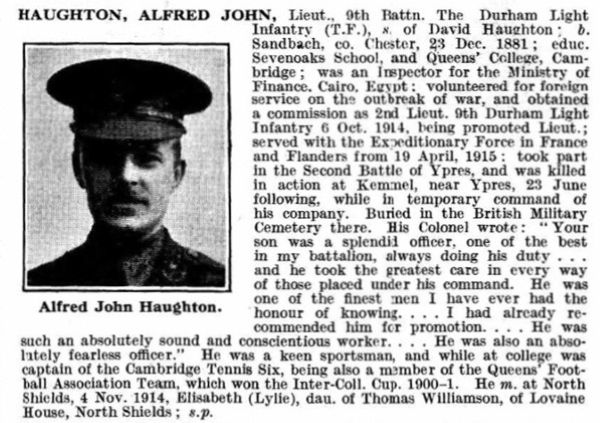
Alfred John Haughton was born in Sandbach on 23rd December 1881, the only son of bank manager David Haughton (1841 - 1921) and his wife Emily Lees Rowley (1856–1940). Alfred had two sisters Ethel Annie (1879–1931) and Marian (1883–1948). The family home was at Bank House, Hightown, Sandbach, next door to the Wheatsheaf pub.
Alfred John Haughton was the first ex-pupil of Sandbach Boys School to die in the Great War. He attended Sandbach Grammar School from the age of ten to sixteen (1892 to 1898) before completing his education at Sevenoaks School, in Kent, following his previous headteacher Mr Heslop. He gained two scholarships, and in 1900, Alfred went to Queens’ College, University of Cambridge, reading Natural Science.
Alfred was a talented sportsman, regularly representing Sandbach School in a wide range of sports. Whilst at Cambridge, he was captain of the Queens’ Tennis Six. He was a member of the Cambridge football team which won the Inter-college Cup in 1901. He was a Cadet Corporal in the Cambridge University Rifle Volunteers.
After graduating from Cambridge in 1903, Alfred entered the Egyptian Civil Service where he initially worked in the Education Department and went on to become an inspector for the Ministry of Finance in Cairo. Aboout ten years later, Alfred returned from Egypt on the outbreak of war, to enlist in the British army on 6th October 1914, just two months after the outbreak of war. He gained a commission as Second Lieutenant in the 1/9th Btn (Territorial) the Durham Light Infantry. His attestation records show that he was 5’ 10” in height.
A month later, on the 4th November 1914, Alfred (32) married 24-year-old Elizabeth (Lylie) Williamson, in Christ Church, South Shields. By this time, his parents had moved away from Sandbach to Blackpool.
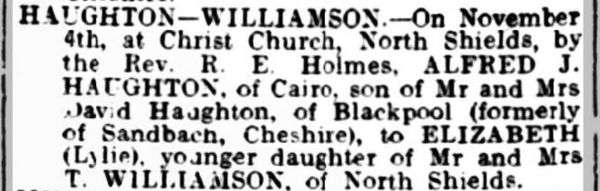
Elisabeth and Alfred’s home was with his parents-in-law at Lovaine House, Lovaine Terrace, in North Shields, Northumberland.
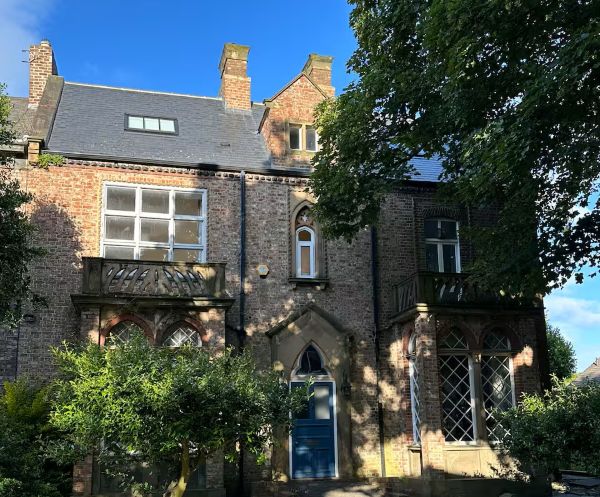
Lovaine House, Preston, North Shields, Northumberland - the home of Alfred's parents-in-law
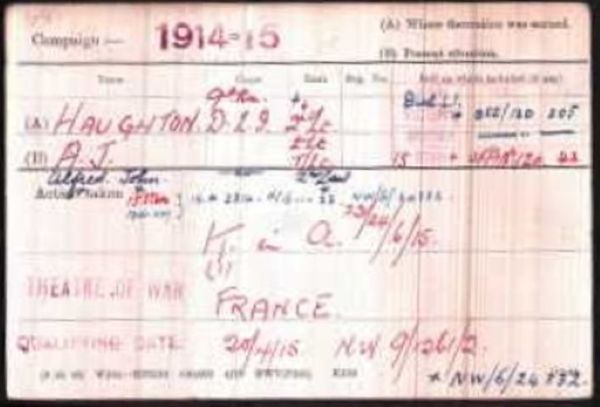
Alfred’s battalion of the Durham Light Infantry arrived at the Western Front on 19th April 1915, three days before the start of the Second Battle of Ypres.
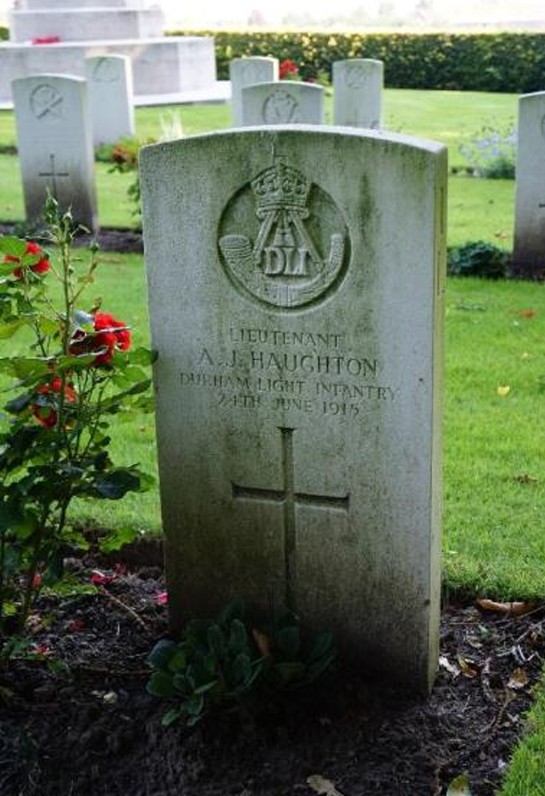
Alfred was killed during the night or early morning of 23/24 June 1915. Accounts differ on the exact date of his death, but his headstone shows 24th June. Lieutenant (Temporary) Haughton, was in temporary command of his company after the officer commanding was killed, injured or missing. Whilst out of the safety of his trenches, examining the defensive barbed wire, he met his fate. Alfred’s death was described by his colonel as “a great loss for the Battalion as he was a most reliable and energetic officer”.
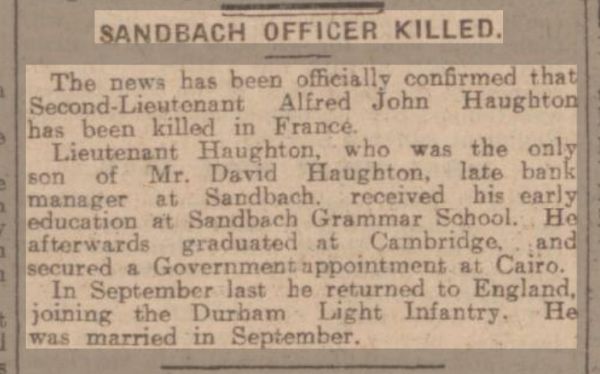
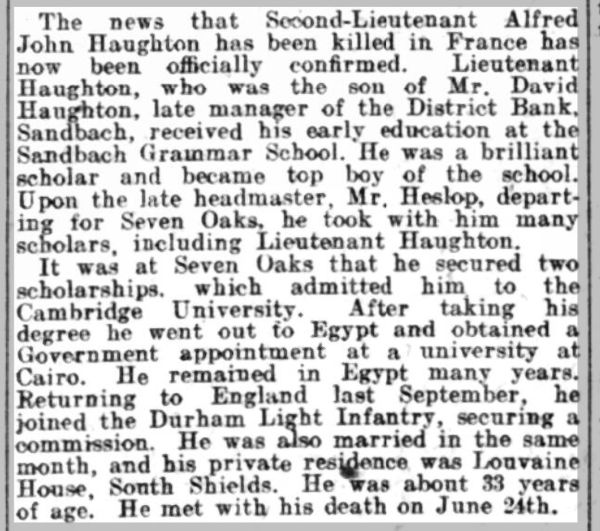
Alfed left a widow, Elizabeth (Lylie) Haughton but no children. Lylie did not remarry, and died in 1957, at the age of 67.
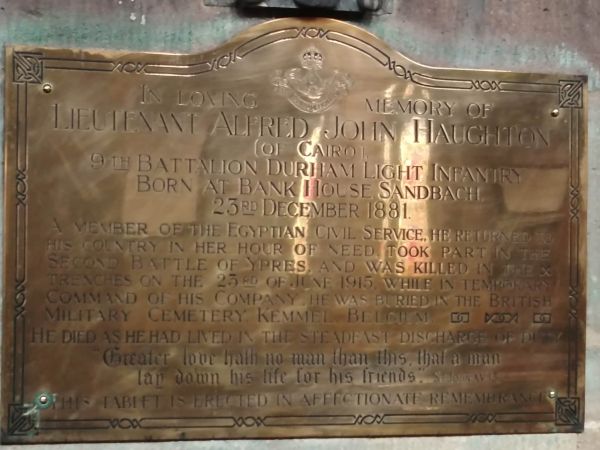
A memorial plaque to Alfred hangs on the lefthand side of St Mary's Church in Sandbach, inscribed with these words:
IN LOVING MEMORY OF LIEUTENANT ALFRED JOHN HAUGHTON (of Cairo) 9TH BATTALION DURHAM LIGHT INFANTRY
BORN AT BANK HOUSE SANDBACH 23RD DECEMBER 1881
A member of the Egyptian Civil Service, he returned to his country in her hour of need, took part in the Second Battle of Ypres, and was killed in the trenches on the 23rd of June 1915, while in temporary command of his company. He was buried in the British Military Cemetery, Kemmel, Belgium.
HE DIED AS HE HAD LIVED IN THE STEADFAST DISCHARGE OF DUTY.
“Greater love hath no man than this, that a man lay down his life for his friends.” — St. John XV.13
THIS TABLET IS ERECTED IN AFFECTIONATE REMEMBRANCE.
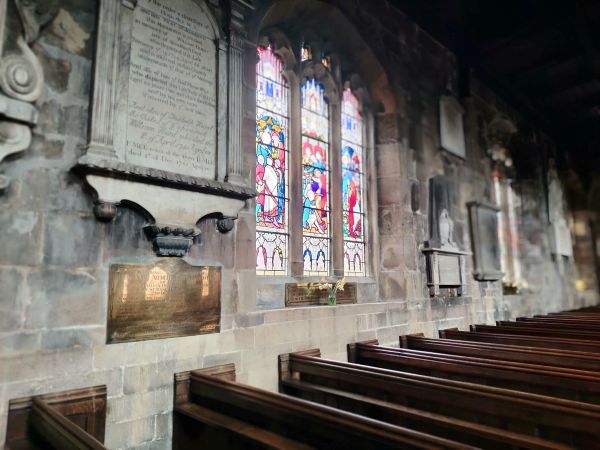
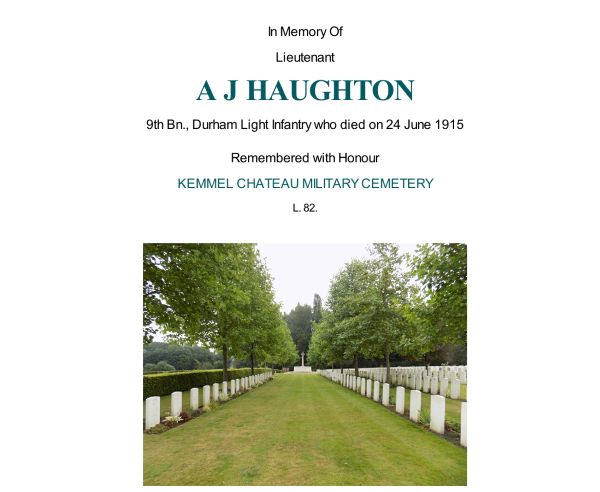
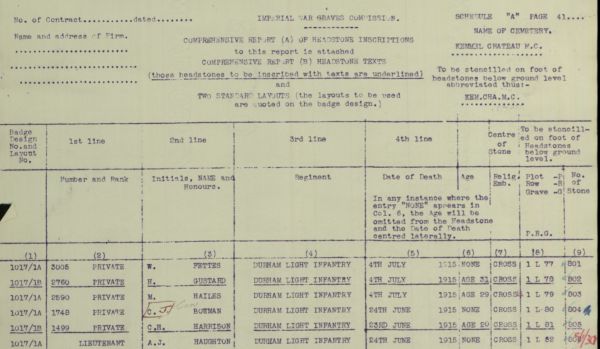
Alfred is remembered by the CWGC, and his cemetery record shows that he was buried in plot L82 of the Kemmel Chateau Military Cemetery in Belgium.

Researched by Shena Lewington (April 2026)