


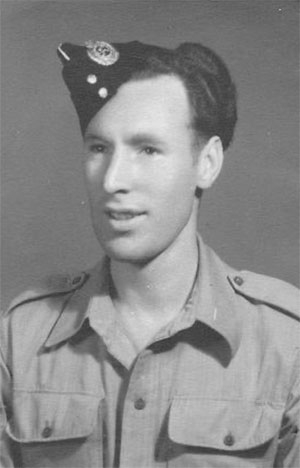
James Henry's Story.
May 1939 the British government commenced a programme of conscription for Men aged 20-22 years. Although he wouldn’t turn 20 until November of that year and despite him being in a job that was protected from conscription Jim and his work friend Delhi Hughes decided to volunteer for service in the army. This gave them two advantages over conscription 1) They could choose which unit to join and could continue in their trade and 2) They received a 10 pounds signing bonus each. Accordingly they went to the Army Recruiting office in Stoke and enlisted in the RAMC ( Royal Army Medical Corps). On 24th June 1939. Jim enlisted as a Tinsmith Class 3 the same trade as he had in the Crewe Railway Works.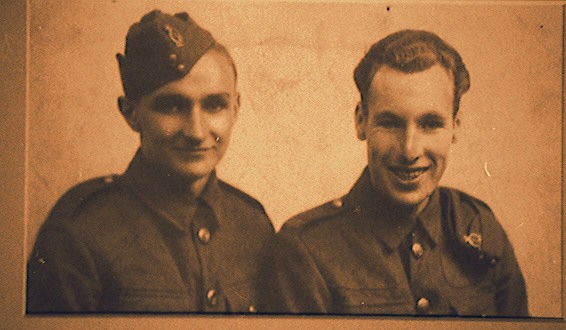
Jim and Delhi Hughes
On 1st September 1939 Jim was assigned to No 3 CCS (Casualty Clearing Station) and travelled to France with the unit on 29th September. Upon arrival in France 3 CCS was attached to the General Headquarters (GHQ ) of the 1st British Expeditionary Force ( BEF) located at Arras and Lille near the Belgium border. At this time the conflict was known as the “Phony War” because there was a standoff between the Germans and British/French armies with no movement or action taking place. On 3rd January 1940 Jim was admitted to 3CCS as a patient for reasons unknown. He was discharged on 16th January. On 24th January 1940 he was transferred to the 9th Field Hygiene Section (FHS) RAMC where he would have been assigned to the motor pool maintaining their vehicles. The function of the FHS was to ensure that front line troops had adequate food storage arrangements, latrines, and safe drinking water.9 FHS was also attached to GHQ. In February 1940 Jim was granted 10 days leave to go home to see his mother who had been taken ill. In April 1940 Jim’s unit was transferred to Cherbourg where they joined reinforcing units arriving from England.
The German Army attack commenced on 10th May 1940 and they quickly cut off the British and French forces who had retreated to the Dunkirk area from where they were evacuated by sea. Jim was evacuated from Cherbourg on 16th June after the collapse of the allied forces.
.jpg)
Jim and friends in Boulogne
Jim spent the rest of the war in North Africa with the 8th Army serving in Egypt, Libya and Tunisia
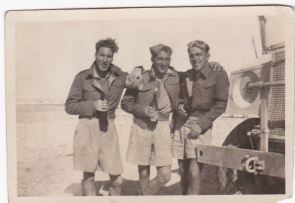
On a desert Road

Jim was discharged from the Army on 20th February 1946 having earned 5 chevrons for his 5 years overseas service. He was placed in Class Z reserve which meant he was liable to be called up again if required.
Jim was awarded the following medals for his service:
The Africa Star with 8th Army Clasp (for service in Africa with the 8th Army )
The 1939- 1945 Star (for Operational War Service Overseas
The Defence Medal ( for non-Operational service in UK )
The War Medal 1939- 1945 (for full time military service)
On 1st September 1939 Jim was assigned to No 3 CCS (Casualty Clearing Station) and travelled to France with the unit on 29th September. Upon arrival in France 3 CCS was attached to the General Headquarters (GHQ ) of the 1st British Expeditionary Force ( BEF) located at Arras and Lille near the Belgium border. At this time the conflict was known as the “Phony War” because there was a standoff between the Germans and British/French armies with no movement or action taking place. On 3rd January 1940 Jim was admitted to 3CCS as a patient for reasons unknown. He was discharged on 16th January. On 24th January 1940 he was transferred to the 9th Field Hygiene Section (FHS) RAMC where he would have been assigned to the motor pool maintaining their vehicles. The function of the FHS was to ensure that front line troops had adequate food storage arrangements, latrines, and safe drinking water.9 FHS was also attached to GHQ. In February 1940 Jim was granted 10 days leave to go home to see his mother who had been taken ill. In April 1940 Jim’s unit was transferred to Cherbourg where they joined reinforcing units arriving from England.
The German Army attack commenced on 10th May 1940 and they quickly cut off the British and French forces who had retreated to the Dunkirk area from where they were evacuated by sea. Jim was evacuated from Cherbourg on 16th June after the collapse of the allied forces.
Jim and friends in Boulogne
Jim spent the rest of the war in North Africa with the 8th Army serving in Egypt, Libya and Tunisia
On a desert Road
Jim was discharged from the Army on 20th February 1946 having earned 5 chevrons for his 5 years overseas service. He was placed in Class Z reserve which meant he was liable to be called up again if required.
Jim was awarded the following medals for his service:
The Africa Star with 8th Army Clasp (for service in Africa with the 8th Army )
The 1939- 1945 Star (for Operational War Service Overseas
The Defence Medal ( for non-Operational service in UK )
The War Medal 1939- 1945 (for full time military service)