


Thomas Henry's Story.
Thomas Henry Warnock was one of nine children of an impoverished family. Like many of his contemporaries he was forced to turn to petty crime and the army to survive. He went on to serve his country in two wars. His motives for serving are unknown but the impact was clear. He returned from The Great War physically, and probably, emotionally shattered. Wounded in action on the Western Front and then incarcerated in the most notorious POW camp of WWI, he also faced the death of four of his brothers. But it didn't end there. He and his wife Annie went on to endure the terrible loss of five of their nine children in infancy.
Thomas Henry was born to Rachel Martin, age 31 and John Warnock, age 38, in Birkenhead, Cheshire in April 1878. John was from Drumachrose, Co. Londonderry and Rachel was from Brantry, Co. Tyrone. John and Rachel married at Brantry Church on 10 April 1866 and moved soon after to Birkenhead presumably for work. According to the 1871 Census, Rachel and John lived at 1 Prospect Place, Birkenhead with their five other children, Mary 11, John 9, Martin 5, Alexander 3, George 2 and two male lodgers from Ireland. John was listed as a boilermaker and Rachel a dressmaker at the time. A year after Thomas’s birth, in 1879, John and Rachel had their sixth son, Robert.
In 1881, when Thomas was 3 years of age, the Warnock family were living at 24 St Mary's Gate in Birkenhead. The following year Thomas’s brother Albert Edward was born, followed in 1885 by his brother William Charles. At this point Thomas had one sister and seven brothers. In July 1889, when Thomas was 11, he had his first recorded brush with the law when he and his older brothers, Alexander, and George, were charged with stealing two croquet balls from a garden in Tranmere Park. They claimed they had found them on waste ground and were discharged.
Two years later, in 1891, Thomas was 13 years old, and the Warnock’s had moved again, this time to 23 Thomas Street in Birkenhead, which they shared with 3 other families. According to the 1891 Census, a total of twenty people lived in the house. It could have been worse, as by this time, his only sister Mary, had left home and married and his younger brother Robert had died sometime before his 11th birthday.
Then in 1893, his sister Mary sadly also died. She was just 26. On the 7 October that year, Thomas found himself in trouble with the law again. This time there were to be serious consequences; he was sentenced to 14 days imprisonment for stealing 15lbs of copper. He was just 15 years old.
This began a sustained period of petty criminality for Thomas. Two years after his first incarceration, Thomas was up in court for sleeping rough. He and five other ‘ill clad youths’ were discovered at 4 am in a shed in an unoccupied yard in Jackson Street ‘without visible means’. According to the Birkenhead News of the 21 August 1895, ‘when asked what they were doing there some said they had no homes and others that they had been locked out’. No sympathy was shown for the plight of Thomas and his companions, and they were committed to a month's imprisonment with hard labour.
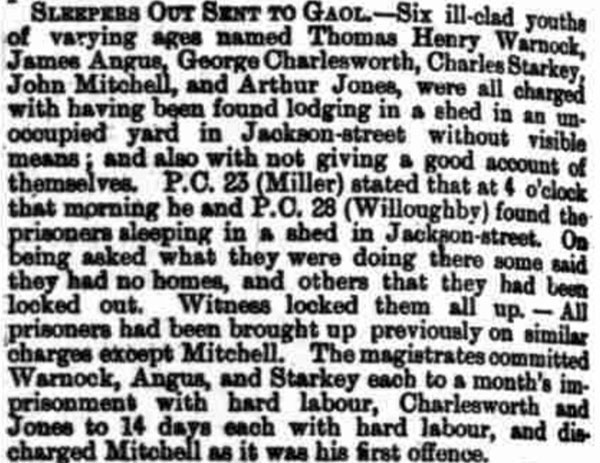
The Birkenhead News 21 August, 1895.
Later that same year, Thomas was charged with entering the yard of 75 Market Street for an 'unlawful purpose'. According to the report in the Birkenhead News of the 12 October 1895, he said that he had, “gone into the yard to see if there was an old pair of boots that he might take as he was wishful of going to Cardiff to get work there.” This is conceivable given that around this time Thomas's elder brother, George, was living in Ystradyfodwg, Pontypridd and working as a colliery engine stoker. This defence had little impact and Thomas was sentenced to a further 14 days imprisonment with hard labour.
The Birkenhead News 21 August, 1895.
Later that same year, Thomas was charged with entering the yard of 75 Market Street for an 'unlawful purpose'. According to the report in the Birkenhead News of the 12 October 1895, he said that he had, “gone into the yard to see if there was an old pair of boots that he might take as he was wishful of going to Cardiff to get work there.” This is conceivable given that around this time Thomas's elder brother, George, was living in Ystradyfodwg, Pontypridd and working as a colliery engine stoker. This defence had little impact and Thomas was sentenced to a further 14 days imprisonment with hard labour.
In addition to these offences, for which he was incarcerated for a total of 58 days, Thomas was also engaged in various misdemeanors. Between 1895 and 1910 he received a further 12 separate convictions for drunkenness, obscene language, and gaming. This is a remarkable record of lawlessness, given he spent three of these years 8,500 miles away in South Africa. Thomas’s South African journey began on the 4 January 1897, when at the age of 18, Thomas joined the 3rd Militia Battalion of The Cheshire Regiment. On his enlistment papers, Thomas was described as being 5' 8½’’ tall, weighing 115 lbs with a fresh complexion and light brown hair. He had ‘TW’ tattooed on his left arm and a medal, cross swords, an anchor and a dot tattooed on his right. By 1903, his military records revealed that he had added a heart, a star, a shield, an American flag and the bust of a woman to his collection of tattoos. Thomas was 21 when the 2nd Boer War started on the 11 October 1899 and his battalion was mustered and deployed to South Africa. His military records for this period are scant so the precise details of his deployment are not clear. We do know, however, that he served throughout the entirety of the war and for this service he was awarded the Queen’s and the King’s South Africa Medals with clasps. We also know that Thomas’s older brother Alexander was in South Africa at the same time, also serving with the Cheshire Regiment. When the war ended on 31st May 1902, Thomas returned home apparently unscathed. He signed on for a further 4 years in 1903, finally leaving the regiment in January 1907 but remaining on the list of reservists.
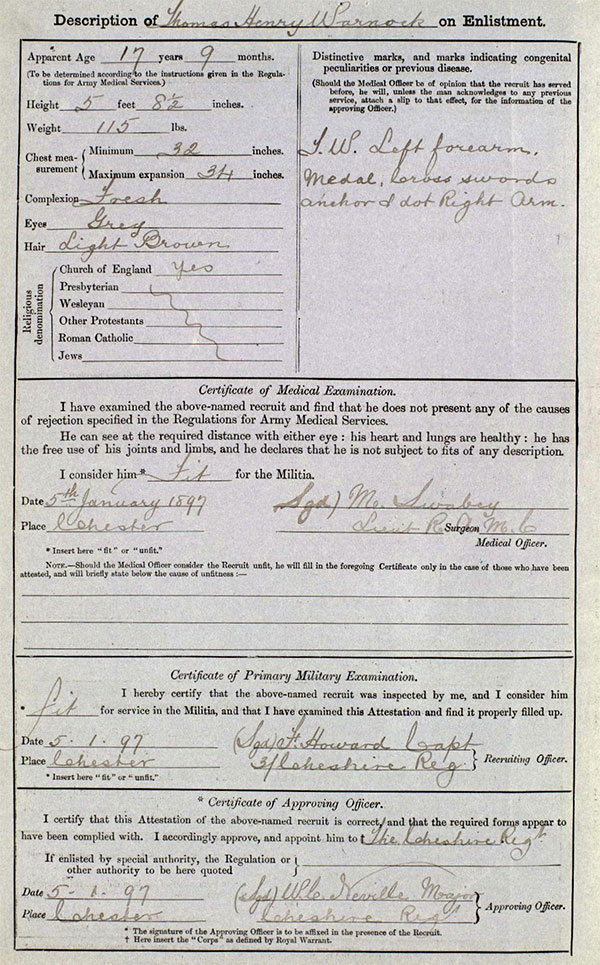
Before he left to fight in The Boer War, Thomas was living at 8 Denison Street, Birkenhead. Whilst living there, he met and married Annie Oakley. The wedding was on the 14th February 1898 at the iconic St Nicholas's Church close to Liverpool’s Pier Head. Annie was living at 6 Gibraltar Row, Liverpool with her family at the time. She had been born in the small village of Hartlebury in June 1882 to her parents Henry (born 1844 in Bebington) and Mary Ann (nee Hughes. Born 1849 in Liverpool). Her family had moved to Worcestershire sometime around 1875, where Annie, her sister Martha and brother George were born. It is hard to conceive of a stranger match than Thomas, a ruffian from the grimy streets of Birkenhead and a young girl from a tiny village in rural Worcestershire. Thomas was getting into trouble with Annie’s brothers Peter and John in 1893, when they raided an orchard, so this was perhaps how he came to know Annie. In regard to their ages, the marriage record indicates both were 18 at the time, however, based on baptismal records, Thomas would have been nearer 20. Thomas was somewhat economical with the truth when it came to his birth year. He seems to have settled on 1880 even though his baptism is clearly recorded as being in 1878. It was three years later in 1901, that Thomas and Annie had their first child; a daughter named Annie after her mother (and her grandmother for that matter). At that time, Thomas and Annie were living at 11 Fore Street, Birkenhead. Strangely, The 1901 Census lists Thomas as being a general labourer, though we know he was serving with The Cheshire Regiment in South Africa between 1899 and 1902. But he was in the Militia so he must have been home at various times during that period. They did after all conceive baby Annie at some point. Two years later, Thomas and Annie had their second child. This time it was a son whom they named George Alexander after Thomas’s two older brothers. George was born on the 28 November 1903. He was my grandfather.
1904 was a significant year for Thomas. It marked the start of a prolonged period of personal tragedy. It began when his father John died in 1904 at the age of 64. Then in 1905 Thomas and Annie had a second daughter named Helena who died before her 1st birthday. In 1907 more tragedy struck when Thomas’s mother Rachel died when she was 60. This was closely followed by the birth and death of their second son, John, who also died before he was 1 year old. Thomas and Annie went on to have another son in 1908 but he died in 1909 when he was just 1 year old. His name was Thomas Henry. In the five years between 1904 and 1909 Thomas lost both his parents and he and Annie lost three of their children in infancy. Even though child mortality was high at this time with an average of 150 infant deaths per 1000 births, this loss seems particularly cruel and must have been incredibly difficult to endure. By the time of the 1911 Census, Thomas aged 33 and Annie aged 29, were living at 11 Fore Street along with their surviving children, Annie aged 11 and George aged 7. Lodging with them was Thomas's older brother Martin who was aged 40. No further tragedy had struck since the loss of their son Thomas Henry in 1909 but Thomas’s luck with the law was about to run out again. On the 19th October that year Thomas was sentenced to 3 months imprisonment with hard labour for stealing 48 jerseys, 36 pairs of stockings and 48 pairs of socks. This time Thomas had roped his younger brother William into the caper who received a lesser 6 week’s imprisonment, presumably because he didn’t have Thomas’s criminal record. Again, there is no evidence of any account being taken of Thomas’s service for Queen/King and country in the sentencing. Better news for Thomas and Annie came on Christmas day 1911 when they had another son. They called him Martin after Thomas’s older brother who was lodging with them at the time. Thankfully, this time, Martin survived into adulthood. The birth of his second surviving son did nothing to stem Thomas’s criminal career and in July 1912, he was sentenced to 2 months imprisonment with hard labour for larceny of a gas bracket the ‘property of the Mayor, Aldermen and Burgesses of the Borough' and 16 ½ lbs of lead from the Great Western Railway Company. As far as we know this is the last offence that Thomas was ever convicted for. It is unlikely that this was the result of some miraculous rehabilitation. More likely he just didn’t get caught again before the outbreak of war in 1914 when everything changed.
Before that momentous event, Thomas and Annie had another personal tragedy to endure when early in 1914 their fifth born son, William Carson died when he was just 1 year old. Britain entered the First World War on the 4 August, 1914. Just two weeks later, on the 18 August, Thomas re-enlisted with The Cheshire Regiment. He was 36 years old and was posted to the 3rd Training Reserve Battalion located at Chester Castle. Meanwhile, on the 24 August 1914, the 1st Battalion of The Cheshire Regiment was decimated fighting a rearguard action against the German First Army in The Retreat From Mons. Given his previous military experience, it was decided that Pte. Thomas was not required to complete his basic training and was therefore selected as one of the first draft of casualty replacements to the British Expeditionary Force. As a result, on the 27 August 1914 he was posted to ‘B Company’ 1st Battalion, The Cheshire Regiment at Ypres. He would have arrived at the front line in Belgium in the midst of continuous and sustained German assaults on the British trenches. As a consequence, just two months later, Thomas was severely wounded and reported missing in action. Records are understandably confused however; it is most likely that Thomas was wounded on 22 October 1914 at La Bassee. It is not clear when Thomas was taken prisoner by the German Army but by his own account this happened at Delvir Wood, Ypres on 14 November 1914. What we do know is that he sustained a serious injury to his arm, was captured and sent to a German prisoner of war camp. Indicative of this confusion, Thomas's wife Annie was mistakenly informed that he had been killed in action on the 28 October and consequently began receiving his war pension. It wasn’t until nine months later, in July 1915, that through the Red Cross she discovered that he was in fact alive and being held as a prisoner of war at the notorious Wittenberg POW camp in Germany.
An article in the Birkenhead News on 1 July 1916, described Thomas as ‘having developed a fever’ at Wittenberg and that he had ‘practically lost the use of his arm.’ It also described how a fellow prisoner, who had since been repatriated, had described the terrible conditions in Wittenberg and said “the punishments for the least offence were very vicious and barbaric.” In April 1916, an official government report entitled The Horrors of Wittenberg was published. This pamphlet set out the extent of the terrible ill-treatment of POWs and the devastating typhus epidemic that hit the camp in the first six months of 1915. Thomas was known to be at the camp during this period before being transferred to the Merseberg Camp sometime in 1916, where reports that he was being held in the Lazarett (sickbay) confirmed that he continued to suffer from his injury. Whilst he was a prisoner of war Thomas’s elder brothers Alexander and George were killed in France. Alexander, a Company Sergeant Major in The Cheshire Regiment died aged 41 on 2 May 1915 from pneumonia as a result of a wound he sustained in action in Flanders. George, a private in the Welch Regiment, was killed in action on 11 July 1916 in Mametz Wood at the Somme aged 40. Thomas was sent from Merseburg POW Camp to convalesce in Switzerland in August 1916. Only the most severely injured soldiers were sent to Switzerland as they had become a burden on German resources. He was one of around 4,000 British and Commonwealth POWs who were sent to the Swiss mountain villages of Murren, Chateaux d’Oex and Leysin. Two months later, Thomas’s younger brother William, a private in the South Lancashire Regiment was killed in action at the Somme on the 21 October 1916. He was 31. On the 2 February 1917, his other younger brother Albert, also a private in the South Lancashire Regiment, was killed in action whilst fighting with The London Rifle Brigade in Belgium. He was 34.
An article in the Birkenhead News on 1 July 1916, described Thomas as ‘having developed a fever’ at Wittenberg and that he had ‘practically lost the use of his arm.’ It also described how a fellow prisoner, who had since been repatriated, had described the terrible conditions in Wittenberg and said “the punishments for the least offence were very vicious and barbaric.” In April 1916, an official government report entitled The Horrors of Wittenberg was published. This pamphlet set out the extent of the terrible ill-treatment of POWs and the devastating typhus epidemic that hit the camp in the first six months of 1915. Thomas was known to be at the camp during this period before being transferred to the Merseberg Camp sometime in 1916, where reports that he was being held in the Lazarett (sickbay) confirmed that he continued to suffer from his injury. Whilst he was a prisoner of war Thomas’s elder brothers Alexander and George were killed in France. Alexander, a Company Sergeant Major in The Cheshire Regiment died aged 41 on 2 May 1915 from pneumonia as a result of a wound he sustained in action in Flanders. George, a private in the Welch Regiment, was killed in action on 11 July 1916 in Mametz Wood at the Somme aged 40. Thomas was sent from Merseburg POW Camp to convalesce in Switzerland in August 1916. Only the most severely injured soldiers were sent to Switzerland as they had become a burden on German resources. He was one of around 4,000 British and Commonwealth POWs who were sent to the Swiss mountain villages of Murren, Chateaux d’Oex and Leysin. Two months later, Thomas’s younger brother William, a private in the South Lancashire Regiment was killed in action at the Somme on the 21 October 1916. He was 31. On the 2 February 1917, his other younger brother Albert, also a private in the South Lancashire Regiment, was killed in action whilst fighting with The London Rifle Brigade in Belgium. He was 34.
It is not clear when Thomas would have received news of the death of his four brothers, but it is very likely he remained unaware of this until his return home. (He would have also learnt of the death of his cousin L/Cpl William Warnock who was killed at Gallipoli on 7 August 1915.) It is hard to comprehend the extent to which this terrible loss would have tempered his joy at being home from the horrors he had endured as a prisoner of war. Thomas was eventually repatriated to Britain in a prisoner of war exchange scheme on 9 September 1917. On his return he was awarded the Silver War Badge which indicated that he had been released from service as a result of wounds sustained in action. This award was conceived in order to prevent returning servicemen from being accused of cowardice.
On the 20 December 1917 Thomas and Annie had another son. They named him Thomas. At the time, the family were living at 3 Back St. Annes Street, Birkenhead. Astonishingly, even though Thomas was unfit to serve, he was still barracked at regimental headquarters in Shrewsbury and required to obtain leave to visit Annie and his newborn son. This he was granted from the 21 December to midnight on 26 December. By the 31 December he hadn't returned to barracks and his regiment wired Birkenhead Police instructing them to arrest Thomas for being AWOL. Detective Maddocks apprehended Thomas at home on the 4 January and he appeared before the Borough Police Court on the 8 January. According to the Birkenhead News Thomas stated to Maddocks in court “Didn’t I tell you I was willing to go back as soon as I received word I was to go back?” to which Maddocks replied “No. You told me you would not go back, and you threatened to throw me through the — window.” The magistrate ordered that Thomas be handed over to military authorities.
Thomas was finally discharged from the army on 26 March 1918. He was awarded the prestigious 1914 ‘Mons’ Star with clasp which indicated that he had been ‘under fire’ between 5th August 1914 and midnight on 22/23 November 1914. Recipients were predominantly officers and men of the British Expeditionary Force (Old Contemptibles), who had taken part in the Retreat from Mons and the First Battle of Ypres. Only 365,622 of these medals were awarded in total. Thomas was also awarded the British War Medal and the Allied Victory Medal. These three medals were sometimes irreverently referred to as ‘Pip, Squeak and Wilfred’ though I doubt Thomas was amused by this. His medals probably offered him little comfort; He had lost four brothers, experienced the horrors of trench warfare, been seriously wounded, endured terrible conditions as a POW and returned home with a war wound that meant he was to suffer from ill health for the remainder of his life. By way of a final tragedy, Thomas and Annie lost another child. Little Lilian was born in 1919 and died before reaching her 1st birthday. This must have seemed so unfair to Thomas and Annie; to lose five children after all the other struggles they had endured in their 21 years of marriage.
When the census was taken in 1921 Thomas and Annie and sons George, Martin and Thomas were living in 3 Back St.Annes Street. Lodging with them was Thomas’s brother Martin and Annie's brother John. Thomas was described as a bottle dealer.
Birkenhead Cenotaph was unveiled on the 1 July 1925. As a small token of appreciation by the authorities, Thomas was chosen to lay a wreath in recognition of his service and the sacrifice made by his four brothers. No doubt this was an immensely proud but bittersweet moment for Thomas.
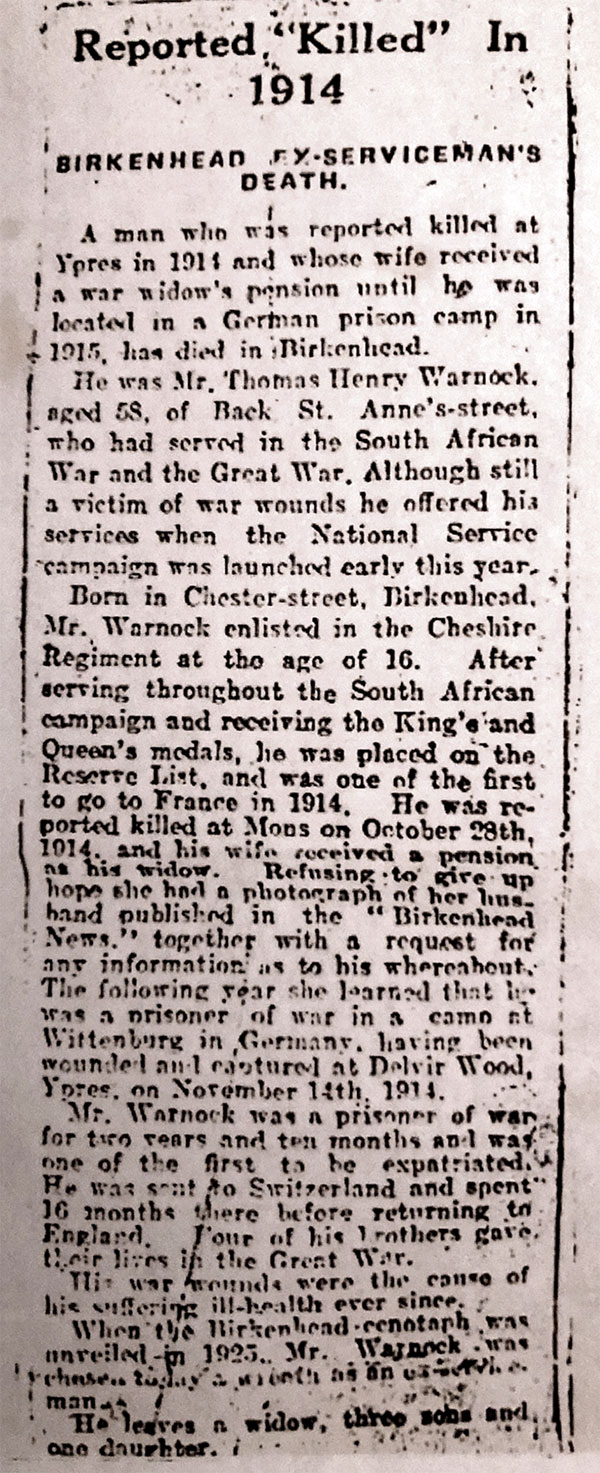
Thomas died on the 10 March 1939 in Birkenhead. He was 60 years old. Nothing is known about his life after that momentous occasion at the Cenotaph 1925. Perhaps he went on to live a happy, quiet life devoid of incident.
Thomas died on the 10 March 1939 in Birkenhead. He was 60 years old. Nothing is known about his life after that momentous occasion at the Cenotaph 1925. Perhaps he went on to live a happy, quiet life devoid of incident.
He was survived by his wife Annie who died in 1953 aged 71, his daughter Annie and his three sons; George (my grandfather) who died in 1981, Martin who died in 1975 and Thomas who survived into adulthood but details of whose death are unknown. Before he died, Thomas saw the birth of ten of his grandchildren, four to his daughter Annie (sadly two died in infancy), one to his son Martin and five to my grandparents George and Ellen Elizabeth (Nellie). Their first child was George born in 1929 followed by twins William and Thomas who died in childbirth in 1930, then my father David Edward, in 1931 and Abert in 1934. Their sixth child, Mary, was born in 1941. It would be nice to think that Thomas and Annie derived some joy from their surviving grandchildren.
When he died The Birkenhead News ran with his obituary which focused on his harrowing wartime experiences. Sadly, this barely scratched the surface of a remarkable life defined by astonishing hardship, struggle and tragedy.
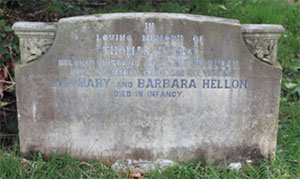
His headstone at Flaybrick Cemetery.
The Cheshire Roll of Honour would like to thank Jon Warnock, great grandson of Thomas Henry for writing his story.
The Cheshire Roll of Honour would like to thank Jon Warnock, great grandson of Thomas Henry for writing his story.