


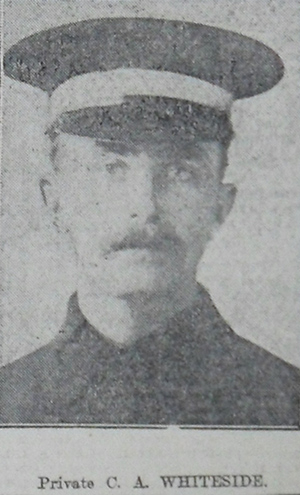
Charles Alfred's Story.
Charles Alfred Whiteside worked as a printer at the Lever Brothers famous soap making factoory at Port Sunlight. Sir William Hesketh Lever had been actively involved in a recruiting campaign with the Member of Parliament for the Wirral, Gresham Stewart. In total there were just short of 1200 volunteers who were formally recognised as being part of 13th (Wirral) Battalion Cheshire Regiment and who marched through the streets of Chester on 7th September 1914, just over a month after war had been declared. At Chester Station Charles and his comrades boarded a train that would take them to the garrison town of Tidworth in Wiltshire, their journey to war had begun.
Short stays at No. 21 Camp Perham Down and Sherrington Tented Camp followed as the army struggled to cope with the logistical problems caused by the huge esponse to Kitchener's call to arms. Finally the battalion moved into its newly completed training base at Codford St Mary, wher it remained until January 1915.
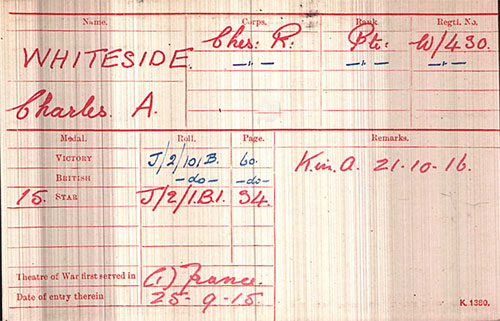
The battalion embarked for France from Folkestone on 25th September 1915, landing at Boulogne. By 3rd October the men were occupying trenches opposite the Le Touquet Salient. Charles was a stretcher bearer and, by all accounts, a good one who was popular with his comrades. The battalion remained in this sector until 31st January 1916 when the men were marched to a rest camp near Bailleul where they remained until 6th March. It should be pointed out that whilst the rest camp allowed the men to play sports it also involved regular route marches and bayonet, bombing and rifle practice sessions.
On 6th March the men left the rest camp and began marching towards new positions in the Vimy Ridge sector. This was to take eleven days and ten overnight stops in total. The second day saw a march of some ten miles after which nine men were evacuated to a Casualty Clearing Station. Itis no surprise perhaps that an inslection by the battalion chiropodist followed!
April and May saw the battalion involved in intensive fighting, including two spells of ten days in the firing line. Both sides were engaged in mining activity and making frequent attacks and counter attacks. Casualties were heavy.
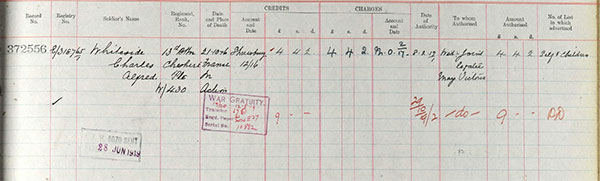
Soldiers Effects Register, shows that his wife recieved £9 war gratuity in 1919.
Soldiers Effects Register, shows that his wife recieved £9 war gratuity in 1919.
The battalion was eventually relieved on 19th May. Intensive training for the Battle of the Somme now began and the men were to fight at La Boisselle, Ovillers, Beaumont Hamel and Thiepval before being involved in the offensive against the Schwaben Redoubt, a German defensive position that lay on the Thiepval Ridge. The Schwaben Redoubt finall fell on 14th October and the battalion's attention now turned to the Regina Trench, the next defensive line.
Charles Alfred Whiteside was killed in the attack on Stuff Trench on 21st October. He has no known grave and is commemorated on the Thiepval Memorial. He left a widow and three children. His youngest child, Norma, had been born in February 1916. Charles never got to meet her.
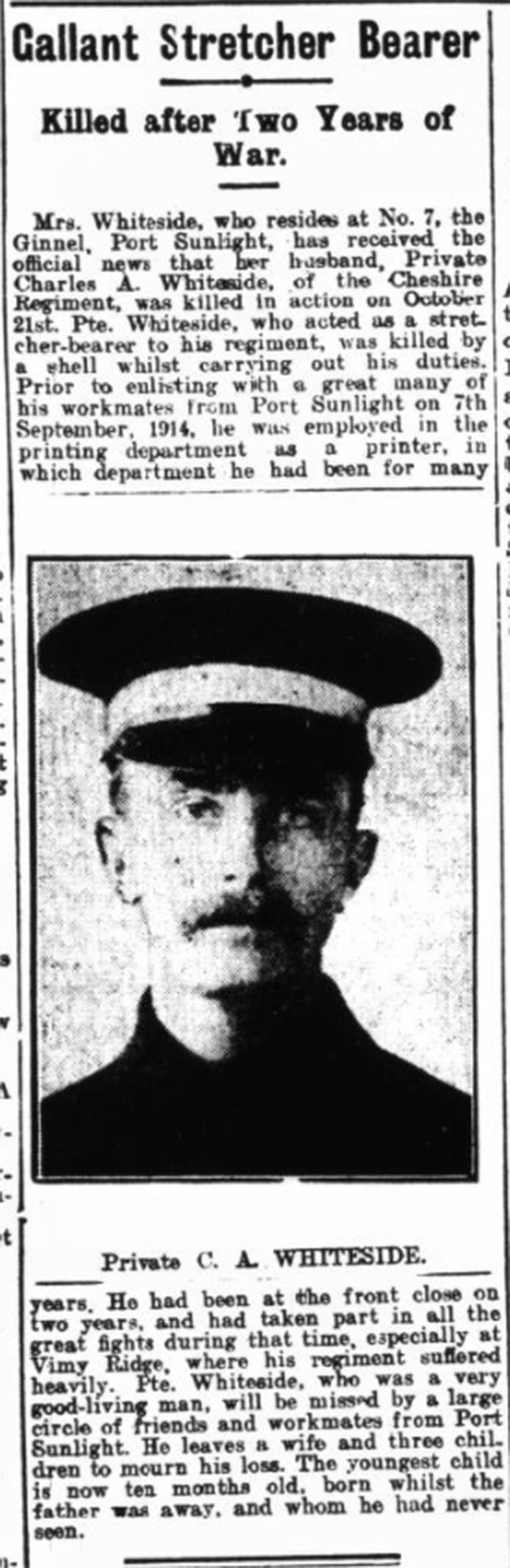
Birkenhead News 23 December 1916
Birkenhead News 23 December 1916