


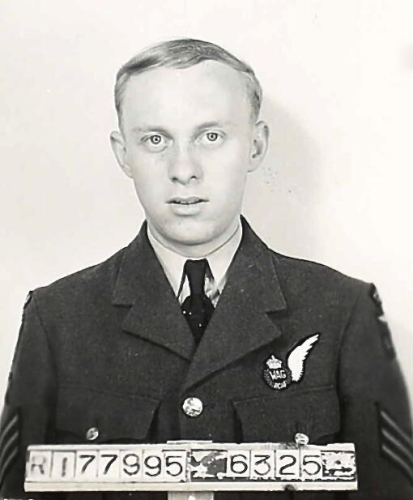
Dean Walter's Story.
Dean was born on 21st January 1923 in Twisp, Washington, USA to parents Edward and Audrey Swedberg who were both US citizens. Dean spent the first two years of his life in Washington before moving to Wadena, Saskatchewan, Canada where he studied at Wadena School from 1930 to 1935. In 1935 the family moved to Flin Flon, Manitoba where Dean studied at Flin Flon Collegiate from 1935 to 1939. After graduating from school in 1939 Dean undertook an apprenticeship with Hudson Bay Mining and Smelting Company. He was one year short of completing his apprenticeship when he volunteered for the RCAF on 6th July 1942.Military Service with the RCAF
6th July 1942
Enlisted in the RCAF at Winnipeg No. 6 Recruiting Centre.
29th July 1942
Transferred to No. 2 Manning Depot in Brandon, Manitoba, for basic drill, inoculations, and kitting.
9th October 1942
Posted to No. 2 Wireless School in Calgary, Alberta, to train as a Wireless Operator (Air Gunner).
2nd May 1943
Posted to No. 6 Bombing and Gunnery School at RCAF Station Mountain View, Ontario, for aerial gunnery training.
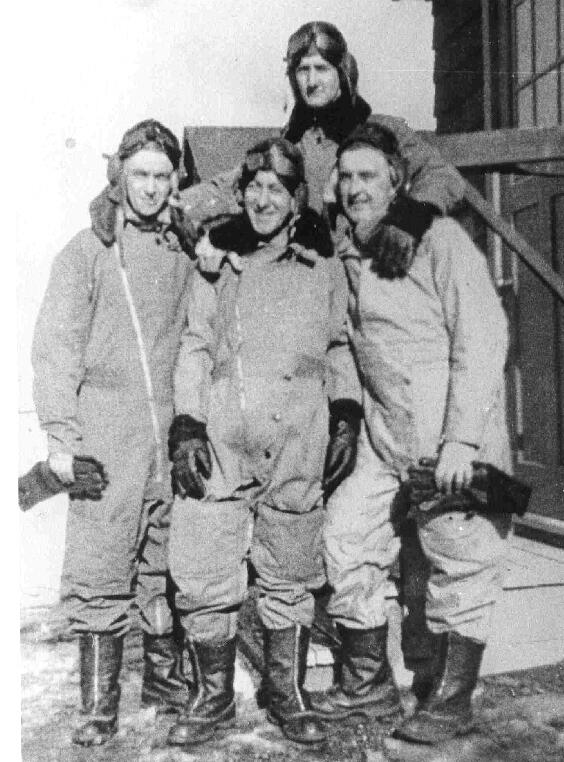
Dean with other Air Gunners upon completion of Gunnery School
28th August 1943
Posted to No. 5 Manning Depot in Lachine, Quebec (a major embarkation/staging depot).
20th November 1943
Transferred to No. 111 Operational Training Unit in Nassau, Bahamas (which specialized in Coastal Command/anti-submarine and heavy transport/bomber training on B-24 Liberators and B-25 Mitchells)
30th December 1943
Transferred to No. 31 Personnel Depot in Moncton, New Brunswick, to await a ship overseas.
1st January 1944
Embarked on a ship to UK at New York, USA
11th January 1944
Arrived in UK
14th March 1944
Transferred to 1674 Heavy Conversion Unit ( Coastal Command) at RAF Longtown in Cumbria for conversion to 4 engined bombers
12th April 1944
Killed in an accident when flying on a training mission in Halifax BB310
The loss of BB310
In the early hours of 12 April 1944, Halifax BB310 of 1674 Heavy Conversion Unit Coastal Command crashed on Great Dun Fell in the northern Pennines with the loss of all 9 crewmen. Four RCAF airmen plus one RAF crewman were in training and the other four crew were instructors.
They were undertaking an arduous cross country night navigation exercise and the Halifax had been in the air for eight and a half hours when it crashed. The low cloud covering the north west coast contributed to the bomber overflying the base at RAF Longtown north of Carlisle and it was at an insufficient height to clear the high ground ahead. The aircraft exploded upon impact, killing all on board instantly.
Crew
Pilot (Instructor) : Flying Officer Sydney Brookes RAFVR 156625 : Commission Gazetted Tuesday 19 October, 1943) [Killed]
Pilot (Under Training) : Flying Officer Paul Bevens Stevens RCAF J/24458 [Killed]
Flight Engineer : Sergeant Robert James Littlefield RAFVR 1853196 [Killed]
Navigator : Sergeant William John Morrison RAFVR 1542074 [Killed]
Wireless Operator (Instructor) : Flight Sergeant William Alan Johnson RAFVR 1107720 [Killed]
Wireless Operator / Air Gunner : Sergeant Dean Walter Swedberg RCAF R/177995 [Killed]
Wireless Operator / Air Gunner : Flight Sergeant Harold Stanley Seabrook RCAF R/168412 [Killed]
Wireless Operator / Air Gunner : Sergeant Frank Pess RCAF R/171924 [Killed]
Wireless Operator / Air Gunner : Sergeant Hugh Dunningham RAFVR 1385253 [Killed]
The Court of Enquiry held on the cause of the accident found that the aircraft captain Flying Officer Brookes was primarily responsible for the accident as he did not follow the emergency procedures that required him to maintain a minimum height of 4000 feet in case of the aircraft becoming lost. However the Court also determined that it was not appropriate to assign Brookes to the captain position because although he had extensive flying experience he had never flown as captain before and had only one hour experience flying solo at night. The uncertain weather was also a factor. The Group Commanding Officer also commented that 1674 HCU was a conversion unit and should not be used for Operational training as was the case on this flight.
Brookes and the four Canadian crew members were buried at Chester Blacon Cemetery and the other four UK crewmen were buried at their local cemeteries around the UK.
Dean is commemorated on the Honour Roll located at the Flin Flon cenotaph. All of the crew are commemorated on a memorial plaque located at the crash site.
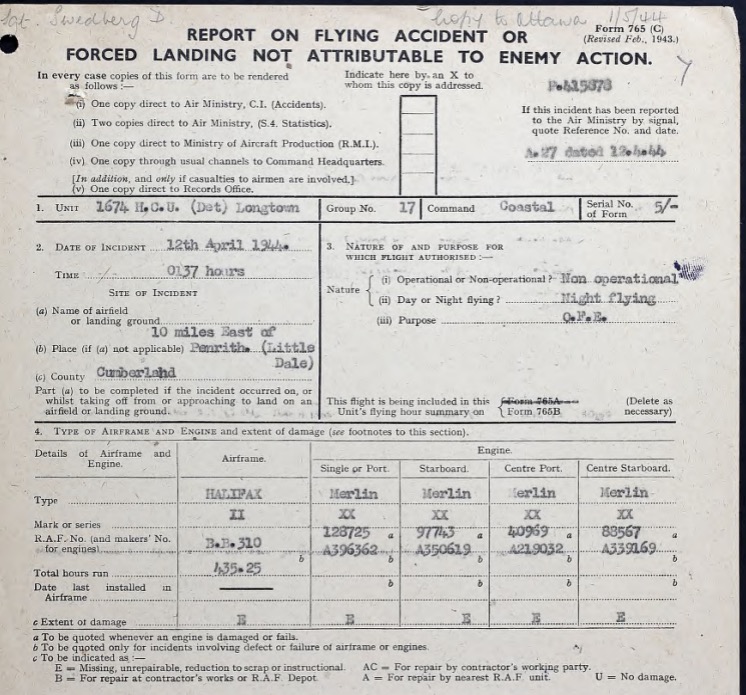
Accident Report 1
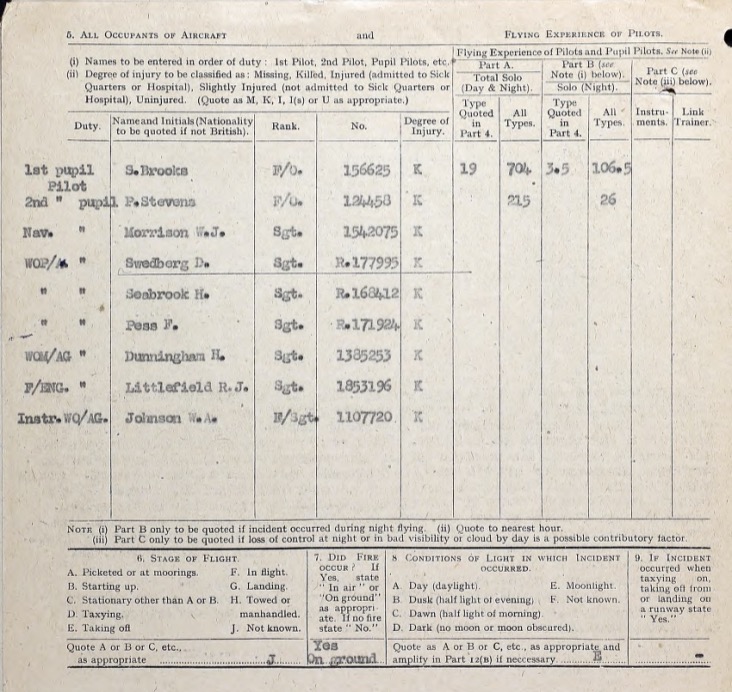
Accident Report 2
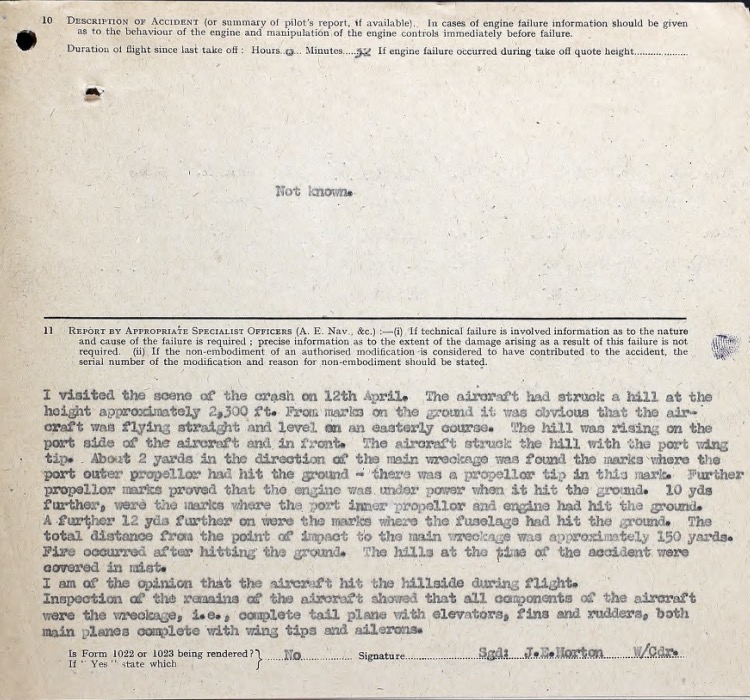
Accident Report 3
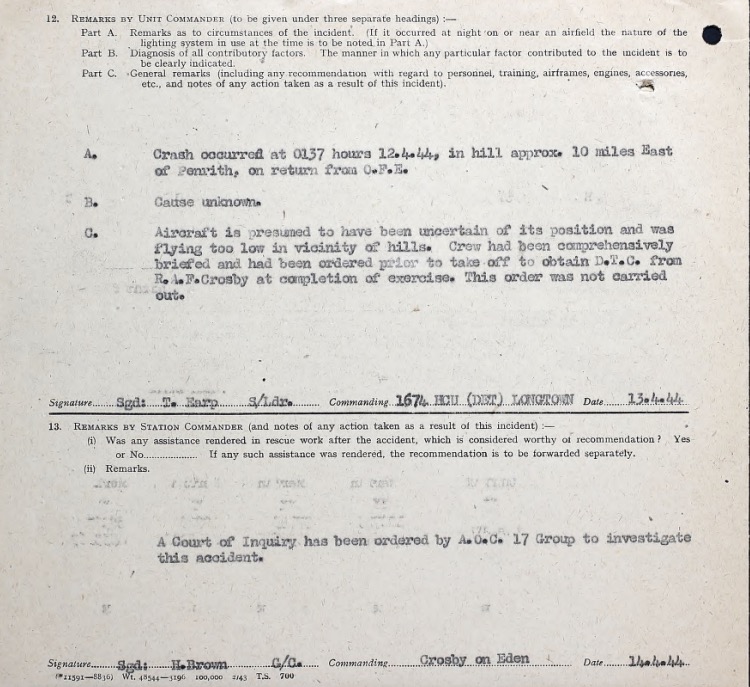
Accident Report 4
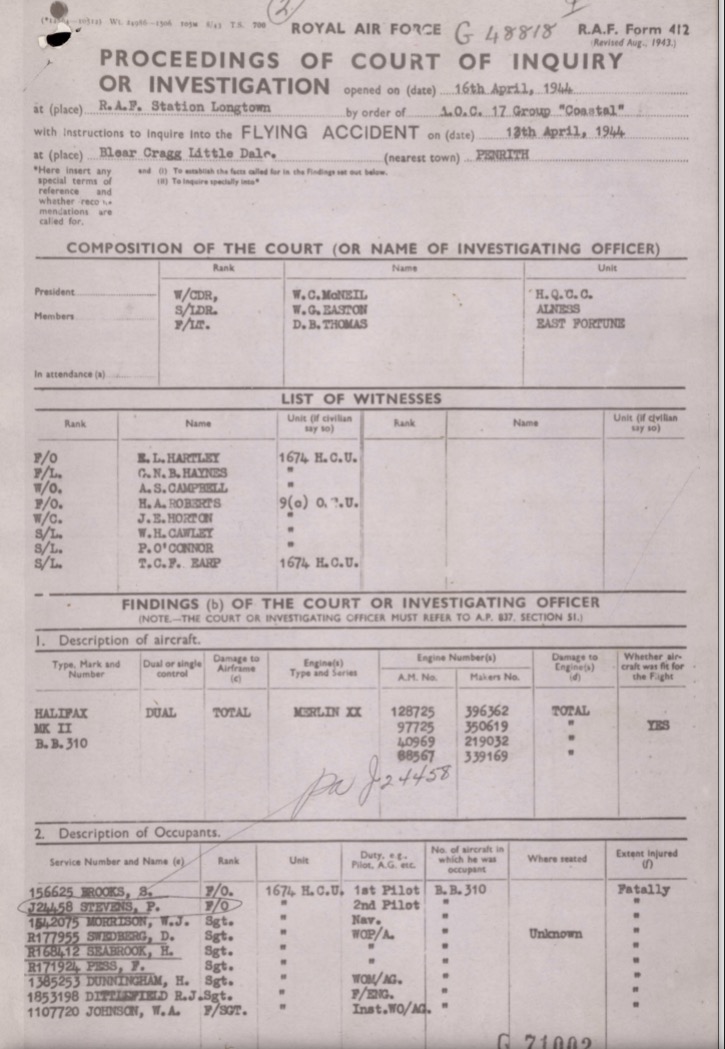
Court of Enquiry 1
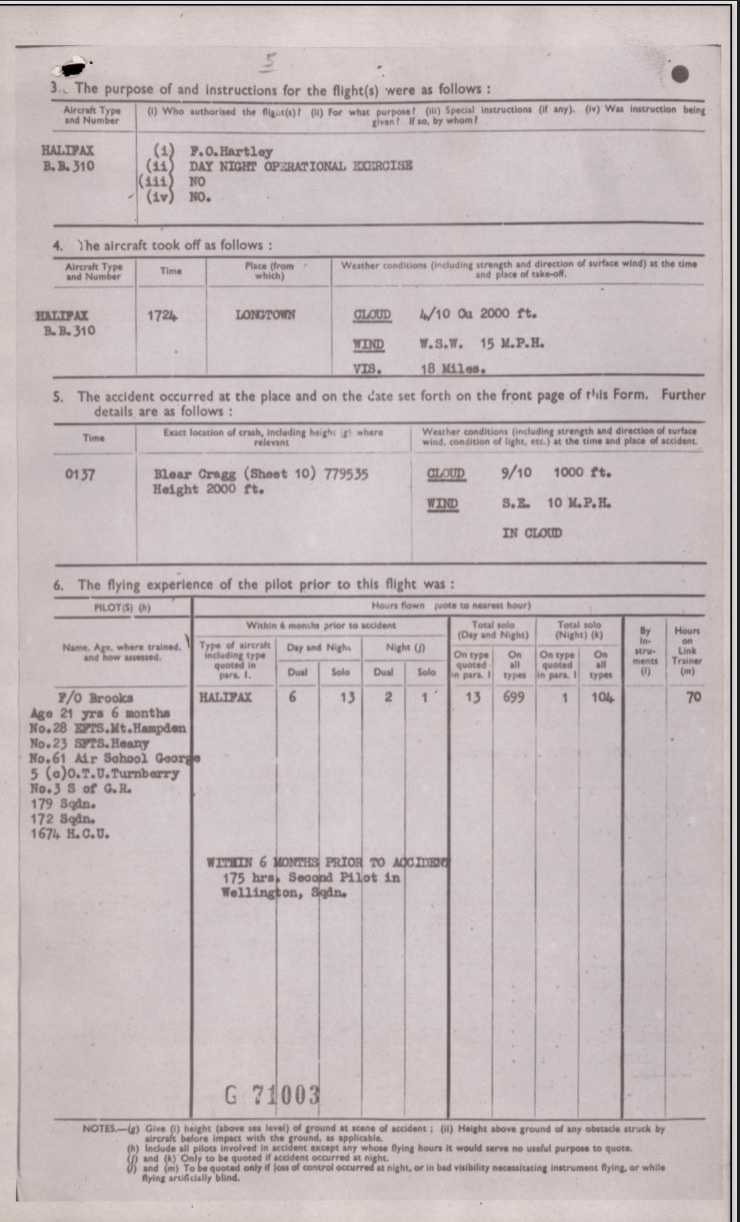
Court of Enquiry 2
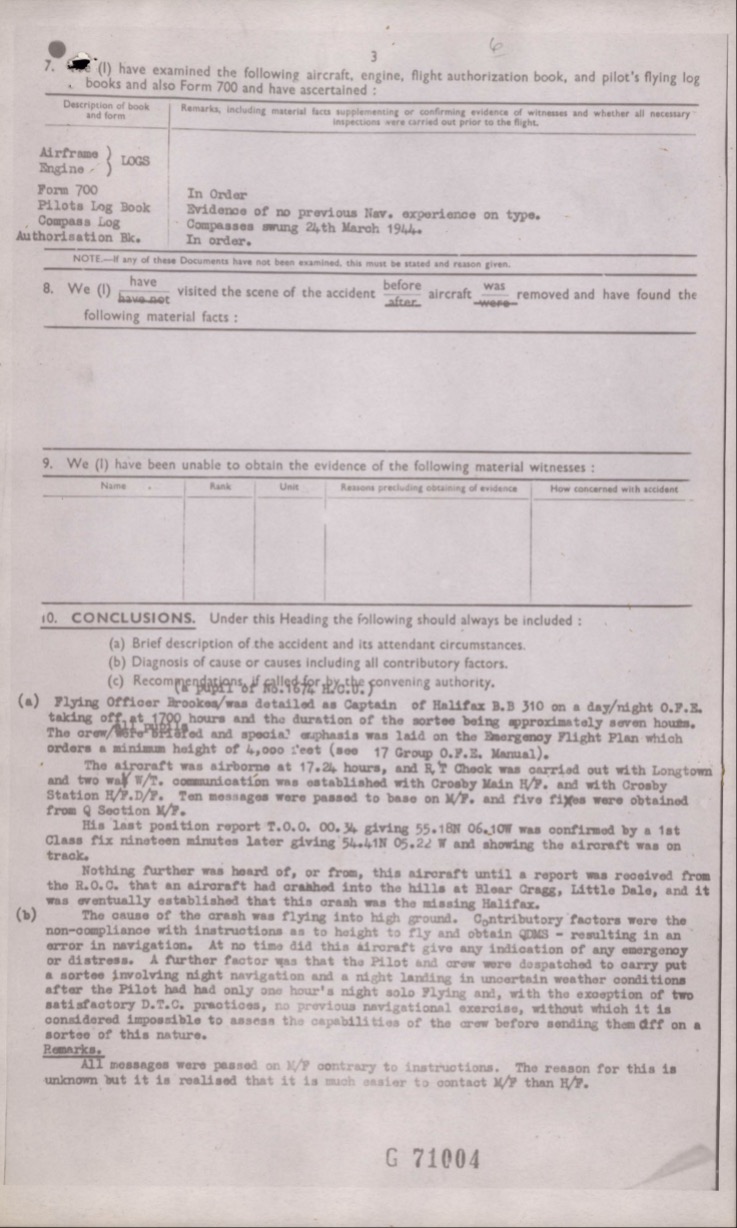
Court of Enquiry 3
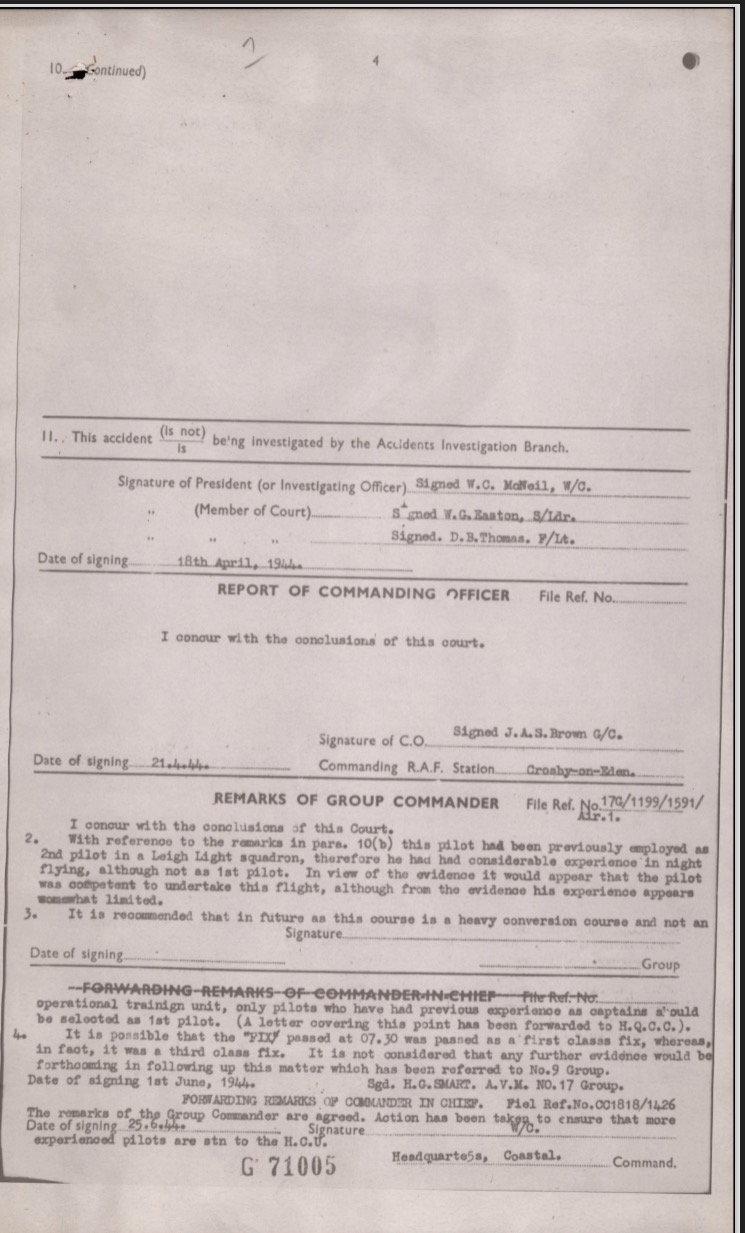
Court of Enquiry 4
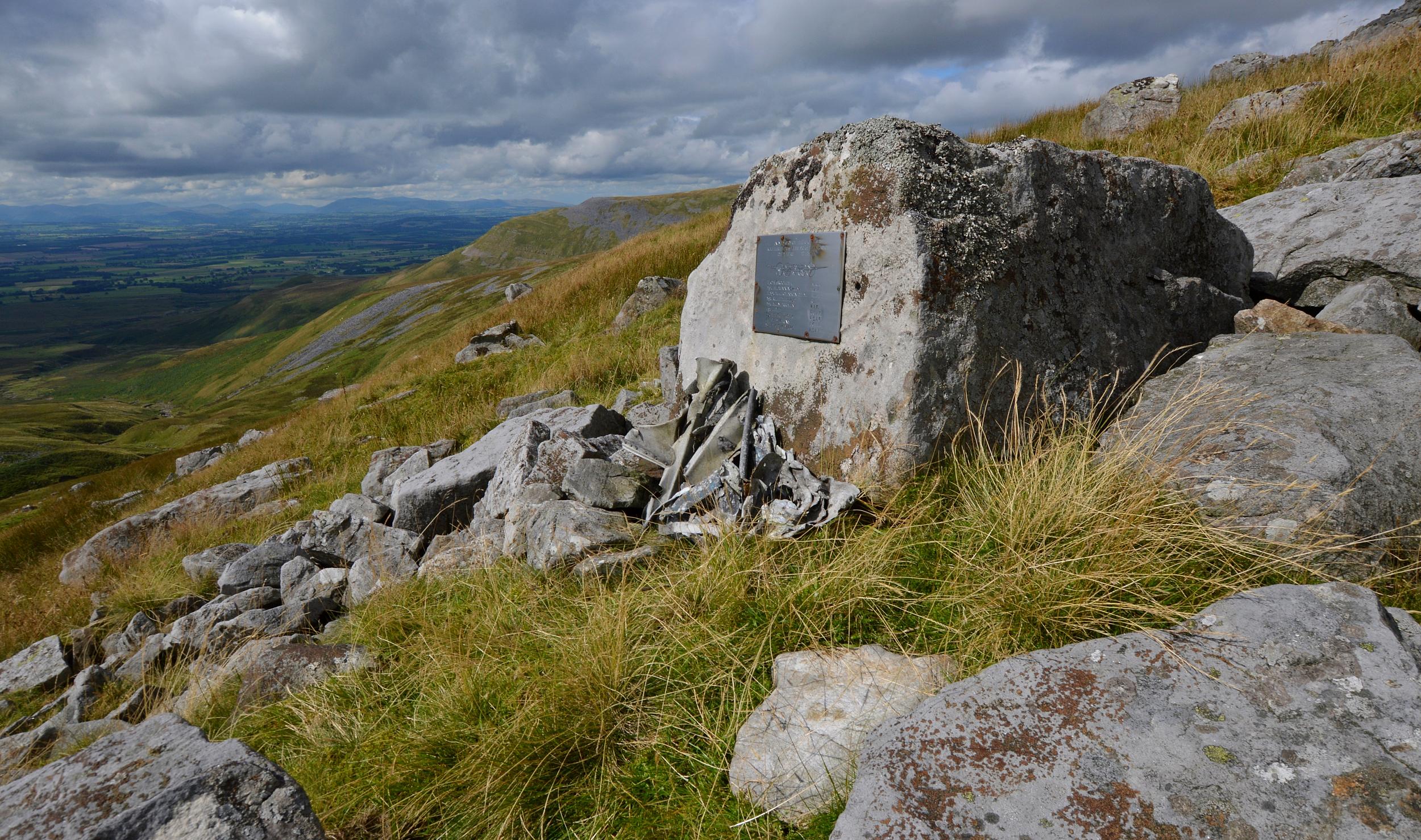
Crash Site Memorial
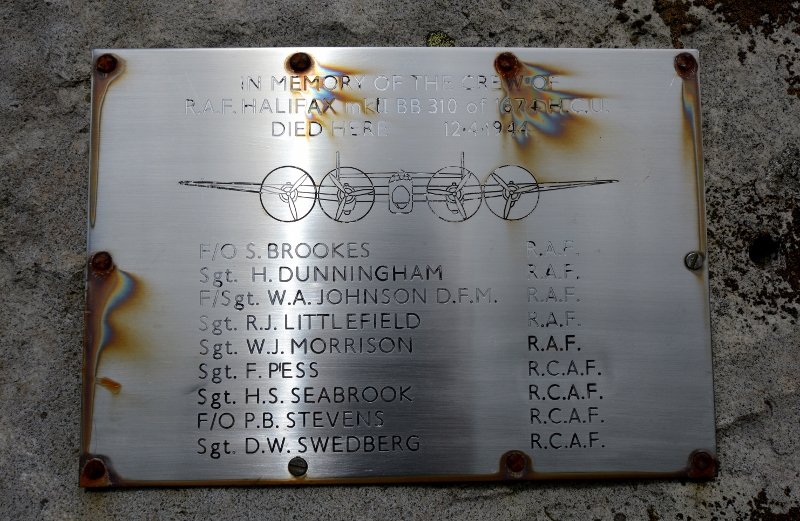
Crash Site Memorial Plaque
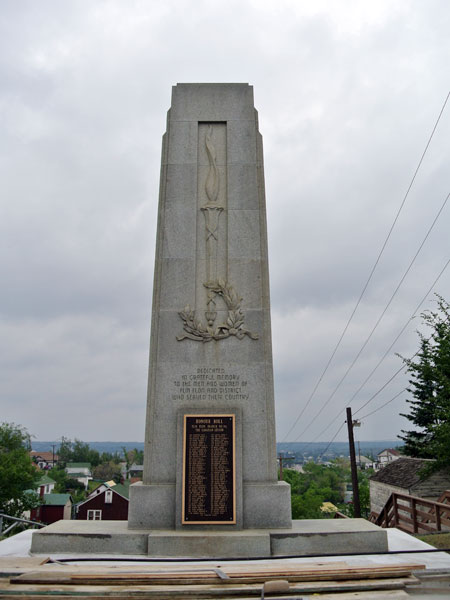
Flin Flon Cenotaph
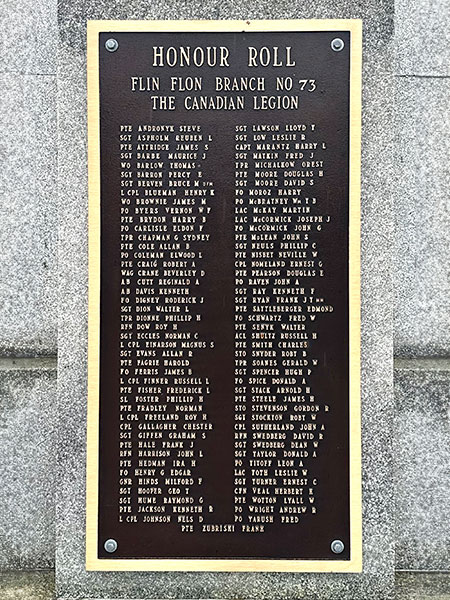
Flin Flon Honour Roll at Cenotaph
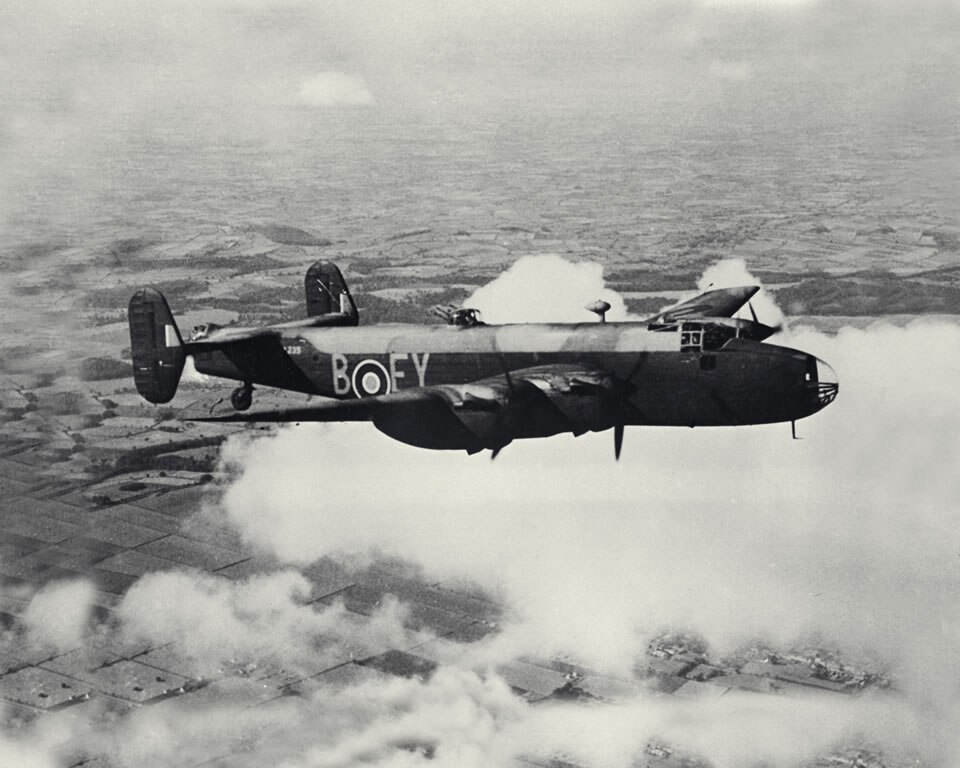
Halifax II bomber