


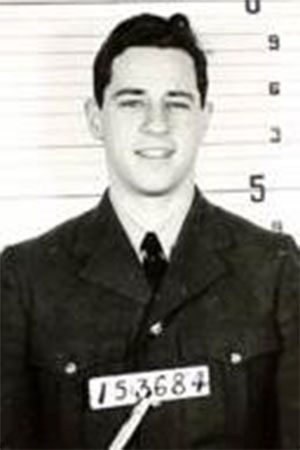
John Haig's Story.
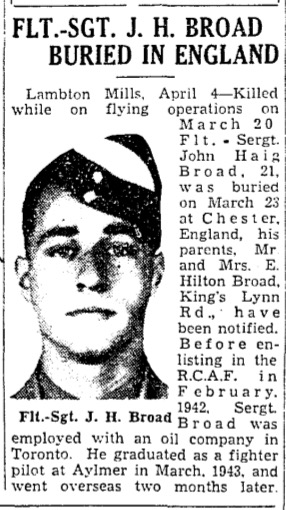
Jack Broad was born in Dundas, Ontario on September 5, 1922, the first child of Earl Hilton Broad and Beatrice May Adair.He left school in 1941 with his Junior Matriculation and had two credits towards his Senior Matriculation. On April 28, 1941, Jack started as a junior clerk in the purchasing department of Imperial Oil and he took a night school course in Accounting. When it was announced that RCAF enlistment would be expanded to all men, not just university graduates and licenced pilots, Jack joined the air force on January 21, 1942.
Like all Toronto area recruits, he spent six weeks at the Exhibition grounds taking basic training. On March 25, he was sent to the Technical Training School in St. Thomas, Ontario. This was the facility where RCAF ground crew were trained in aircraft mechanics.
On June 9, he returned to Toronto to No. 6 Initial Training School, where recruits spent several weeks taking theory courses like Navigation and Meteorology.
He continued at No. 12 Elementary Flying Training School in Goderich, Ontario on August 16. Jack and the other trainees were given 50 hours of basic flying instruction in a Tiger Moth trainer. By the end of the course, Jack was able to solo for over 38 hours during daylight, but for only 15 minutes at night. It had been determined at a medical examination in June that his night vision was below average. He graduated from the course on November 6 1942
The next stop for Jack on the Commonwealth Air Training Plan was to No. 14 Service Flying Training School in Aylmer, Ontario on November 22. This program was 16 weeks long. In the first half of the course, the students were part of an intermediate training squadron, then did six weeks of advanced training and two weeks of Bombing and Gunnery school. The base flew Harvard trainers, a plane that helped pilots transition from the Tiger Moth bi-planes to the operational fighters like the Spitfire and Hurricane.
Jack won his pilot's wings on March 19, 1943. His instructor felt that he was an above average pilot with “natural skill and instrument flying” and was given embarkation leave. He returned to his family in Toronto and then reported to Halifax on April 3, to await a ship to Britain. In mid-May, he departed Canada and arrived in Britain on May 24.
All RCAF members arriving in Britain first reported to the Personnel Reception Centre in Bournemouth, England to await their assignment.
Jack was assigned to No. 7 Advanced Flying Unit for pilots on June 15. It was located at RAF Peterborough.
Once the Peterborough course ended, Jack was given a lengthy leave until his next posting. On September 19, he was promoted to Flight Sergeant and two days later he began the course at No. 55 Operational Training Unit (OTU), which was based at RAF Annan, in Dumfrieshire, Scotland, not far from the English border. At the time, the unit was flying Miles Masters, a two seat training plane, and Hawker Typhoons.
Jack served with the unit when he was attached to RAF Woodvale, near Liverpool, England, on November 11. A week later, he was attached to RAF Great Orton, near Carlisle, England and not far from RAF Annan. He was given leave from December 12 but was recalled 16 days early , on December 27, to join No. 1 Tactical Exercise Unit (TEU). It was located at RAF Tealing, about 10 kilometres north of Dundee, on Scotland's east coast. The unit flew Hurricanes, but began to take possession of Spitfires in February, 1944. Jack was sent to Glasgow for a training course from January 18 to 20, 1944. On the first of March, he was transferred to No. 4 Tactical Exercise Unit. No. 55 OTU at Annan had been disbanded and was redesignated as a TEU, flying Hurricanes. Jack's training continued, including air target shooting, low level bombing and night exercises.
On March 18, 1944 he was made a Warrant Officer. On March 20, Jack took up Canadian built Hurricane AF 970 on a night flying exercise. When near Castle Carrock 8 kilometres west of Carlisle, he dove out of a low cloud and was killed instantly when he flew into the side of a hill.
Jack was given a full military funeral two days later at Blacon Cemetery near Chester.
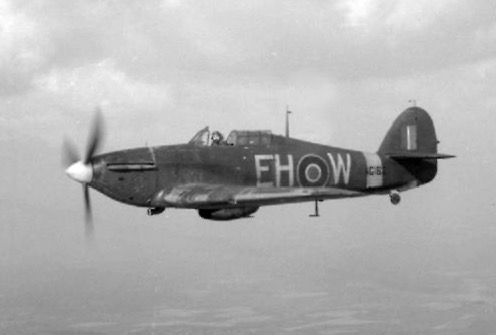
55 OTU Hurricane