


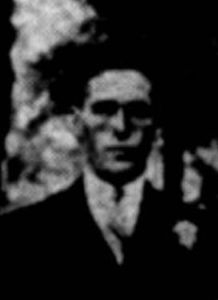
Charles's Story.
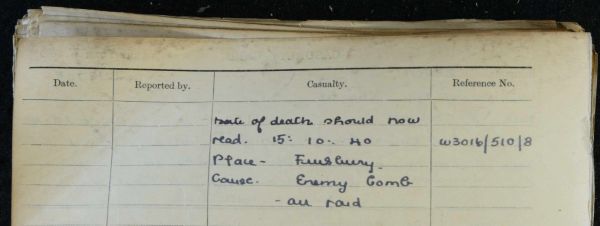
Sapper Charles Beech of the Royal Engineers was killed in an air raid in Finsbury, Islington, London, on the night of 15th October 1940. He was 24 years old, and left a widow, Olive, and an infant son John Arthur. Note that some records show his date of death as 16th or 17th October.
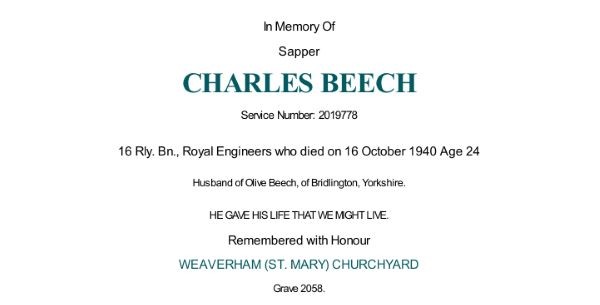
CWGC certificate
CWGC certificate
Charles was born on 25th July 1916, at Acton Bridge near Northwich, and was baptised at St Mary's Church, Weaverham, on 10th August 1916. He was one of fifteen children born to John Beech (1878–1928) and Mary Ann Chambers (1882–1981). Because he was one of the youngest of their children, by the time he was born he already had a nephew (Stephen Poole) of almost his own age. His father was a waterman, transporting salt or chemicals along the inland waterways of Cheshire and Staffordshire, and the family lived aboard a canal boat. In April 1911 they were on the vessel "Alice", berthed on the Bridgwater Canal, at Runcorn, Cheshire.

A canal boat similar to the "Alice"
In the June 1921 census, Charles (aged 4 years and 11 months) was shown with his parents and eight of his siblings living at Acton Bridge. By that time, several of his brothers and sisters had died at a young age - John aged 2 (1901–1903), Alice aged 5 (1906–1911) and Albert aged 8 (1912–1920).
A canal boat similar to the "Alice"
In the June 1921 census, Charles (aged 4 years and 11 months) was shown with his parents and eight of his siblings living at Acton Bridge. By that time, several of his brothers and sisters had died at a young age - John aged 2 (1901–1903), Alice aged 5 (1906–1911) and Albert aged 8 (1912–1920).
In 1928, his father John died at fifty years old. His mother Mary was left with six children under the age of 14, including Charles. Their canal boat was named the "Annie". 11-year-old Charles gained a stepfather in June 1928, when Mary married James Hollinshead (1878 - 1937), another waterman aboard the boat "Supreme".

Mary and his stepfather lived at Acton Bridge. They appear to have had a stormy relationship. In January 1934, James was charged with hitting her with a bottle. (At this time, Mary's son, Charles, was aged 17)


His mother was widowed again in 17th October 1937 when James died at Rookery Bridge, in Sandbach. Mary was living at 32 Heath Road, Owley Wood, Weaverham in 1937 and in 1939. Mary died at Barnton, Northwich, in 1981 aged 99.
Mary and his stepfather lived at Acton Bridge. They appear to have had a stormy relationship. In January 1934, James was charged with hitting her with a bottle. (At this time, Mary's son, Charles, was aged 17)
His mother was widowed again in 17th October 1937 when James died at Rookery Bridge, in Sandbach. Mary was living at 32 Heath Road, Owley Wood, Weaverham in 1937 and in 1939. Mary died at Barnton, Northwich, in 1981 aged 99.
Marriage to Olive Roughley
On 2nd October 1937, when he was 21, Charles married 18--year-old Olive Roughley (1919 - 2001) in St Mary's Church, Weaverham. His occupation was shown as Motor Driver. He was a motor mechanic with Messrs Samuel Hutton Ltd. They lived at 14 Morris Drive, Weaverham, next door to his parents-in-law at number 12.


In the early summer of 1939, Charles and Olive had a son, John Arthur Beech (1939 - 2021). The 1939 Register shows the family living at 14 Morris Drive.
On 2nd October 1937, when he was 21, Charles married 18--year-old Olive Roughley (1919 - 2001) in St Mary's Church, Weaverham. His occupation was shown as Motor Driver. He was a motor mechanic with Messrs Samuel Hutton Ltd. They lived at 14 Morris Drive, Weaverham, next door to his parents-in-law at number 12.
In the early summer of 1939, Charles and Olive had a son, John Arthur Beech (1939 - 2021). The 1939 Register shows the family living at 14 Morris Drive.
When the war started, Charles enlisted into the Royal Engineers, into the 16th Railway Battalion. In October 1940, he was based at the Central London Technical Training Group. An air raid on the night of 15th October caused devastating damage to an air raid shelter in the basement of Dame Alice Owens Girls' School. A high-explosives landmine was dropped by parachute which caused a collapse of the building plus flooding. We know it was a parachute bomb that hit the school because a soldier saw it when he stepped out of the shelter for a cigarette. 109 civilians died that night, in addition to some service personnel who were present in the shelter. Charles' body was found the following day. His wife Olive was widowed at the age of 21. She went on to have other children, including a daughter called Hilary. In 1960, she married Janusz (John Paul) Kandzia (1914–1967). Olive died in 2001, aged 81.

“The night of 15 October 1940 was the night of the heaviest air raids of the autumn. Flying conditions were good with a full moon and 400 bombers attacked London, dropping incendiary bombs and high explosives. On this night about 150 people, who mainly lived in the surrounding area, had come to sleep in the public air raid shelter in the basement of Dame Alice Owen’s Girls’ School.


(Image: Girls' School pre 1940, and memorial structure in the Peace Garden created on its site in 2005 - credit to D. Eade)
The school building stood 50 metres south of the commemorative panels. There were many families with children and elderly people.
At 20.07 hours, as people were settling in for the night, a large parachute high explosive bomb – a land mine – hit the school directly and most of the building collapsed. The explosion also shattered the major water main (The New River) in front of the building, which ran to the reservoir near Sadler’s Wells. People were crushed or trapped in the basement, which began to fill with water.
Local people started rescue work immediately. They were later joined by uniform services, who were dealing with incidents all over London. Some people were rescued, including the school caretaker’s wife, Mrs Burley, who was photographed being carried from the ruins 17 hours after the bomb fell. The picture was sent all over the world and became an icon of the London Blitz.

But the majority died in the shelter or afterwards in hospital. The last bodies arrived at the mortuary on 8th November after more than three weeks of recovery work. Seventeen of the bodies were unidentified. The names, which are known of those who died, are recorded on the panels. Throughout London, 430 people were killed on the night of 15th October and there was huge damage to water, gas and electricity supplies and to five major railway stations.”

Charles' body was recovered on 16th October, and he was buried at St Mary's Church in Weaverham on 23rd October 1940.

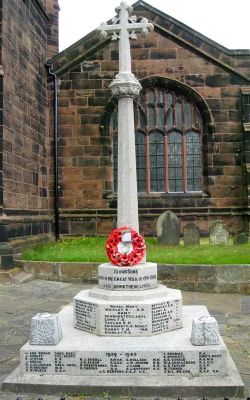
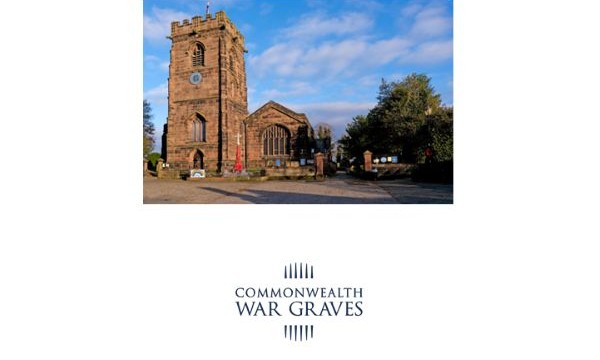
St Mary's Church, Weaverham
His name appears on the War Memorial at the church, but unfortunately with the wrong initial.
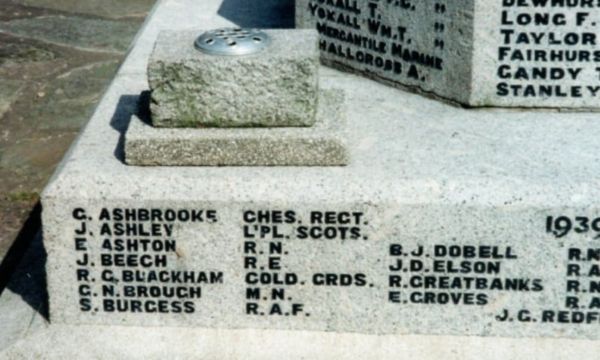
The inscription on the nearby war memorial incorrectly lists him as J Beech.
Other memorials
"A SOLDIER who is buried in Weaverham will be commemorated on a special roll of honour at a service for the Corps of Royal Engineers next week. Private Charles Beech, who served with the corps during the Second World War and died on October 16, 1940, aged 24, is buried in St Mary's Church."
In October 2002, a restored Stanier 8F class locomotive engine, which had served with the Corps of the Royal Engineers, was used to transport visitors to a remembrance service at Kidderminster. Charles' name was included in two books of remembrance held by the Royal Engineers Museum at Chatham and the Museum of Army Transport at Beverley.

Air raid site in Islington
In October 2005, a memorial structure was unveiled on the site of the bombed school in London, with a board showing the names of the 109 known civilian casualties. There were also 17 unidentified bodies, and the names of service personnel, including Charles, were not included on the board. The installation was designed by Matt Moate to resemble an Anderson shelter. It is located within the Peace Garden of Capital City College, at Goswell Road, Islington.


Memorial structure and plaque in the Peace Garden of Capital City College, Goswell Road, Finsbury, Islington
Researched by Shena Lewington (October 2025)
“The night of 15 October 1940 was the night of the heaviest air raids of the autumn. Flying conditions were good with a full moon and 400 bombers attacked London, dropping incendiary bombs and high explosives. On this night about 150 people, who mainly lived in the surrounding area, had come to sleep in the public air raid shelter in the basement of Dame Alice Owen’s Girls’ School.
(Image: Girls' School pre 1940, and memorial structure in the Peace Garden created on its site in 2005 - credit to D. Eade)
The school building stood 50 metres south of the commemorative panels. There were many families with children and elderly people.
At 20.07 hours, as people were settling in for the night, a large parachute high explosive bomb – a land mine – hit the school directly and most of the building collapsed. The explosion also shattered the major water main (The New River) in front of the building, which ran to the reservoir near Sadler’s Wells. People were crushed or trapped in the basement, which began to fill with water.
Local people started rescue work immediately. They were later joined by uniform services, who were dealing with incidents all over London. Some people were rescued, including the school caretaker’s wife, Mrs Burley, who was photographed being carried from the ruins 17 hours after the bomb fell. The picture was sent all over the world and became an icon of the London Blitz.
But the majority died in the shelter or afterwards in hospital. The last bodies arrived at the mortuary on 8th November after more than three weeks of recovery work. Seventeen of the bodies were unidentified. The names, which are known of those who died, are recorded on the panels. Throughout London, 430 people were killed on the night of 15th October and there was huge damage to water, gas and electricity supplies and to five major railway stations.”
Charles' body was recovered on 16th October, and he was buried at St Mary's Church in Weaverham on 23rd October 1940.
St Mary's Church, Weaverham
His name appears on the War Memorial at the church, but unfortunately with the wrong initial.
The inscription on the nearby war memorial incorrectly lists him as J Beech.
Other memorials
"A SOLDIER who is buried in Weaverham will be commemorated on a special roll of honour at a service for the Corps of Royal Engineers next week. Private Charles Beech, who served with the corps during the Second World War and died on October 16, 1940, aged 24, is buried in St Mary's Church."
In October 2002, a restored Stanier 8F class locomotive engine, which had served with the Corps of the Royal Engineers, was used to transport visitors to a remembrance service at Kidderminster. Charles' name was included in two books of remembrance held by the Royal Engineers Museum at Chatham and the Museum of Army Transport at Beverley.
Air raid site in Islington
In October 2005, a memorial structure was unveiled on the site of the bombed school in London, with a board showing the names of the 109 known civilian casualties. There were also 17 unidentified bodies, and the names of service personnel, including Charles, were not included on the board. The installation was designed by Matt Moate to resemble an Anderson shelter. It is located within the Peace Garden of Capital City College, at Goswell Road, Islington.
Memorial structure and plaque in the Peace Garden of Capital City College, Goswell Road, Finsbury, Islington
Researched by Shena Lewington (October 2025)