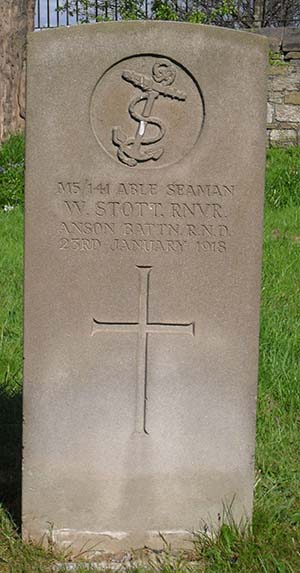
William's Story.
Birkenhead News 8 September 1915
Shot in the Knee
YET GOT DOWN A CLIFF
Able Seaman Wm. Stott, 5, Gladstone Street, Birkenhead, is one of those who have been in the war from the beginning. He belongs to the Anson Battalion, and was in the siege of Antwerp, and later was sent out to the Dardanelles. At the present time he is in hospital in Malta, having been wounded on April 28th, but he is progressing favourably.
In a letter home, written on August 7th, Stott says he was in the thick of the battle from April 25th to 28th. The battleships were sending in a terrific bombardment. He was engaged taking ammunition up to the firing line, and when about 50 yards off he was shot in the knee. “But,” Stott immediately adds “we haven’t half given them a shaking up!” When he got the shot, he looked up the field but could see no one, so he fell flat on his stomach and crawled about half a mile before he could get into a safe place. He came to a big cliff, close to the sea-shore, and “got down it somehow,” about 20 feet, and then, fortunately, he saw a couple of scouts, and they bandaged up his knee and carried him about a mile to a small boat, on which he was taken to a hospital ship.
Stott told his mother not to worry about the wound, as it was not serious, and he hoped he should be home before too long.
- - - - - - - - - - - - - - - - - - - - - - - - - - - - - - - - - - - - - - - - - - - - - - - - - - - - - - - - - - - - - - - - - - - - - - - - - - - - - - - - - - - - - - -
William had joined the Royal Naval Volunteer Reserve (RNVR) in November 1913 and after having spent sometime in hospital because of the wound to his leg was discharged to resume his former work at Cammell Laird and Co, Birkenhead.
On January 21st 1918 William Stott, then aged 24 was employed as a caulker on a vessel on the slips, when he dropped a tool which fell to the bottom of the hull. He started to go down a ladder which was resting against the shell of the ship, but the ladder twisted sideways, and he fell off dropping 24 feet. He sustained a fracture of the skull. William was removed to the Borough Hospital, Birkenhead where he lain in an unconscious condition until the morning of the 23rd January, when he died.
A verdict of accidental death was recorded.
The Birkenhead News on 2 February 1918 gave a report of William’s funeral at Flaybrick Cemetery, Birkenhead. As well as being attended by many family members, about 40 men of the RNVR (commanded by Petty Officer J Crighton) formed a procession in front of the funeral to the cemetery. A large number of his work mates also walked in the procession and the boilermaker’s union was well represented.
William left a widow, Isabella, a four month old son and his daughter who was born in 1918, a few months after he died.