


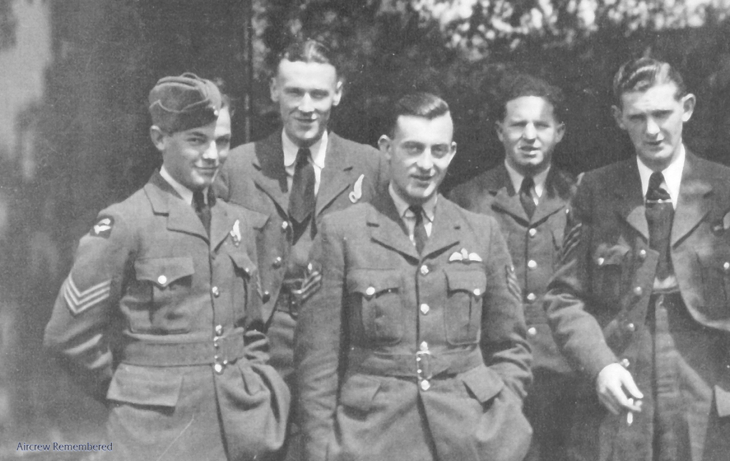
Norman Jones's Story.
Norman Jones Huxley was the son of Richard and Nellie Huxley of Altrincham, Cheshire. He trained as a Flight Engineer and joined 427 (Lion) Squadron Royal Canadian Air Force (RCAF) when they reequipped with Halifax V aircraft requiring 7 crew having previously flown Wellington aircraft requiring 5 crew members. The squadron was based at RAF Leeming in North Yorkshire.427 Squadron
Although it was an RCAF Squadron 427 was staffed with a mixture of RCAF and RAF personnel.
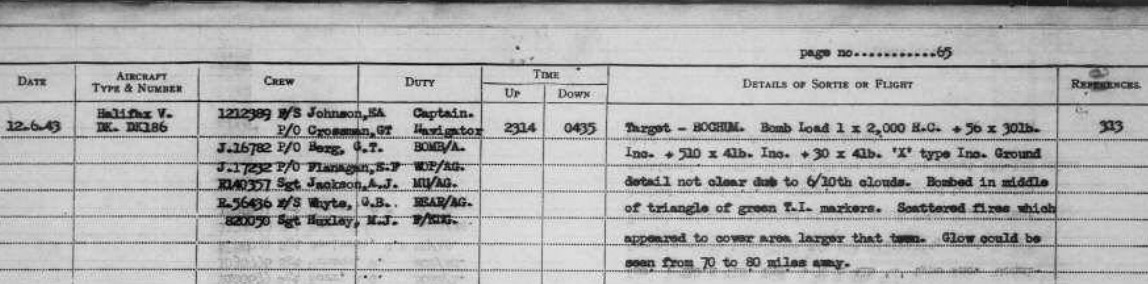
In May 1943, Metro-Goldwyn-Mayer Studios based in Hollywood, California offered to "adopt" the Royal Canadian Air Force's No. 427 Squadron that was flying Halifax Bombers. A special presentation was held on 24th May 1943 to formalize the relationship. Mr. Samuel Eckman Jr., managing director of M.G.M. (England), attended and the No. 427 commanding officer, Dudley Burnside, was present as well. Featured at the event was Halifax DK-186 (ZL-L). The bomber was painted with nose art featuring the M.G.M. lion (with wings) flying while holding a bomb between its paws. The bomber was named "London's Revenge". At the presentation a lottery was held to determine which crew could use the name of MGM star Lana Turner on their aircraft. Sgt Edward Arnold Johnson won the lottery and immediately wrote the star’s name on the nose of DK 186. EA Johnson was captain of Norman’s crew for 12 of his 13 missions and Norman flew in DK186 on 12th June 1943 on a mission to Hochum.
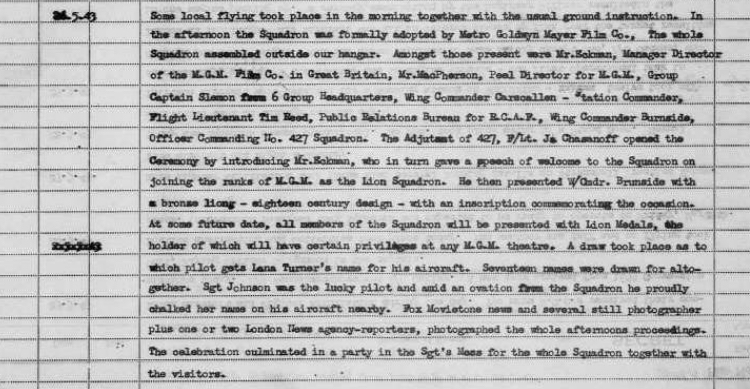
MGM Ceremony description taken from Operation Record

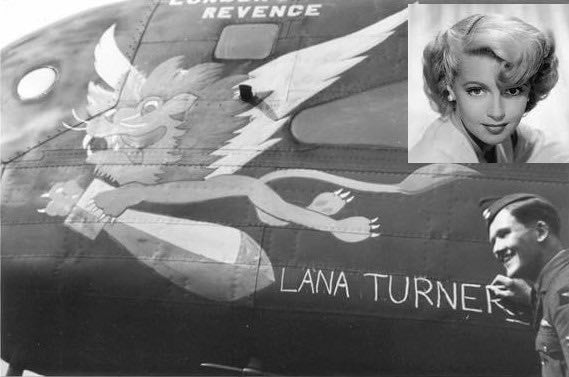
Sgt EA Johnson chalks Lana Turner's name on DK186
Norman’s Missions
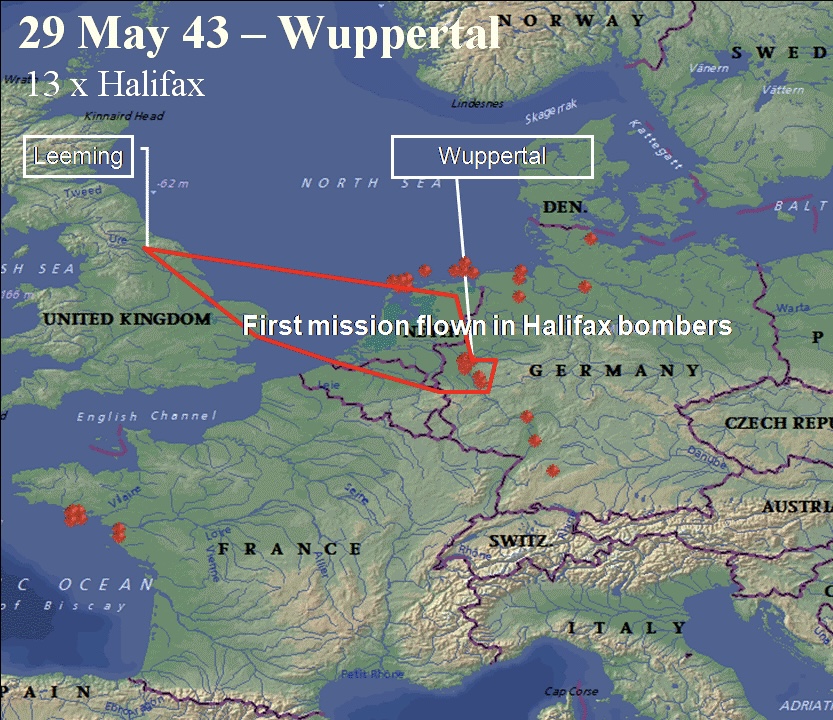
29/30 May 1943 Mission to Wuppertal
The RAF sent 611 heavy bombers to Wuppertal, an industrial city in the Ruhr region. They dropped nearly 300,000 incendiary bombs and 60 4,000lb heavy explosives. The bombing resulted in the deaths of at least 2,500 people and destroyed 90% of the town. The raid also caused extensive damage to factories, industrial premises, and homes. Norman flew in Halifax DK140 captained by Sgt EA Johnson on this mission.

Operation Record 29 May 1943
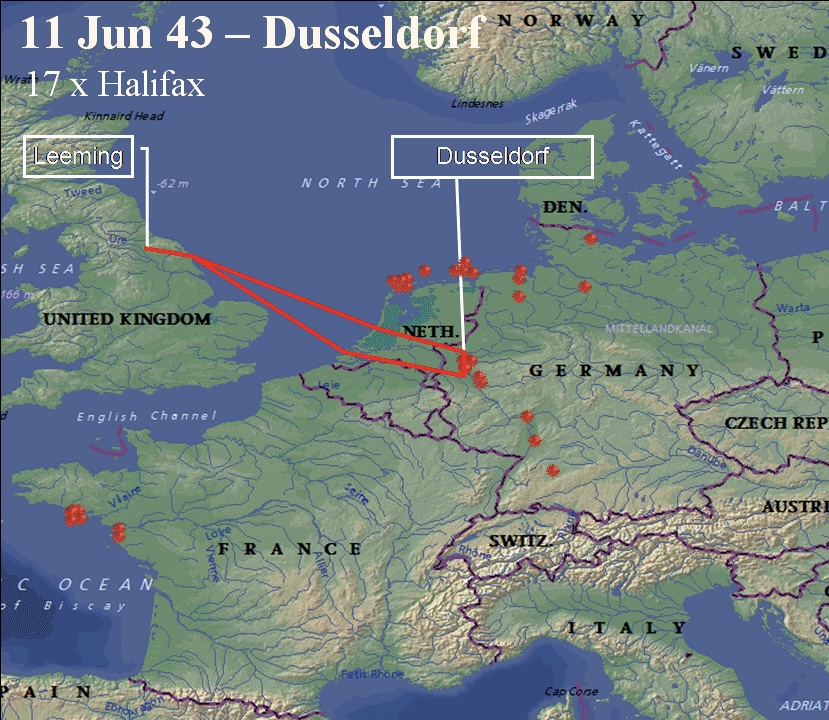
11th June 1943. Mission to Dusseldorf
326 Lancasters, 202 Halifaxes, 143 Wellingtons, 99 Stirlings, 13 Mosquitos. The Pathfinder Marking Plan proceeded excellently until an Oboe Mosquito inadvertently released a Load of target Indicators 14-miles north-east of the Target area. This caused part of the Main Force to waste its Bombs on Open Country. But the Main Bombing caused extensive damage in the Centre of Düsseldorf, where 130-acres were claimed as Destroyed, and this proved to be the most damaging Raid of the War for this City.
38 Aircraft – 14 Lancasters, 12 Halifaxes, 10 Wellingtons, 2 Stirlings – Lost, 4.9% of the Force. Norman flew in Halifax DK140 captained by Sgt EA Johnson.

Operation Record 11 June 1943
12th June 1943 mission to Bochum
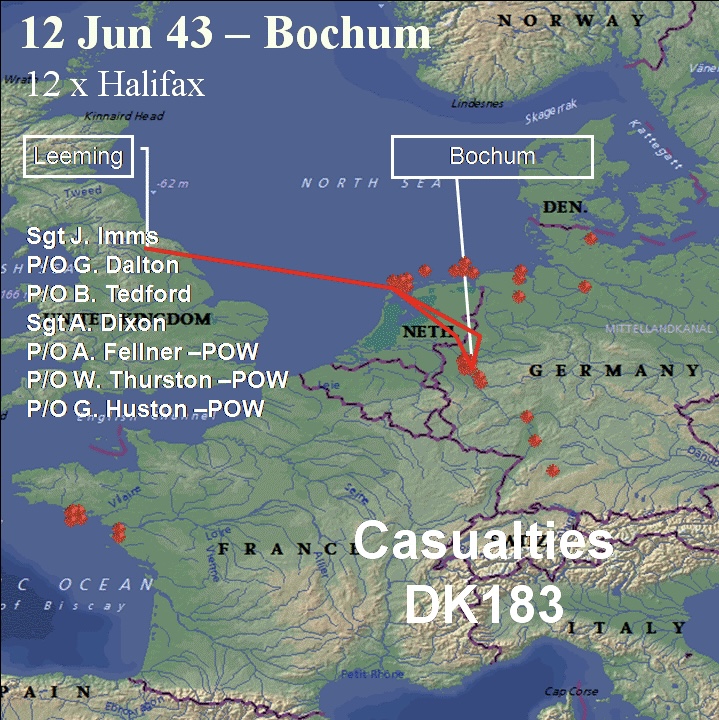
503 aircraft (323 Lancasters, 167 Halifaxes, 11 Mosquitos) 24 losses, 14 Lancasters, 10 Halifaxes, 4.8 per cent. Target covered by cloud but Oboe sky marking enabled Main Force to hit accurately the city centre. PR photographs revealed that 130 acres (53 ha) of the centre had been destroyed. German records revealed 312 people killed, 449 buildings destroyed and 916 severely damaged. Norman flew in DK186 with Sgt EA Johnson for this mission
Operation Record 12 June 1943
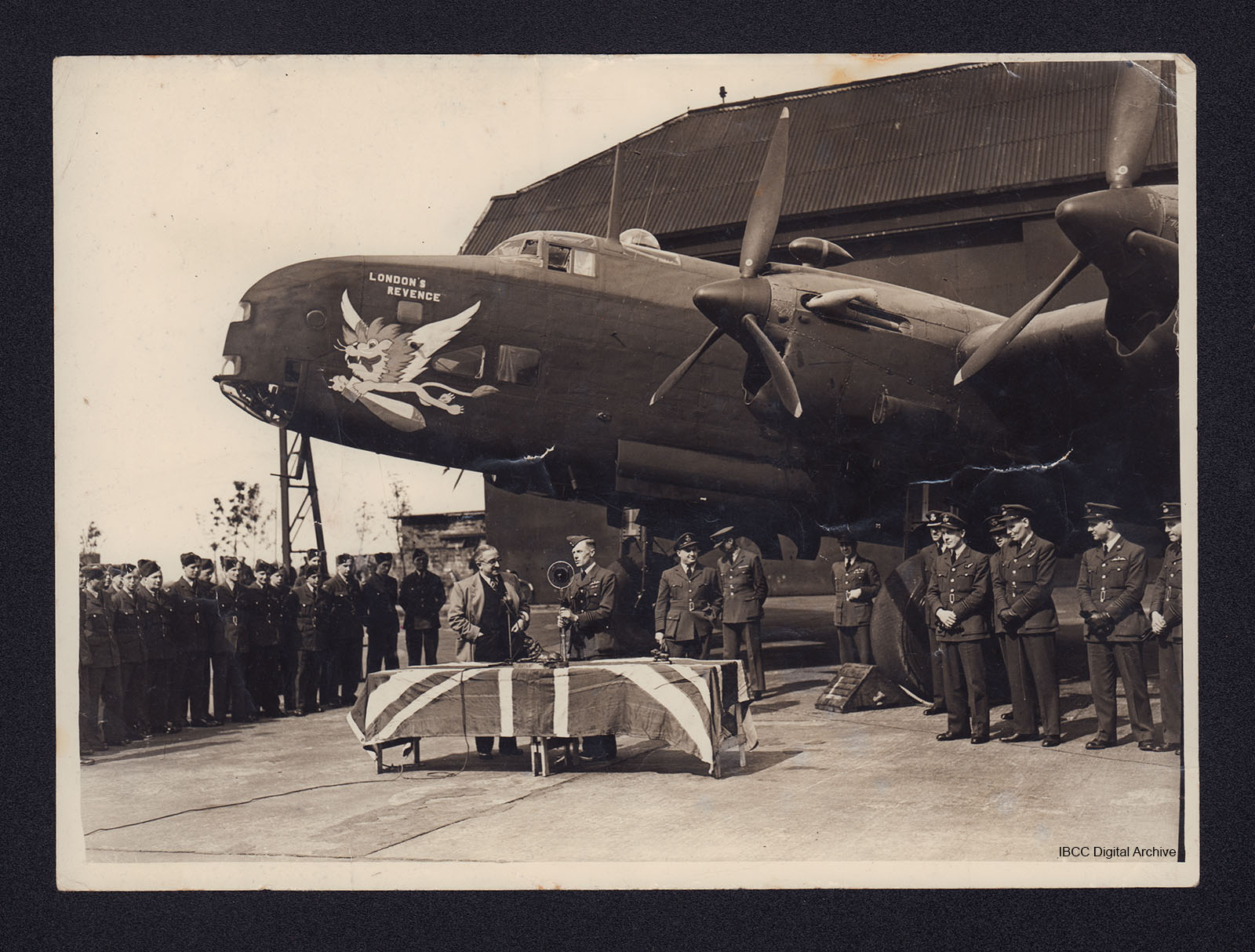
DK 186 flown in by Norman on 12 June 1943
19th June 1943 Mission to Le Creusot
On the night of June 19-20, 1943, Bomber Command launched a large-scale air raid on Le Creusot, France, targeting the Schneider armaments factory and the Breuil steelworks. This raid involved 290 bombers, mostly Halifaxes and Stirlings, with a significant portion of the bombload hitting the Schneider plant. Norman flew in DK181 with Sgt EA Johnson on this mission. 2 Halifaxes were lost on this raid.
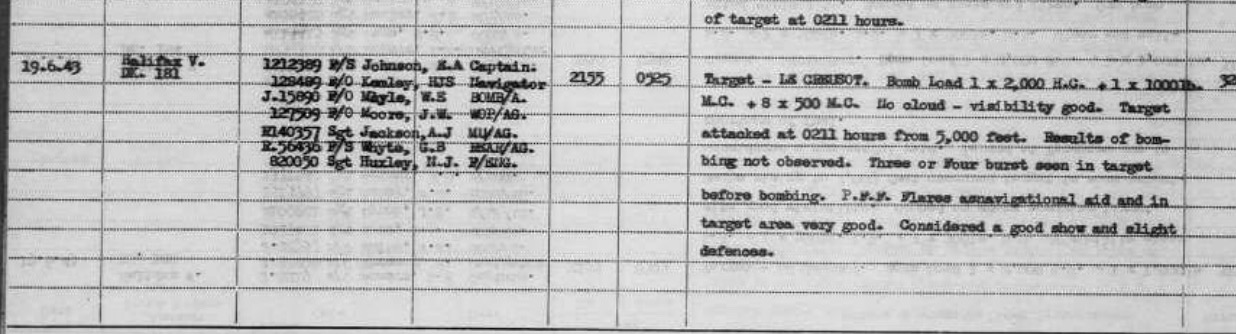
Operation Record 19 Jue 1943
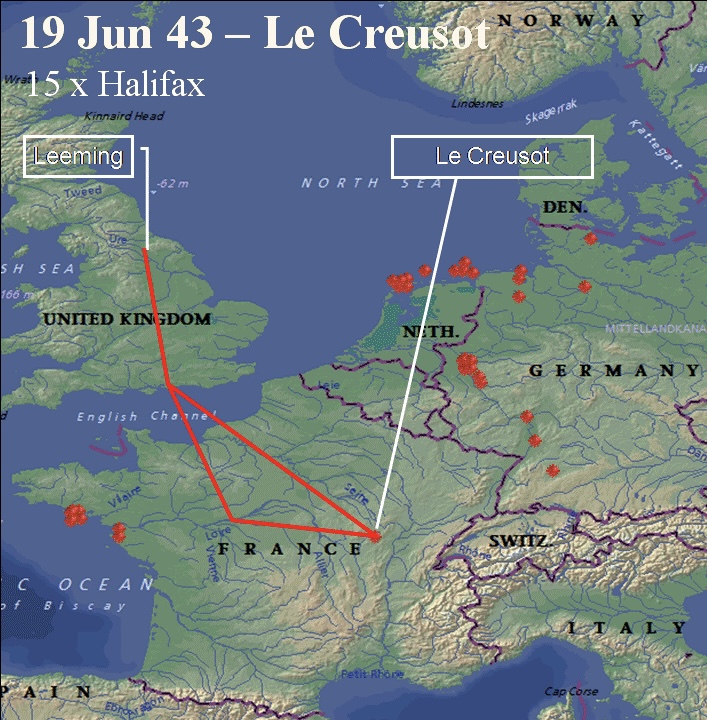
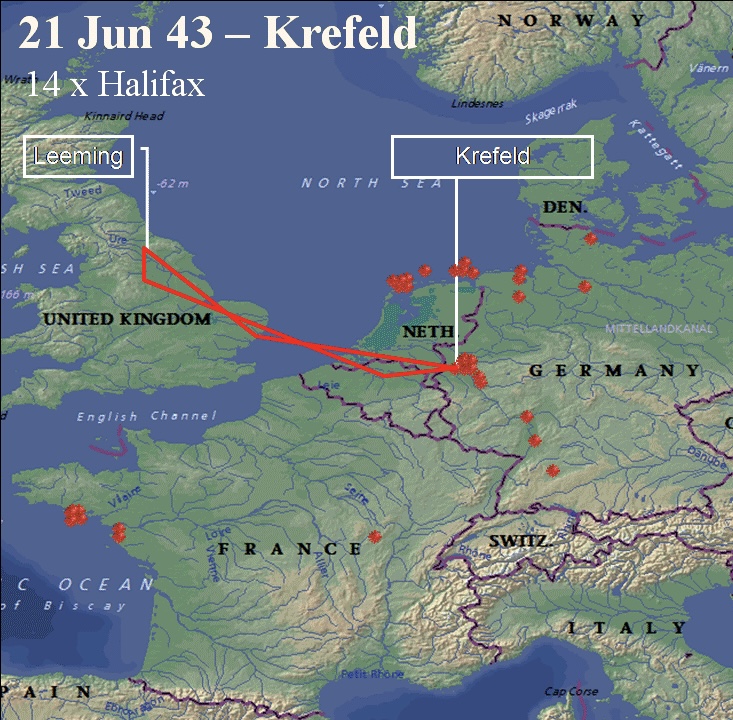
21st June 1943 Mission to Krefeld
On the night of June 21/22, 1943, Krefeld, Germany, was bombed by the RAF. The raid, involving 705 aircraft, severely damaged and destroyed parts of the city, including a large area of the city center. The raid resulted in significant casualties and extensive damage to infrastructure and housing. 44 aircraft were lost.Norman flew in DK 192’with Sgt EA Johnson on this mission.

Operation Record 21 June 1943
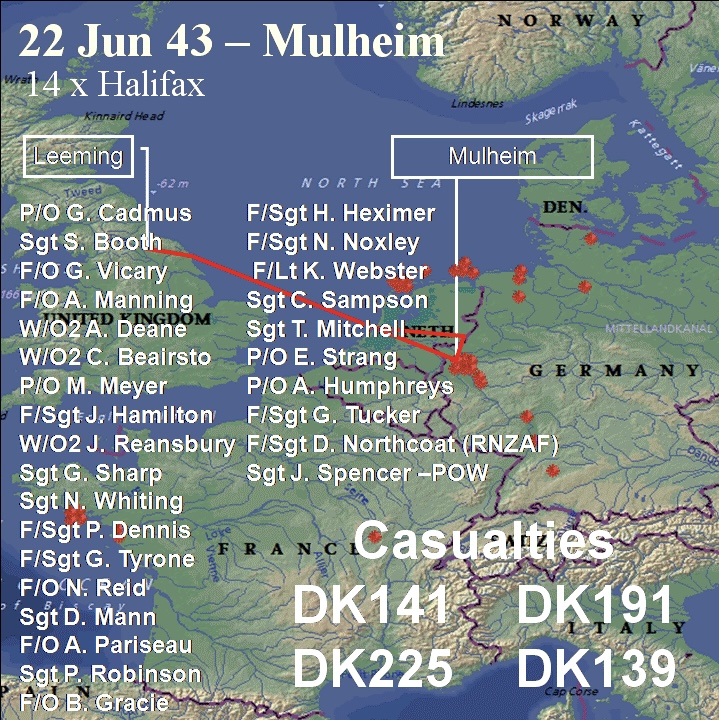
22nd June 1943 Mission to Mulheim
On the night of June 22-23, 1943, a large-scale RAF bombing raid on Mulheim, Germany, a key industrial center in the Ruhr Valley, took place. Approximately 557 bombers, including 155 Handley Page Halifaxes, participated in the operation. Norman flew in DK181 with Sgt EA Johnson on this mission.
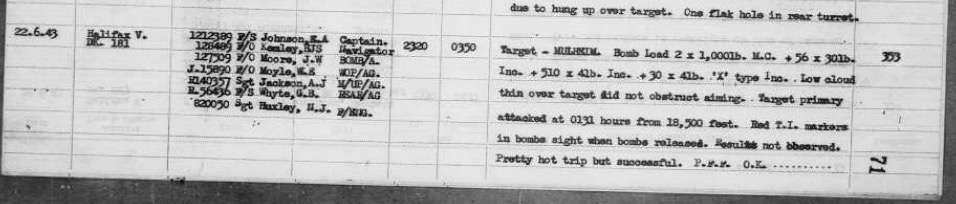
Operation Record 22 June 1943
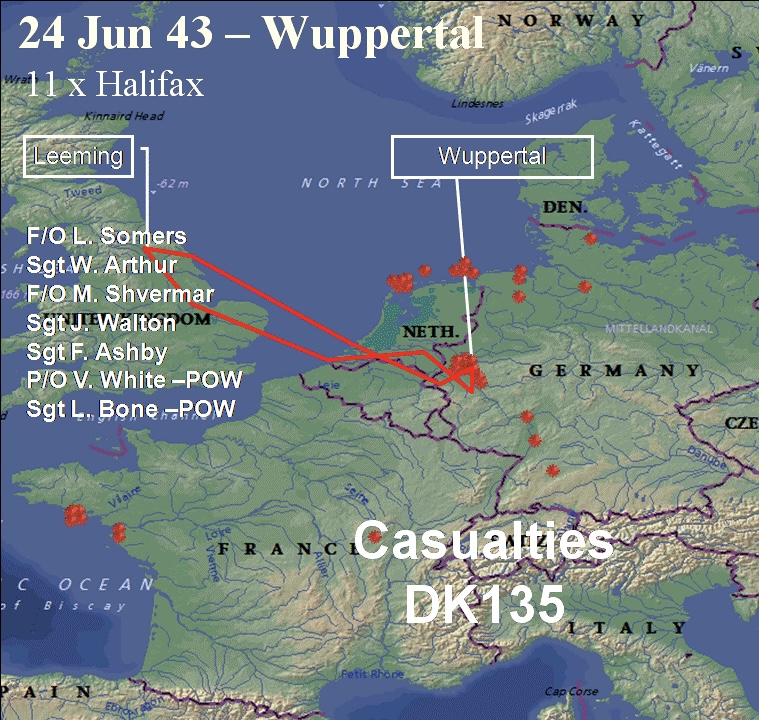
24th June 1943 Mission to Wuppertal
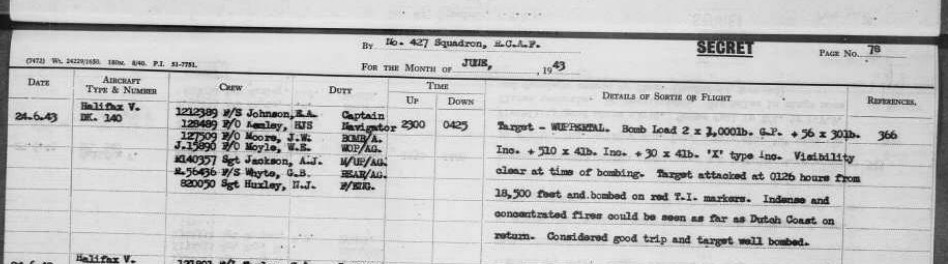
On the 24th June 1943 of 630 aircraft took part in an attack on Wuppertal. In the post-war bombing survey they were estimated to have destroyed 94% of the Elberfield target area - 3,000 houses and 53 industrial premises were destroyed. Almost the same number were seriously damaged. Around 1,800 people died. Norman flew in DK140 with Sgt EA Johnson on this mission.
Operation Record 24 June 1943
25th June 1943 raid on Gelsenkirchen
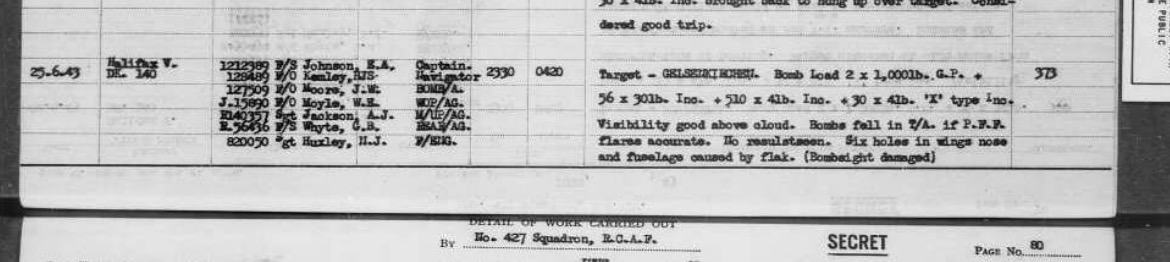
473 aircraft took part (214 Lancasters, 134 Halifaxes, 73 Stirlings, 40 Wellingtons, 12 Mosquitos), 30 losses, 13 Lancasters, 7 Halifaxes, 6 Stirlings, 4 Wellingtons, 6.3 per cent. Cloud cover; 5 of 12 Oboe-Mosquitos had unserviceable Oboe sets, Main Force scattered bombs over much of the Ruhr. German reports showed 16 people killed in Gelsenkirchen, 24 buildings destroyed, 3,285 damaged, 2,937 superficially and 21 killed with 58 injured at Solingen 30 mi (48 km) miles distant. Norman flew in DK140 with Sgt EA Johnson on this mission. When they returned to England they found that the aircraft had been hit 6 times by flak.
Operation Record 25 June 1943
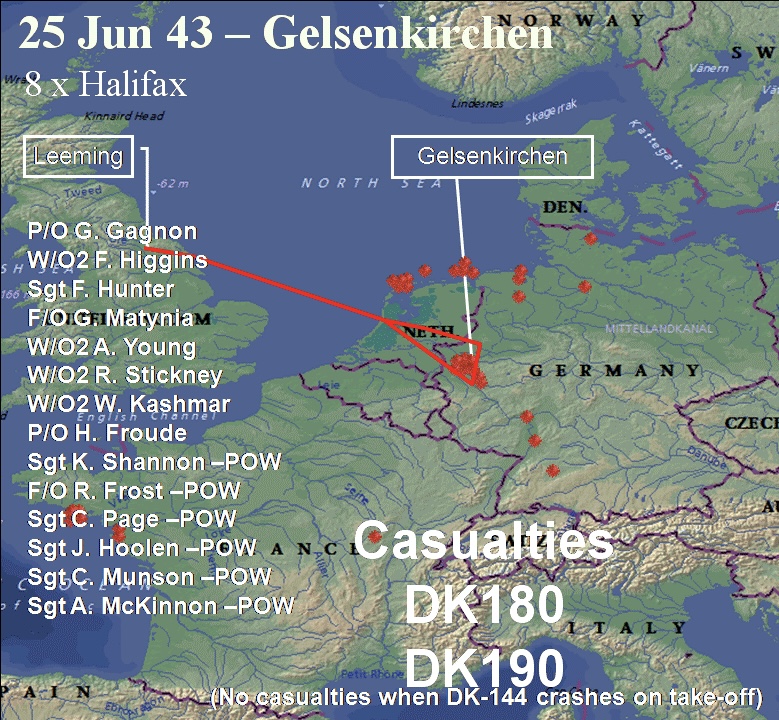
24 July 1943 Mission to Hamburg
This mission was first mission in a 10 day campaign to attack Hamburg ordered by Arthur Harris under the code name “Operation Gommorah” On this night 791 bombers were deployed. German radar was rendered useless by the use of Window aluminum strips that were dropped from the bombers to reflect the radar signals. Norman flew in EB 246 with Sgt EA Johnson.

Operation Record 24 July 1943
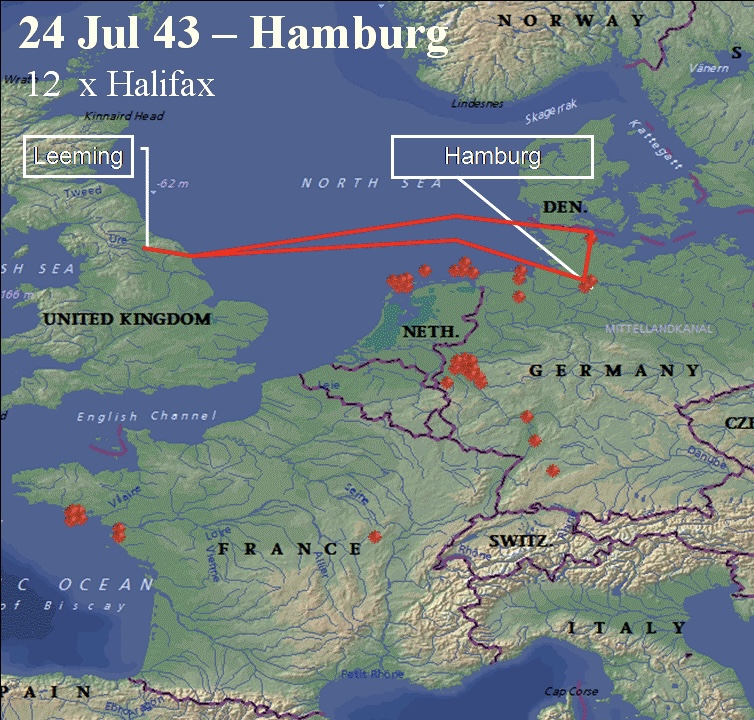
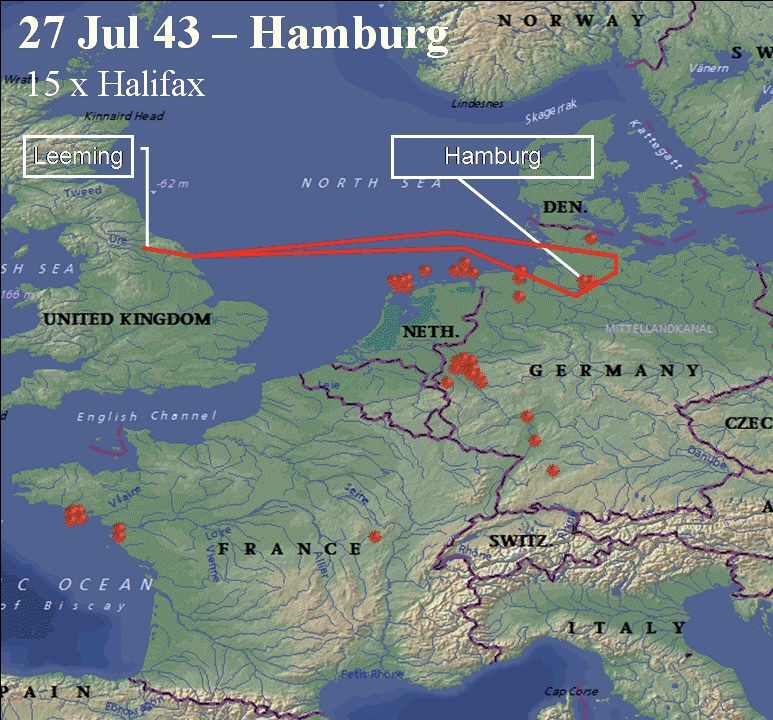
27th July 1943 Mission to Hamburg.
Another mission as part of Operation Gommorah. At 10:00 p.m. on July 27, Bomber Command launched 787 bombers, with pathfinders dropping yellow flares just after midnight. The 722 aircraft that made it to the target began dropping 1,174 tons of incendiaries at 1:00 a.m. The bombs continued to fall for the next 45 minutes. Landing largely in the eastern part of the city, fires began to rage. An RAF pilot later recalled: “We didn’t need any navigation. We could see Hamburg from over the North Sea lit up by fires and flares.Norman flew in DK234 with Sgt EA Johnson.


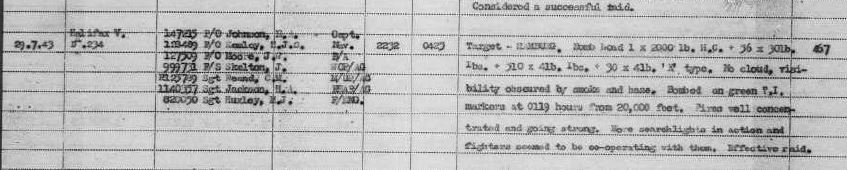
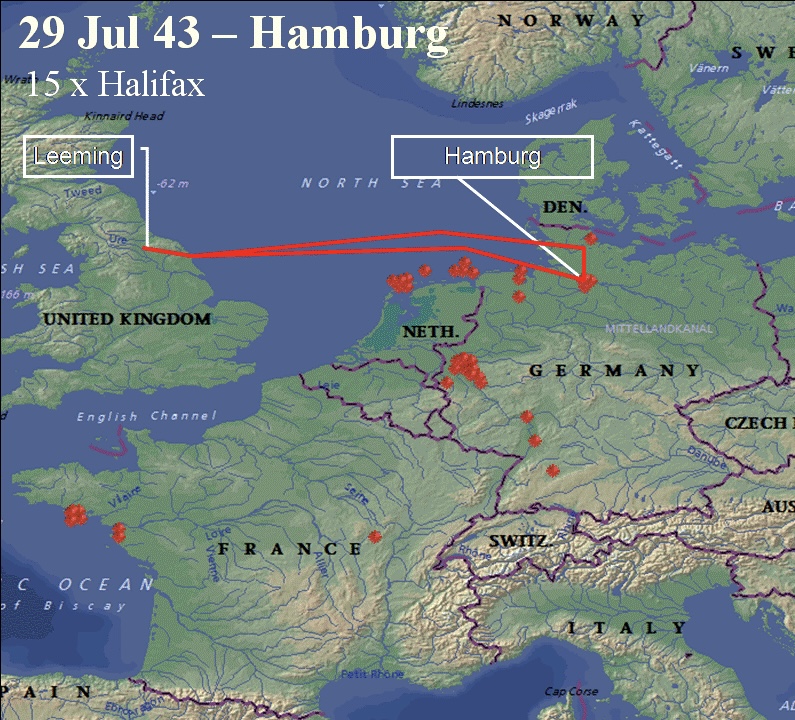
29th July 1943 Mission to Hamburg.
Another mission as part of Operation Gommorah with 777 bombers sent on the mission with 30 being lost. Norman flew in DK234 with Sgt EA Johnson.
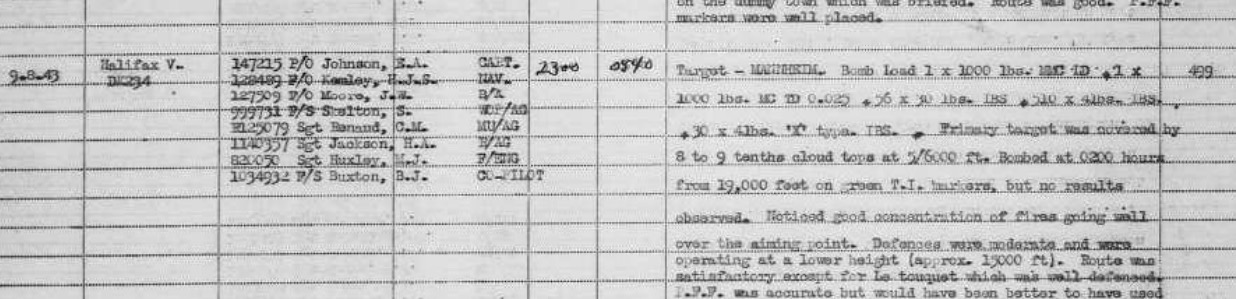
9th August 1943 Mission to Mannheim
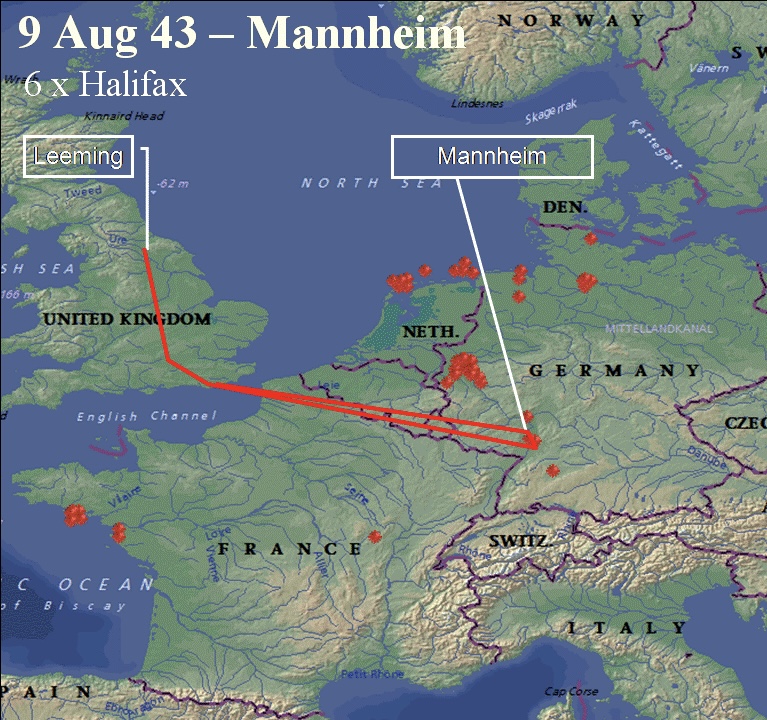
On this mission 457 aircraft were assigned to attack the BASF chemical plant at Mannheim. Norman flew in DK234 with Sgt EA Johnson.
Operation Record 9 August 1943
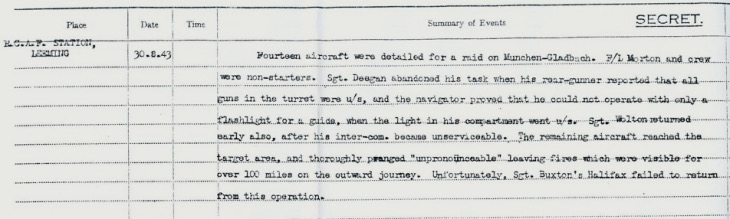
30th August 1943 Mission to Munchen Gladbach
This was Norman’s 13th and final flight. For some reason he flew with a different captain and crew for this mission.
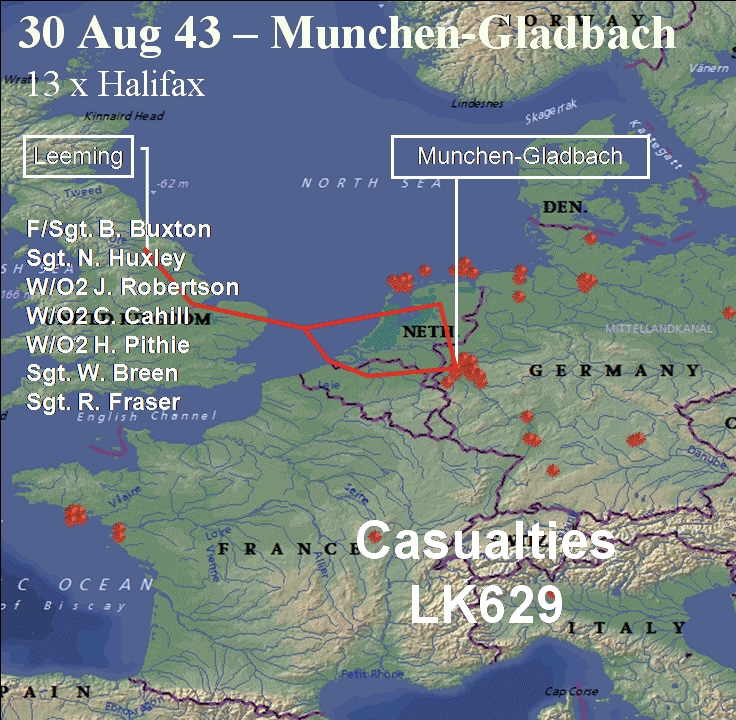
Norman flew in LK629 for this mission under Sgt Buxton as captain. Took off from RAF Leeming, Yorkshire at 23.58 hrs along with 14 others from the Squadron. Part of a 660 strong force to bomb Münchengladbach, (3) Germany.
Visibility was good this night and the pathfinders mission was classed as almost perfect. The bombing was very concentrated and although German reports are limited a total of 1,059 buildings were destroyed - 171 industrial, 19 military, 869 domestic with 117 people killed on the ground.
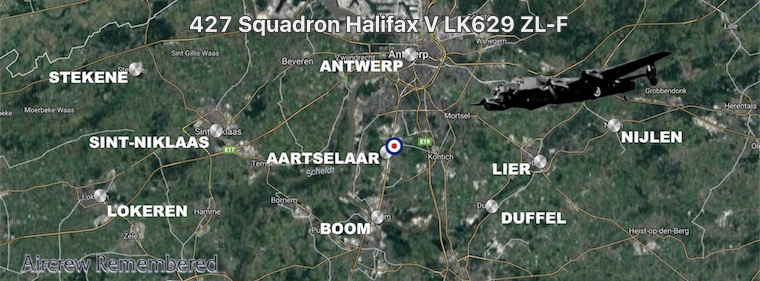
LK 629 failed to return from this mission and the crew were listed as missing. It was later determined that LK629 was shot down bu a German night fighter flown by Walter Schon of 1/NJG1 based at Arnhem and flying a Heinkel He219 night fighter. They were shot down on on the return flight from Germany. The plane crashed near the town of Aartselar south of Antwerp in Belgium with the loss of all 7 crew members. The crew were buried at Schoonselhof Cemetery at Antwerp.
Operation Record 30 August 1943
Crew of LK629
Pilot: Fl/Sgt. Bernard John Buxton 1034932 RAFVR Age 21. Killed
Fl/Eng: Sgt. Norman Jones Huxley 820050 RAF (Auxillary) Age 26. Killed
Nav: W/O.2 John Robertson R/103625 RCAF Age 20. Killed
Air/Bmr: W/O.2 Clement Bernard Cahill R/102903 RCAF Age 21. Killed
W/Op/Air/Gnr: W/O.2 Harold Cruse Pithie R/101308 RCAF Age 23. Killed
Air/Gnr. (M/U): Sgt. William John Breen R/58998 RCAF Age 24. Killed
Air/Gnr. (Rear): Sgt. Robert Anton Fraser R/176127 RCAF Age 20. Killed
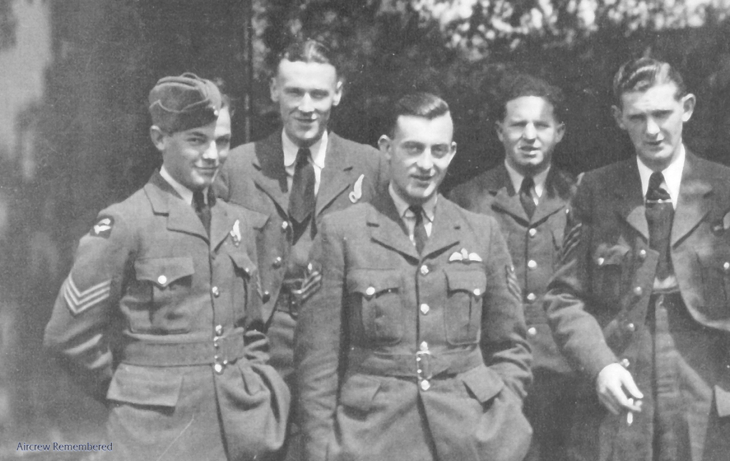
Crew of LK629
Note
1) Breen Island in Burntwood Lake, Manitoba is named after Sgt. Breen
(2) Fraser Lake in Saskatchewan is named after Sgt. Fraser
Eyewitness account of the crash of LK629
16 year old Louis Willems witnessed the crash and told his story to researchers in the early 2000s. He saw a plane flying at high speed and low level coming from the direction of Germany. The plane was on fire and as it came over it tried to make a turn but its right wing hit a tree and crashed into a wooded area near to Castle Solhof. Louis went to see if he could help any survivors but found the area cordoned off by German troops. He said that it was obvious that there were no survivors as the plane was completely destroyed and on fire. In 2001 a memorial plaque was installed at the crash site but it has been stolen leaving just a concrete post.
Researched and compiled by Steve Merrill.