


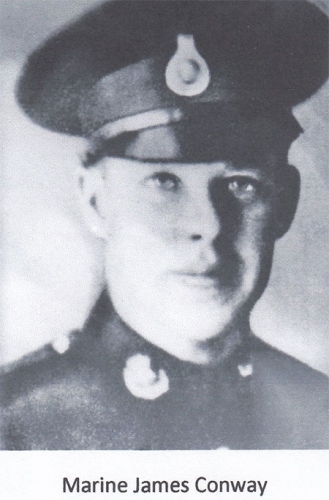
James's Story.
Son of Thomas and Mary Ann Conway.
Thomas was involved in Operation Frankton; he was executed by the Nazis on the 23rd March 1943 after been interrogated for over three months. This is the account of the raid.
On the 30th November 1942 after just over a month’s training codename Operation Frankton began. The plan was for the Commando’s to paddle their six by two man canoes some 60 miles to the Port of Bordeaux, paddling by night and hiding during the day.
The canoes were named, Catfish, Crayfish, Conger, Cuttlefish, Cachalot and Coalfish, the crews were
Herbert Hasler and Bill Sparks in Catfish.
Albert Laver and William Mills in Crayfish.
George Sheard and David Moffat in Conger.
John Mackinnon and James Conway in Cuttlefish
A. Ellery and E. Fisher in Cachalot.
Samuel Wallace and Robert Ewart in Coalfish.
They were loaded on to the submarine HMS Tuna and set of for the south west coast of France, towards the rivers Gironde and Garonne and the city of Bordeaux. On December 7th 1942 at 7.30pm Tuna surfaced and the canoes were ordered up top to be launched into the Bay of Biscay. The canoes were launched with the aid of the submarines gun which was used as an improvised crane. Cachalot knocked against the hatch clamp tearing an 18-inch gap in its canvas side. Major Hasler ordered Ellery and Fisher to abort the mission, and despite their pleadings they were left behind.
The other five canoes formed up and began paddling towards the mouth of the River Gironde. After an hours paddling they heard a roaring sound ahead, this was the sound of a tide race, a place where several currents of water come together. One by one the canoes paddled into the foaming waters, at the other side they waited for each other to meet up. Wallace and Ewart in Coalfish never showed up, Hasler and Sparks went back to look for them, but they were not to be found. They returned to the others and headed on with their mission, already two canoes down.
Wallace and Ewart had lost their way in the tidal race, the sea had got so rough that it rolled their canoe and threw them into the sea, they managed to swim to the shore where they were spotted by a German gun crew and immediately captured.
Soon they came to another tidal race, once again they paddled furiously to get through it, this time Conger with Sheard and Moffat never appeared. Again, Hasler and Sparks went back to search and found the Conger capsized with its crew hanging on to the upturned canoe. Conger was so full of water it was impossible to re-float her so Hasler ordered her scuttled and with Sheard and Moffat hanging on to the stern of two of the other canoes they paddled towards the French coast. Getting as close to the coast as was safe the two men were released and left to swim to the shore. A few days later David Moffat’s body washed up ashore, George Sheard was never seen again.
Now down to three canoes and still a long way short of the target they set off up the river estuary, which was intense with activity.
At a major German checkpoint the three crews had to lay flat on the canoes and paddle silently past which they managed to do, but McKinnon and Thomas Conway became separated from the others, they went ashore and evaded capture for four days as they tried to get to the Spanish boarder.
With dawn approaching the remaining commandos had to find shelter for the day, they found what they thought was a small island, it turned out to be a small peninsular. They hauled their boats out of the water and camouflaged them, had something to eat and managed to get some much needed rest. At dusk they floated their canoes again and headed for the centre of the river and turned upstream for Bordeaux. With occasional rest they kept the pace up for six hours, covering 25 miles, and with dawn about to break again they headed for the shore to rest up for the day, it was December 9th. The next dawn found them approaching the Ile de Cazeau, where once again they would rest up for the day, but it was covered with German AA guns so they looked for someplace else. Finding nowhere else they landed on the tip of the island and decided to take their chance.
As dark came to the Ile de Cazeau the surviving canoeists slipped their canoes into the river and set of on the last stage of their mission. Leaving the Gironde behjnd, they entered the Garonne and paddled to Bordeaux. During the dark of the morning of December 11th they found some tall reeds in which they could lay up for the day, before attacking the ships that lay in Bordeaux harbour.
As the light began to fade they prepared the limpet mines that had sat between their legs since leaving the Tuna. The timers were set for eight hours, giving them time to make their getaway. Laver and Mills went to the north side of the river and Hasler and Sparks took the south. Although there were several hairy moments they managed to attach their limpets and get out of the harbour without being discovered. After placing their mines they managed to get to the centre of the river and with the tide in its ebb paddling was made easier and they made their escape The same morning as the two canoes started their attack Wallace and Ewart were taken from their cells to a sandpit where they were tied to posts and shot by a naval party of sixteen ratings.
At 7 am the first of the mines exploded the last went off at 1 pm. The damage inflicted on the ships was quite severe; The Dresden sank with holes in her outer plating and propeller shaft The Portland was badly holed and damaged by fire. The Tannenfels was also badly damaged causing her to list badly. The Alabama, Portland and Tannenfels were patched by divers and made it to dry dock for repairs, there were two other ships attacked but the damage to them was never discovered. The two remaining crews now headed down river to scuttle their canoes and make their escape overland to Spain and back to Britain.
James is remembered on the Plymouth Naval Memorial.