


Harold's Story.
James Shaw had married Mary Ann Birchenough at St Stephen's Church, Newton, Hyde, in the first months of 1895. Harold was born the same year and would be followed by Herbert and Ellen. The family attended St Mark's Church and, as a boy.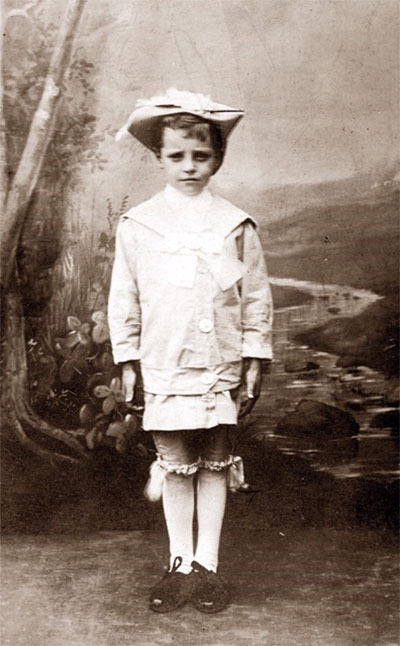
Harold had attended the Sunday School and Bible Class. He had also been a member of the Church Lads Brigade. He worked locally in the warehouse of Mayall and Massey until he enlisted into the army on 3 September 1914. He went to France on the 28th September 1915. 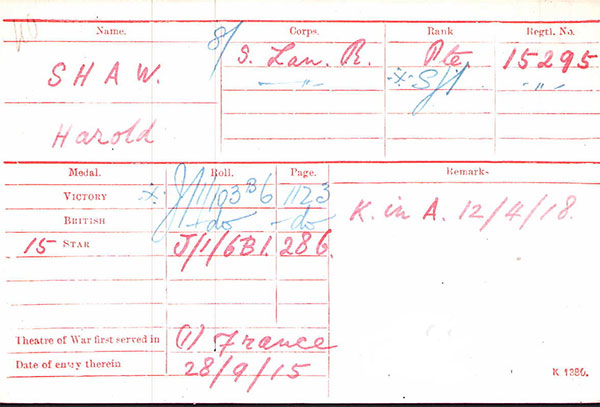
In 1918, Harold had been recommended for a commission and had been expecting to come to Britain for officer training. However, the German spring offensive, which started on 21 March, had delayed his departure. On 9 April 1918, the German army launched the second phase of its spring offensive in what would become known as the Battle of the Lys (after the river). The War Diary of the South Lancashire’s records that heavy artillery fire was heard about 4am and this was, indeed, the prelude to the infantry attack, which followed three hours later. The Battalion was some miles away from the attack area and spent a normal day. On the morning of the 10th, however, they were ordered forward to a position known as Regina Farm near Ploegsteert. They arrived about 11.30 having collected some small groups of stragglers from other units. The situation remained quiet, but the enemy could be seen massing near the village. At 6pm, two companies of the Battalion took part in a counterattack to recapture Ploegsteert, but without success. Later in the evening, the Battalion received order to withdraw to Le Bizet. The troops were reorganised during the night, which included a further small withdrawal at 2am. The War Diary records "About 6am the enemy attacked all along the Battalion front very heavily but was repulsed with severe loss by rifle and Lewis gun fire, there being no artillery available." There were further strong attacks at 9am and 11am. After the latter attack, the Battalion on the right had been forced to withdraw and the South Lancashire’s had no option but to follow. They took up a position about 300 yards north east of Romarin, remaining there until 8pm, when a further withdrawal was ordered. At about 5am on the 12th, the enemy shelled their position but did not follow it up with an infantry attack. Two hours later, it was reported that the Germans had attacked on the right and were in the British trench system. The men prepared for hand-to-hand fighting, but no attack materialised. However, at 2pm, the enemy did attack on the Battalion's front and they were forced to give ground. They were now 500 yards south east of Neuve Eglise where they dug in for the night. In the chaos of retreat, there was no time to deal with the dead and the bodies were, no doubt, buried later by the advancing Germans. It is, perhaps, no surprise that they were not overly concerned with ensuring the individual identification of each man. Harold now has no known grave and his name is commemorated on the nearby Memorial to the Missing.