


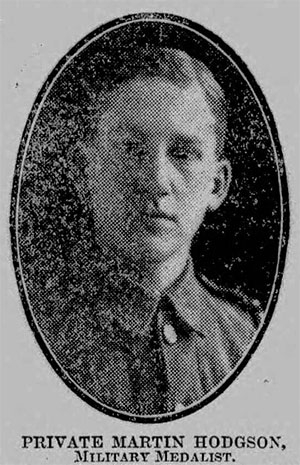
Martin's Story.
Martin was born in Silverdale, Lancashire in 1898, by 1901 he was living with his family in Stockport. The 1911 census shows Martin age 12 and at School, he was the eldest child born to Thomas and Sarah Ann Hodgson, at the time they were living at 3 Dale Street, Edgeley, Stockport. Thomas was working as a Club Steward.
He was a pre-war member of the Territorial Army, joining the 5th Battalion Cheshire Regiment on the 12th February 1914, his service number was 1983, he gave his age as 17 years 8 months when in reality he was around 15. The surviving service papers also show he was 5ft 7 ½ inches, it states that he was working as a Hatter at Suttons of Torkington, Lord Street Stockport. He also stated he was born in the Christ Church area of Heaton Norris. His address in February 1914 was 3 Dale Street, Edgeley. On the 5th August 1914, the day after war declared Martin was mobilised. He would stay in UK until the 28th August 1916, he embarked from Southampton arriving in Rouen the next day. He stayed at the infantry base at Rouen until the 16th September 1916, he was then posted to the 10th battalion Cheshire Regiment and given the new service number 49402.
On 9 October 1916, Martin took part in the attack on the Somme.
The Battle of the Somme had started on 1 July. There had been success in the south of the battlefield but, further north, the attack had faltered. Now, weeks later, progress was still very slow. Further major attacks, officially known as the Battle of the Ancre, had been launched from 1st October, with the intent of capturing the high ground of a ridge near the village of Thiepval. This ridge was held by the German strongholds of the Schwaben and Stuff redoubts.
The southern part of Stuff Redoubt had already been captured when the 10th Cheshire’s were ordered into the attack to finish the job on 9 October. The attack is fully described in the Regimental History: -
"The 10th Battalion moved up by platoons and relieved the troops holding the front line by 10.15am on the 9th. A hot meal was issued. By 12:35, when an intense artillery fire opened on the enemy trenches, every man was in his place. The barrage was rather "over" the enemy trench. Under its cover, the Battalion formed up in no-mans land and advanced in excellent style, keeping good direction and not bunching.
Thanks to the excellent leadership of 2nd Lieuts Wilson and Hills, the advance of the first wave was so rapid that our men were in the German trenches before their men had time to man the parapet and get their machine guns to work. On the right, the enemy put up a poor fight. On the left, a bombing party rushed a strong point where there were several deep dug-outs, from which many Germans were emerging. A melee ensued. Many Germans were killed in the open or in dug-outs. Five officers and 100 men were captured. Some very fierce bombing and a determined bayonet charge under 2nd Lieut Hills ensued, before the enemy blocks, some way up the two communication trenches leading away from the Redoubt, were captured, these being the second objectives.
A block was then made to protect the left flank, but was twice destroyed by our own artillery fire. The third wave, led by Captain Simmons, materially assisted in the capture of the second objective.
By this time, all communication with our artillery had been cut and increasing German pressure with bomb and rifle drove our men back some 50 yards. All the time, enemy shelling was severe on the communication and support trenches, making the supply of bombs and ammunition very precarious. At about 4:30pm, the enemy brought up a minenwerfer and under cover of its fire and of a heavy artillery barrage, made a counter attack which was successfully driven off......The situation quietened about 7pm, but a fresh counter-attack in the night was repulsed."
Martin was part of the group of 22 men who formed the bombing party mentioned in the account. For his bravery during this attack and for taking 2 messages whilst under heavy fire, he was awarded the Military Medal. He was 18.
By early 1917, he was part of the Battalion's Lewis Gun section. Lewis guns were light machine guns operated by two-man teams. One man would carry and fire the gun; the other would carry and load ammunition.
On 16 January, the Battalion was in trenches at a position known as Despierre Farm, near the northern French town of Nieppe, close to the border with Belgium. This was a generally quiet sector throughout the war, but the Battalion's War Diary records "Enemy artillery bombarded our centre section held by "C" Company severely with 4.2s and shrapnel for about an hour. Considerable damage was done to trenches but only slight casualties were inflicted. 2 killed. 2 wounded." William Brunt, another local Stockport man was with Martin.
Later, Lance Corporal Bob Henshall, who served with them, wrote to Martin's father telling him what had happened. Martin and William had been in their dugout in the trench sleeping "in the customary shoulder to shoulder fashion", when a shell had exploded close to them killing them both. Bob Henshall had had a lucky escape as he usually slept in the same dugout, but that night had been ordered further along the trench.
In 1917 when the War Office wrote to Thomas about Martin’s personal possessions they were living at 73 Lower Hillgate, Stockport and were still there In October 1919 when Thomas completed the statement of services form of those who had died, it also shows that Martin’s younger brother Arthur age 19 was serving with the South Wales Borderers.