


Richard's Story.
Richard Newport was born in Halton near Runcorn, Cheshire on 9th October 1887. He was the 2nd son of John Newport, a self-employed boot and shoe maker, and his wife, Elizabeth. They lived at 206 Main Street, Halton. Runcorn. Richard was educated at then Halton Grammar School where he had won a scholarship and then on to Runcorn Secondary School before moving on to Chester College to train as a schoolteacher in 1907. By now the family had moved to 103 Main Street, just further down the main road. Richard’s sister, Margaret, was recorded as an assistant school teacher in the 1901 census. She was 19 years old.
Richard attended Chester Teacher Training College from 1907 to 1908. Whilst at college he played for the rugby team. Richard was a keen all round sportsman and also played football when back in Halton, where he was secretary of the Association club. He was also a member of the Halton Tennis and Rifle clubs.
He became an assistant teacher employed by Cheshire County Council and taught at St. Mary’s School Liscard, Wallasey. He was 23 years old and single at this time and still living with his parents in Halton. In January 1910 he took a position as Certificated Assistant Teacher at Runcorn Parish Church Boys School.
On 11th September 1914 Richard enlisted in the 10th Cheshire Regiment. He served with the Expeditionary Force in France and Flanders arriving in France on the 26th September 1915 and gained rapid promotion to the rank of sergeant. Richard was a particularly good shot before joining the army and came out of the marksmanship tests with flying colours. On the night 1st May Richard’s battalion moved to the trenches at Mont St. Eloi to relive the 3rd Worcestershire. Here, an awkward trench salient poked into British positions with the enemy on slightly higher ground – including an artificial earth bank called “The Mound” – that gave the Germans excellent observation over British trenches and roads. In all some 33 surface mines had been exploded within a small area, of which the Germans had fired the majority. British activity had been more on the defensive, with many camouflet charges being blown in an effort to destroy the enemy’s mine works. However, in summer 1915 three much deeper (60 feet) shafts had been started by the 172nd Tunneling Company RE, which by now extended to six mines. Above ground, the churning by mine explosions and shellfire had created a very difficult terrain for infantry assault – added to which it was still waterlogged from the winter. In early May, German artillery and trench mortar fire -a natural response to British aggression – began to intensify. Front line trenches were very badly damaged, and communication trenches also became targets. Richard was wounded on 1st/2nd of May 1916 near Mont St. Eloi, by a shell while on his way to the trenches, where he was Acting Quartermaster- Sergeant in charge of rations. He and his pals had run out of the way of the first shell to fall but right into the path of a second shell which exploded just 20 yards in front of Richard injuring him in the stomach. Despite the best efforts of the medical Corps, Richard died of his wounds on 1st/2nd May 1916, although he is recorded in some sources has having died in action on 1st May.
His pre war headmaster paid tribute to him stating "Sergt. Newport was of a quiet and cheerful disposition, and very kindhearted," said Mr. Arthur Lindsay, the headmaster of the Runcorn Parish Church boys' school, to a "Chronicle" representative. "He was a staunch friend and a splendid teacher, and gave of his best to the school. We shall miss him very much."
The War dairy for the day reads:
Relieved 3rd Worcestershire Regt after dark, a bombardment was in progress while we were moving in, owing to a mine explosion S of SOUCHEZ the communication trench on our left (central) suffered considerable damage but few causalities were inflicted.
Richard is buried in Ecoivres Military Cemetery, Mont-St Eloi Grave Ref: I.H.6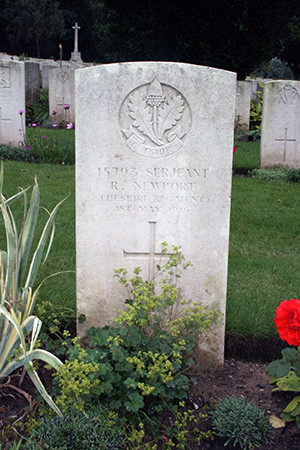
Research and information kindly done by Steve Parker.