Robert Cecil's Story.
Birth
14 November 1888 in Dún Laoghaire, Dublin
Father George Brett Morrison was born on 4 February 1852, Mother Kate Lamb was born in 1856 in Ireland
Ireland, Census, 1901
10,York Street, Kingstown, Dublin, Ireland
|
|
|
|
|
|
1911 Ireland, Census
|
Name: |
Robert Cecil Morrison |
|
Gender: |
Male |
|
Marital Status: |
Single |
|
Age: |
22 |
|
Birth Year: |
abt 1889 |
|
Birth Place: |
Co Dublin |
|
Residence Date: |
2 Apr 1911 |
|
House Number: |
6 |
|
Townland/Street: |
Eglinton Park |
|
District: |
Kingstown No. 3 |
|
County: |
Dublin |
|
Country: |
Ireland |
|
Electoral District: |
Kingstown No. 3 |
|
Literacy: |
Read and write |
|
Occupation: |
Undergraduate of Dublin University (Trinity College) |
|
Religion: |
Church of Ireland |
|
Relationship: |
Brother |
SUPPLEMENT TO THE LONDON GAZETTE, 14 AUGUST, 1916. 8013
Cheshire Regt.
Cadet Robert Cecil Morrison to be 2nd
Lt. (on prob.). 5th Aug. 1916.
On the day
From the 6th Battalion's history:
"On November 12th, at 10 p.m., the Battalion moved up to assembly positions in shell holes and blown in trenches prior to the attack on St. Pierre Divion. The attack took place at 5-45 a.m. on ~November 13th and resulted in St. Pierre Divion being taken and the Strasburg line being cleared of the enemy. Two machine guns and 150 prisoners were captured. The casualties were fairly heavy, and included Captain H. Kirk, M.C., Captain W. H. Innes, Lieut. Morrison, and 27 other ranks, two other ranks died of wounds, and nine missing. Three officers and 123 other ranks were wounded.
A mist screened the movements of our troops, but also enabled many enemy parties, who had been overlooked, to fire into the backs of the troops who had passed. Many of the Germans, who
had surrendered to the first wave of the attack, took up arms again, and we sustained many casualties in this manner. It took a con¬siderable time to round up these isolated parties. Tanks went forward with the attack, but were soon left behind stranded, owing to the bad state of the ground. Some of the hardest fighting of the war took place in this sector, and the whole area was a mass of shell holes, crater meeting crater.
St Pierre Divion was a village on the south bank of the River Ancre; on the road to Grandcourt, which was about two miles away. The village itself was non-existent, only piles of bricks remaining. One signaller had been told that when he arrived at St. Pierre Divion he must look out for Brigade Signals for further supplies of wire. He sent a message back, “Brigade Signals ain’t here, wire isn’t here, and St. Pierre Divion isn’t here.”
The Germans did not know the full extent of our advance. One German machine gun section, during the night of the 13th, walked into a dug-out which was already occupied by our men. This was the battle which resulted in the capture of Beaumont Hamel."
The History of the Cheshire Regiment in the Great War.
13th Nov. 1916. "Our 6th Battalion (39th Division) was formed up in the Schwaben Redoubt ready to advance in 4 lines, part of the main attack. Zero was fixed for 05.45. The darkness was accentuated bt thick fog which lasted until 09.00 and caused some confision on the left of the attack, which moved forward under an excellent barrage. Our 6th battalion and the BLack Watch were culprits, owing to the loss of direction.
The attack of our 6th Battalion down the Strassburg line, being interrupted by the lack of direction, they missed their opbective. However the adjutant, Lt Naden managed to re-organise them and they captured their objective, Mill Trench, along the banks of the Ancre, by 08.30.
Capt R Kirk, MC who lead the leading wave was killed as was Captain W R Innes & Lt Morrison. The total casualties were 167"
Chester Chronicle 25/11/1916
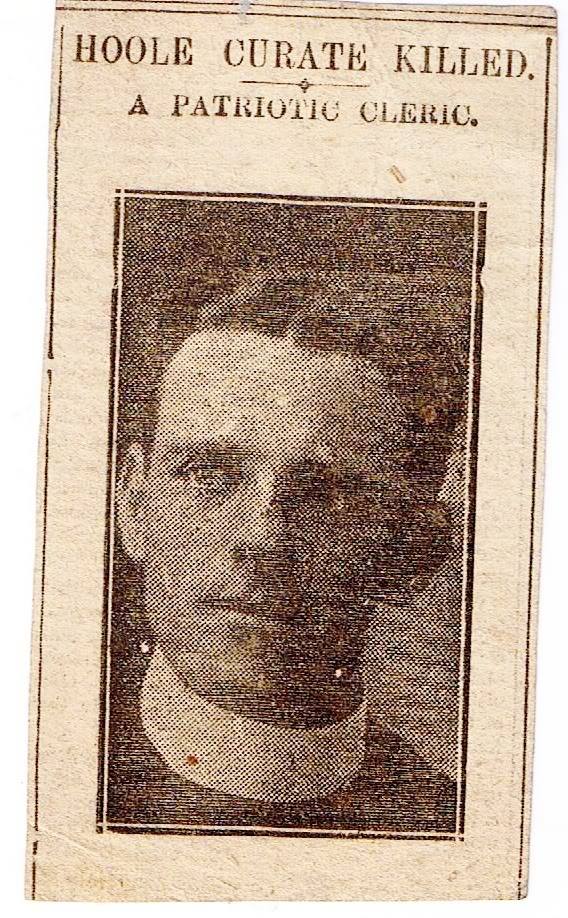
Hoole Curate Killed in Action
A gallant soldier clergyman
Deep sorrow was caused in Hoole on Tuesday by the news that the Rev. Robert Cecil Morrison, BA, formerly curate of All Saints Parish, staying at 67 Hoole Road, had been killed in action at the front.
Mr Morrison, who was 28 years of age, was a native of Kingstown, Dublin, taking his BA in 1913. He was a well-known athlete in his university days, being an international hockey player for Ireland. He also served 3 years in the Officers’ Training Corps of the University, and put in the usual period of camp training. Mr Morrison was ordained Deacon in 1914 and Priest in 1915, and came to All Saints, which was his first curacy, on Trinity Sunday of 1914. After the outbreak of way he heard the call that was being made to the young manhood of the country. As a clergyman he might have remained without criticism fulfilling his parochial duties, but once his conscience had decided upon the true course, it was not in his nature to choose an easier way of service, and he at last (though not as early as he himself would have wished) obtained his desire to be allowed to go and dedicate his manhood to fighting for his country against the foes of civilisation and righteousness. Having been allowed to relinquish his work in the parish, he departed at the beginning of the present year, with the consent and Godspeed of the vicar and other intimate friends to quality for a commission. Becoming a cadet in the OTC at Bristol, he put in three or four months there, obtained a 2nd Lieutenant’s commission in the Cheshire Regiment, and went to the front on October 10th. On the two Sundays before his departure he was back in Hoole, and the parishioners (who in the previous February, on his departure, had presented him with a silver communion set and a cheque in token of their esteem), were delighted “to have him again in their midst.” He fell in action on the 13th of November, having only been a month at the front.
He is deeply mourned by the people of Hoole, for he was genuinely loved. He was devoted to the duties of his calling, and his manly, kind-hearted nature made friends wherever he went. He will be warmly remembered by all who knew him, and especially by the sick and aged people of the parish, who will ever recall with grateful and heart-felt memories the time he ungrudgingly gave up to cheering their loneliness with his bright presence and helpful words. Even since he had gone from the parish he had sent postcards bearing kindly thoughts to some of the old people. It was a beautiful trait in his character that he thought of the pleasure these little remembrances would give, but it was in keeping with his unselfish life and his last sacrifice. He took a keen interest in the Band of Hope, and indeed in parochial work in every department, was a willing and energetic co-operator with an enthusiastic and vigorous vicar and would have made his mark, had he been spared, in the service of the church to which he had been ordained.
Vicar of Hoole’s Tribute
The Rev. E. A. Pavitt, MA, (Vicar of All Saints’) pays the following tribute to his late curate in the parish magazine, which is just being issued:- “News has just come to hand as I write that the Rev. RC Morrison was killed in action on Monday, November 13th. To many of you, as to myself, this has come as a great shock, and is a source of very real personal sorrow. He left us in February last, and became 2nd Lieutenant RC Morrison, of the Cheshires.
“On Sunday, October 1st, he was in Hoole, and read evening prayer for me; and on the following Sunday evening – our harvest festival – he turned up quite unexpectedly just before the bell ceased, and to our great pleasure, again read service. He was then on his final leave. On Tuesday, October 10th, he crossed over to France, and was almost immediately in the trenches. In just under 5 months his “bit” was done, and one more promising life was cut off. I must not attempt to write of all that is in my heart. Let it suffice that the whole parish mourns his loss. He wrote me several times during his few weeks abroad, and pervading all his letters there was a deep seriousness and maturity of thought, and reflection which indicated that ripening of character which the terrible experiences of the battlefield might be expected to produce in a noble-minded young man.
“One thing we may rejoice to know from his own testimony – though we could never have doubted it – and that is that when he received his baptism of fire, and as he went about his hazardous duties, he was intensely conscious of the unseen Presence of his Lord ever near him. One letter described a little service he had held for his men in a dug-out, at which he spoke a few words in the name of Christ. This is a recollection which I for one will always treasure of his last days on earth, even while I try to think of him as having entered upon that service which is higher than any that earth can afford – that service in the nearer presence of the King, where they always see His face “and serve Him day and night in His temple”.
“On Sunday, December 3rd, we shall use morning prayer as a memorial service. In regard to that service, I may mention now, that when he resigned the curacy, he expressed a wish to present some new service books for the Holy Table, but anonymously. Later on, when settled at Oswestry, he sent me a cheque in fulfilment of his promise; but pressure of our National Mission work, and then subsequently the difficulty of getting the correct thing have delayed the consummation of his wish. I am given to understand that the books will be ready in time for December 3rd, and I propose to dedicate them in his memory, and to the glory of God, and the memorial service that day. They will be an abiding record of the ministry of a good soldier of Jesus Christ, who, being found “faithful unto death,” has most assuredly received “the crown of life”. There was one other wish of his concerning the parish, but I must not speak of it yet.”
Probate
Morrison, The reverend Robert Cecil of 1 Devesci Place, Kingstown, county Dublin, clerk and second-lieutenant in HM army died 13 November 1916 in France on active service probate Dublin to George Albert Morrison, draper. Effects £152.8s.4d in England. Sealed London 19 May.
Researched Simon Gildea.