


Pulteney's Story.
Captain Pulteney Malcolm was the only son of Emily and Lieutenant Colonel Pulteney Malcolm D.S.O., M.V.O. who had served in the Royal Fusiliers and the Indian A (4th Gurkhas) He had been gazetted in the Royal Fusiliers in 1880 and saw service in Afghanistan and while with the 4th Gurkhas he served in Burma. In 1888 he was awarded the Albert Medal by Queen Victoria for trying to save the life of an officer serving in the 4th West Yorkshires at Dalhousie in the Punjab. He did serve in the First World War. In 1917 he was mentioned in despatches.
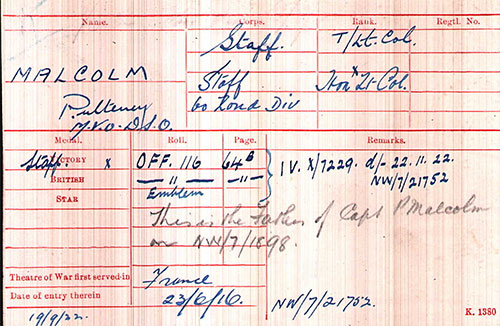
The medal index card shows Pulteney (senior) went to France 23 June 1916.
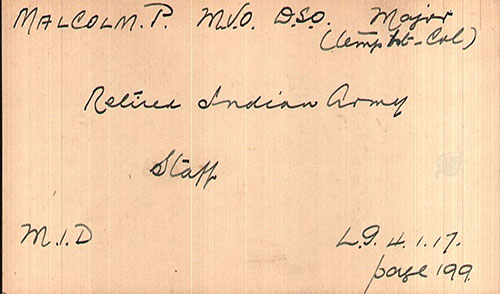
He was mentioned in despatches, London Gazette 4 January 1917.
The medal index card shows Pulteney (senior) went to France 23 June 1916.
He was mentioned in despatches, London Gazette 4 January 1917.
In June 1910 Pulteney Malcom (senior) was appointed Chief Constable of Cheshire Police. This gave him a salary of £500 per annum, (in 2025, according to the bank of England inflation calculator around £51,200) he also received £75.00 as officer under the Contagious Diseases (Animals) Act with an advance of £30 at the end of three years. He was also provided with a car and an allowance of £100 with which to provide a chauffeur. In 1910 he was 48, prior to taking the position in Cheshire for over six years, he had been Chief Constable of Kingston upon Hull and of the Fire Brigade. He had also served in the Chief of Police office in Buckinghamshire. He held the post of Chief Constable of Cheshire for 23 years, retiring at the age of 72 in 1933. In 1932 he was awarded a C.B.E. He then moved to London and died 20 April 1940 age 78.
Although he was Chief Constable of Cheshire Police he was given permsission to offer his services to the army.
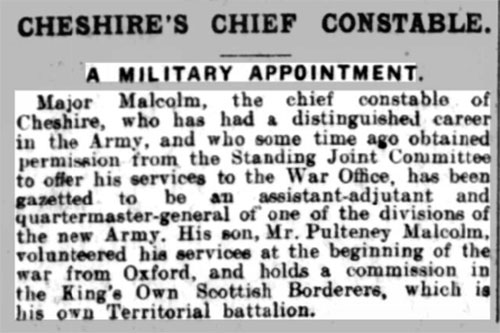
Nantwich Guardian. 26 March 1915.
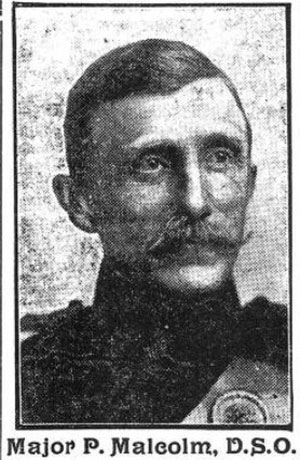
Pulteney Malcolm (senior)
Although he was Chief Constable of Cheshire Police he was given permsission to offer his services to the army.
Nantwich Guardian. 26 March 1915.
Pulteney Malcolm (senior)
Pulteney (junior) was born in India in August 1894, he went to school at Summerfields near Oxford and then to Eaton. In 1913 he went to Corpus Christi College at Oxford. He was a member of the O.T.C. at both Eaton and Oxford holding the rank of Sergeant in the school corps. He rowed in his college boat as a freshman and later won the University challenge sculls. When the war broke out, he applied for a commission in one of the Dumfriesshire Territorial Battalions and was gazetted to the Kings Own Scottish Borderers in August 1914, with which he served in Scotland for a few months before being transferred to the Grenadier Guards.
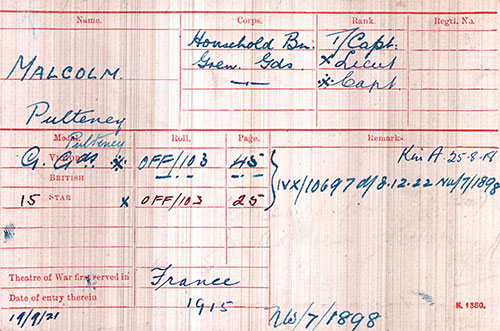
The address on the back of both Medal Index Cards is Brook House, Huxley, Near Chester.
The address on the back of both Medal Index Cards is Brook House, Huxley, Near Chester.
He was wounded and gassed during the battle of Loos in September 1915, and after recovering at home he was attached to the Household Battalion. He was wounded again in 1917 and after recovering again at home he was sent to the reserve battalion at Windsor where he acted as adjutant. In May 1918 he was selected to command a company of the Grenadier Guards and returned to France. He was slightly wounded in March 1918 but remained on duty.
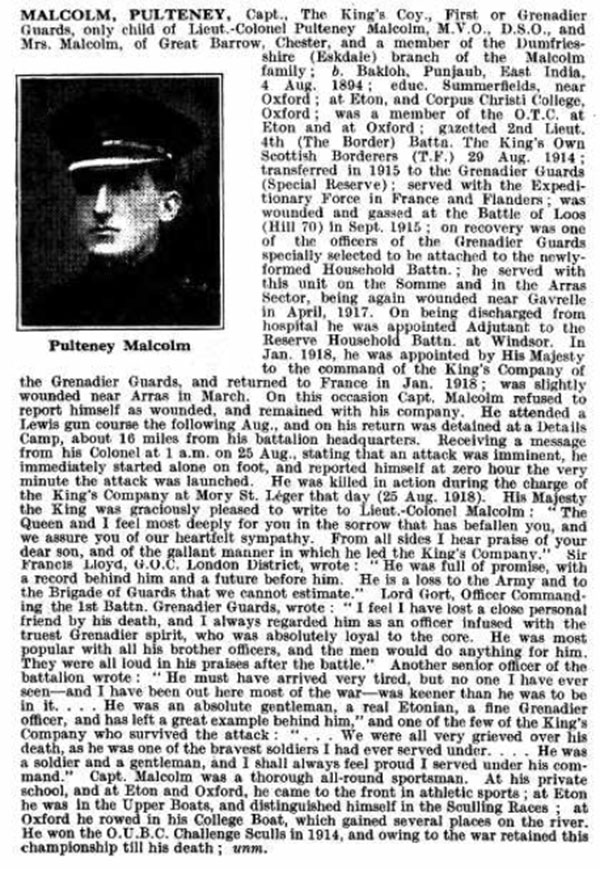
de Ruvigny's Roll. Volume 5, page 118.
de Ruvigny's Roll. Volume 5, page 118.
He was killed in action on 25 August 1918 leading a charge. His commanding officer wrote “he was absolutely magnificent. I saw him most of the time setting a wonderful example to all his men of sterling British courage and devotion to duty. I always regarded him as an officer infused with the truest Grenadier spirit, and who was absolutely loyal to the core. The men would do anything for him. They were all loud in his praises after the battle.”
Pulteney is buried at L’Homme Mort British Cemetery, Ecoust-St. Mein near to where he fell.
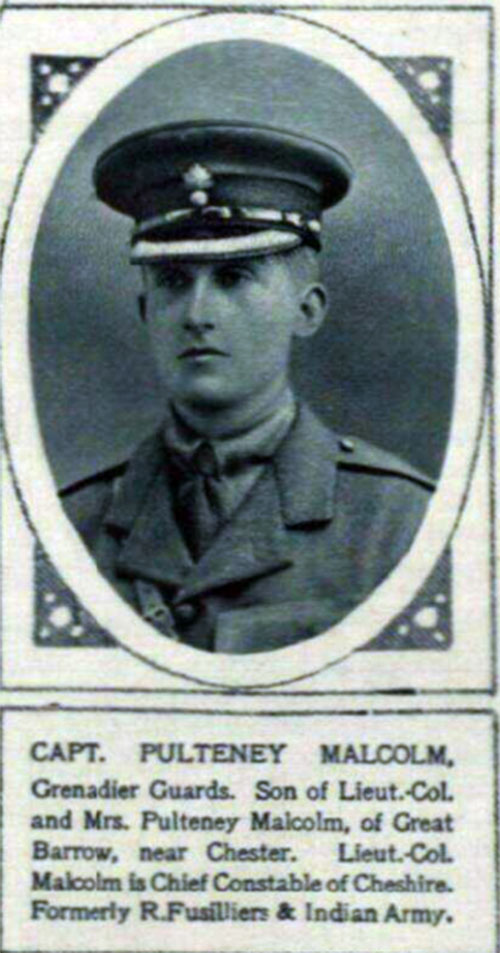
Illustrated London News. 21 September 1918.
Illustrated London News. 21 September 1918.