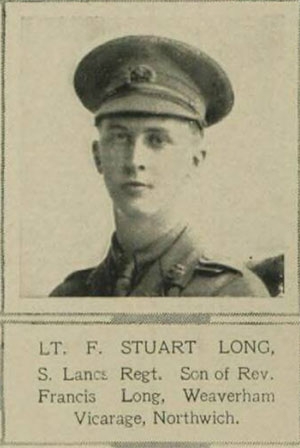
Francis Stuart's Story.
Chester Chronicle Saturday, September 23, 1916.
Weaverham Vicar’s Son Believed to be Killed.
A promising career has been cut short, so it is feared, by the death on the battlefield off Lieutenant Francis Stuart Long, only son of the reverend F. and Mrs. Long, of Weaverham Vicarage. The sad news was conveyed in unofficial telegram on Wednesday evening last week. The message came from the record office, Preston, the deceased having held a Commission in the South Lancashire Regiment an read as follows. “I regret to inform you War Office reports Lieutenant F.S. Long, South Lancashire Regiment missing, believed killed, September 8th. the secretary of state for war expresses his sympathy.”
At the time of writing no definitive information is to hand as to the circumstances under which Lieutenant long met his fate. The young soldier, he was only 20, had taken part in a great amount of fighting, having been at the front 15 months, but in his letters home he rarely referred to the actual warfare. He always wrote in a happy and cheerful strain, and even when wounded by a shell on August 14th he made light of it and declined to return on sick leave to England. He remarked that he did not consider it fair on his part to do so, and when he looked around the hospital where he was being treated and saw the numbers of men who would soon be returning to the fighting line, he insisted upon re-joining his battalion as quickly as possible. The last letter received at the Vicarage was written to his mother on September 4th. In that he stated that he was quite well again. He also added that he wished he could tell them where he was but of course he was not allowed. The last time Lieutenant Long came to England was in February when he visited his father at St. Luke’s hospital London.
Lieutenant Long was educated at the Craig, Windermere and at the Manchester Grammar School, after which he was a civil engineer in the office of his uncle, Colonel W. Compton Hall (Preston), bridgemaster for the county of Lancashire. He made headway in his profession and proved of great assistance to his uncle. Apart from his professional work, he took up the study of wireless telegraphy as a hobby, he manufactured a wireless installation, which was fixed up in the Vicarage grounds, government licence being obtained to permit him to do so. This was some three years ago, and the residents of Weaverham will recall the occasion with much interest. When the war broke out the installation was taken down. Lieutenant Long was also particularly fond off motorcycling. Prior to the outbreak of war, he joined the R.F.A. and was in camp with them near Dundee when hostilities were commenced. In January 1915 he received a Commission in the South Lancashire Regiment and was promoted to Lieutenant in the same year.
The distressing news has occasioned keen regret in the village and the Vicar and Mrs. long have the heartfelt sympathy of one and all.
War Diary
The battalion had relieved the 8th West Kent evening of the 5th September which was complete by 7pm. During the 6th they checked the line, cleaned, and improved the front line.
On the 7th the battalion was out at night, digging strong points, 300 yards in advance of the front-line trenches held by 1/5th Loyal North Lancs Regt. Four Strong points were dug and a communication trench from original front line to the right strong point. Casualties 4, Officers 40, Other Ranks
8th September 1916
Strong Points were garrisoned by 1 officer and 20 other ranks and communication trench held by 2 officers and 60 other ranks. About 10am an enemy 5.9 battery heavily enfiladed new communication trench and badly damaged it. During the night strong points were completed and connected up under very accurate sniping fire, in spite of this, work was well done and fully completed.
Casualties 4 officers 45 other ranks.
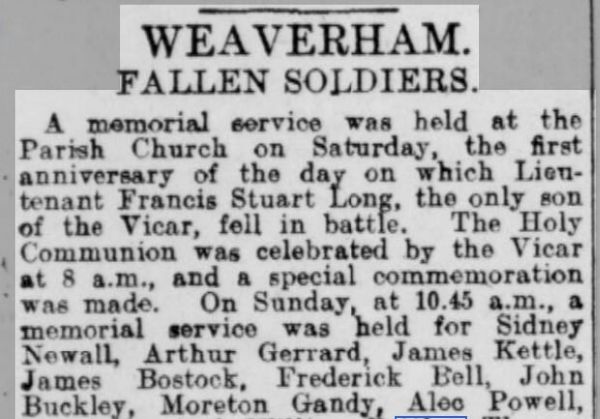
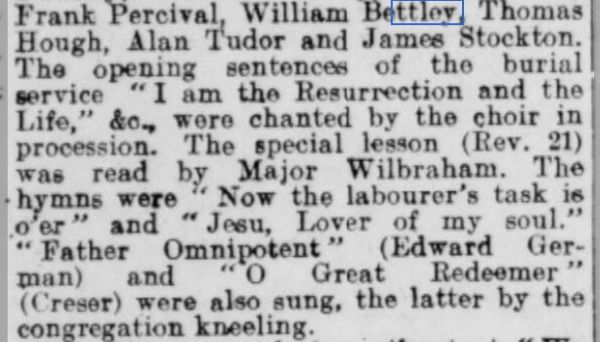
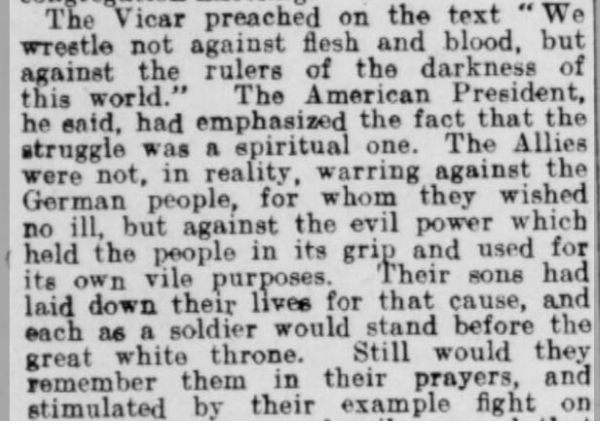
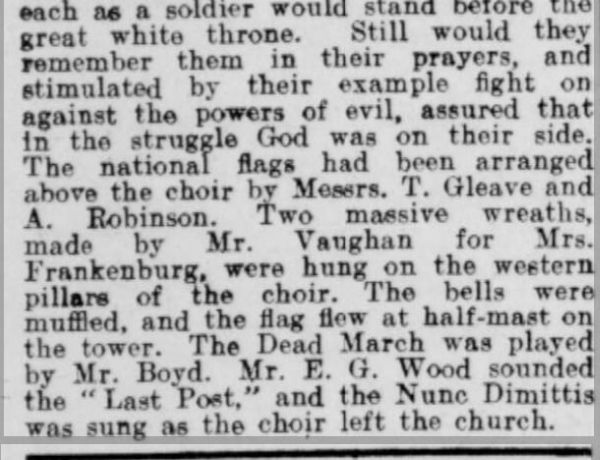
Memorial Service
On Saturday 8th September 1917, a memorial service was held by his father, Rev Francis Long, at St Mary's Church in Weaverham. On the following day, the lives of other local men were commemorated.