


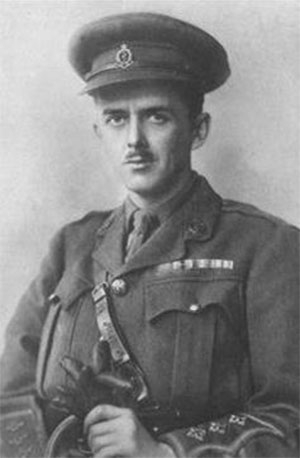
William Howard's Story.
William Howard Lister is, without doubt, one of the bravest men commemorated on the roll. His courage was recognised by the award of gallantry medals on four separate occasions. He was the son of William and Louisa Lister, of Norris Bank, Stockport and, later, of 3 Penrhyn Terrace, Buxton. He was born in Stockport, 5 May 1887 but lived most of his early life in Buxton. His father William, was managing director of H Faulder & Co., a local firm of cocoa and confectionary manufacturers with numerous outlets around the town. As with many middle-class boys of the time, William was educated at boarding school, at first, he attended Merton House School, in Pennaenmawr, he spent six months at the Quakers’ Ackworth School at Pontefract, before finally going to Buxton College, he left there in 1905. He started a medical course at University College, London. In 1907, William was involved in a “cause celebre” known at the time as the “Brown Dog Affair”. The dog had been used in experiments three years earlier and anti-vivisectionists erected a bronze statue of it as a protest. There were a few student demonstrations against it, mainly by medical students who believed that animal experiments furthered the cause of medical science. On 10 December, 100 students, including Howard, went to the Memorial with the intent of vandalising or destroying it. William was arrested along with nine others. He was fined £5. Two years after this, he joined the University’s Officer Training Corps and, in 1912, he went with the Red Cross to assist the Greek Army during the Balkan War. In October 1913, he qualified as a physician. He immediately gained employment as a ship’s doctor aboard the Royal Mail Packet Ship “Cobequid”, which sailed between the UK, Canada, and the West Indies. It sank in January 1914, William and all on board were saved. In July 1914, he became a house physician at University College Hospital but had not started work when War was declared on 4 August.
William volunteered for the army and was attached to the 16th Field Ambulance. Based in Cambridge the 16th Field Ambulance embarked for France 9th September sailing from Southampton on the SS Tintoreta, arriving St. Nazaire at 8am Saturday 12th September 1914.
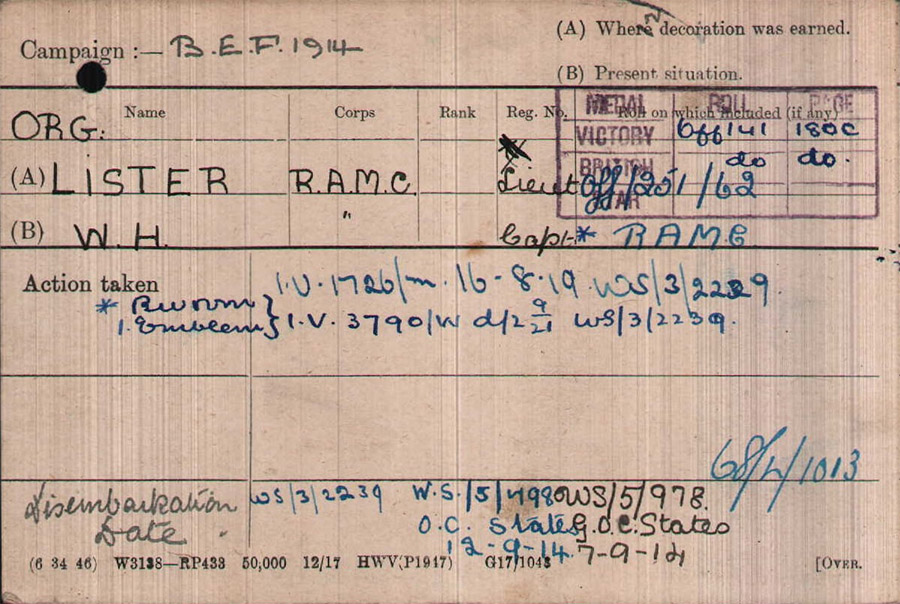
23 October 1914, he was near the front line near to Erquinghem when he heard that Captain Mervyn Keats Sandys, of the 2nd Battalion, York & Lancaster Regiment, was gravely wounded in No Man’s Land. William went out to help him but found him dead. While out in the open, he was shot in the right arm, losing a large portion of his elbow joint. He is mentioned in the war diary, it states. Lt. O’Driscoll and Lt. Lister of the same unit together with three privates R.A.M.C. were wounded by shell and rifle fire. The two officers were wounded while out collecting casualties. He was urged to have it amputated but refused, he would recover almost all use. For this act of courage, he was awarded the Military Cross (London Gazette, 23 June 1915). He received the medal from the King, on 24 August 1915, at Buckingham Palace. While on sick leave he spent time with friends and a Captain Cleminson later wrote “His arm was almost useless but he was persistent in his refusal to accept any assistance in such things as cutting up food, yet appreciated keenly unobtrusive attentiveness which might make things easier for him.”
In December, passed fit for duty, he was posted to the 30th General Hospital in Sicily, a few weeks later however, returned to France where he was assigned to the 55th Field Ambulance. He wrote home on 14 May “I don’t like war and I like it less than ever now as I find I get in a great old funk if any gun goes off near me. I do hope and trust I shall behave myself when the real testing time comes, as soon it will, I suppose.”
The forthcoming attack that would mark the opening of the Battle of the Somme, William would oversee the evacuation of the wounded from the front line to the Advanced Dressing Station. He wrote home after the first day, on 1 July, “I insisted in having carte blanche as to the plans….and got my way. Everything went like clockwork and everyone is very bucked up. We had the whole battlefield cleared in twenty hours.” William is mentioned in the 55th Field Ambulance war diary, it states. 8th July Capt. Lister 1/c Bearers worked and organised his plans in a most efficient manner. He mentions Capt. Richards for the efficient way in which the area allotted was cleared.
The London Gazette, on 20 October 1916, recorded the award of a Bar to his Military Cross (in effect, a second Cross). The citation states. “For conspicuous gallantry and devotion to duty during operations. For thirty hours, he supervised the work of his stretcher bearers in the open under heavy shell fire. On another occasion, he searched a wood for wounded under very heavy shell fire.” A friend mentioned. “His individual acts of bravery were very numerous to my knowledge. On one occasion, for instance, he searched Trones Wood, which was being subjected to an extraordinarily heavy artillery barrage, from end to end, in search of an officer who, he believed, was lying wounded in it. The very idea that a man might be lying out wounded was a terrible thought to Lister.” 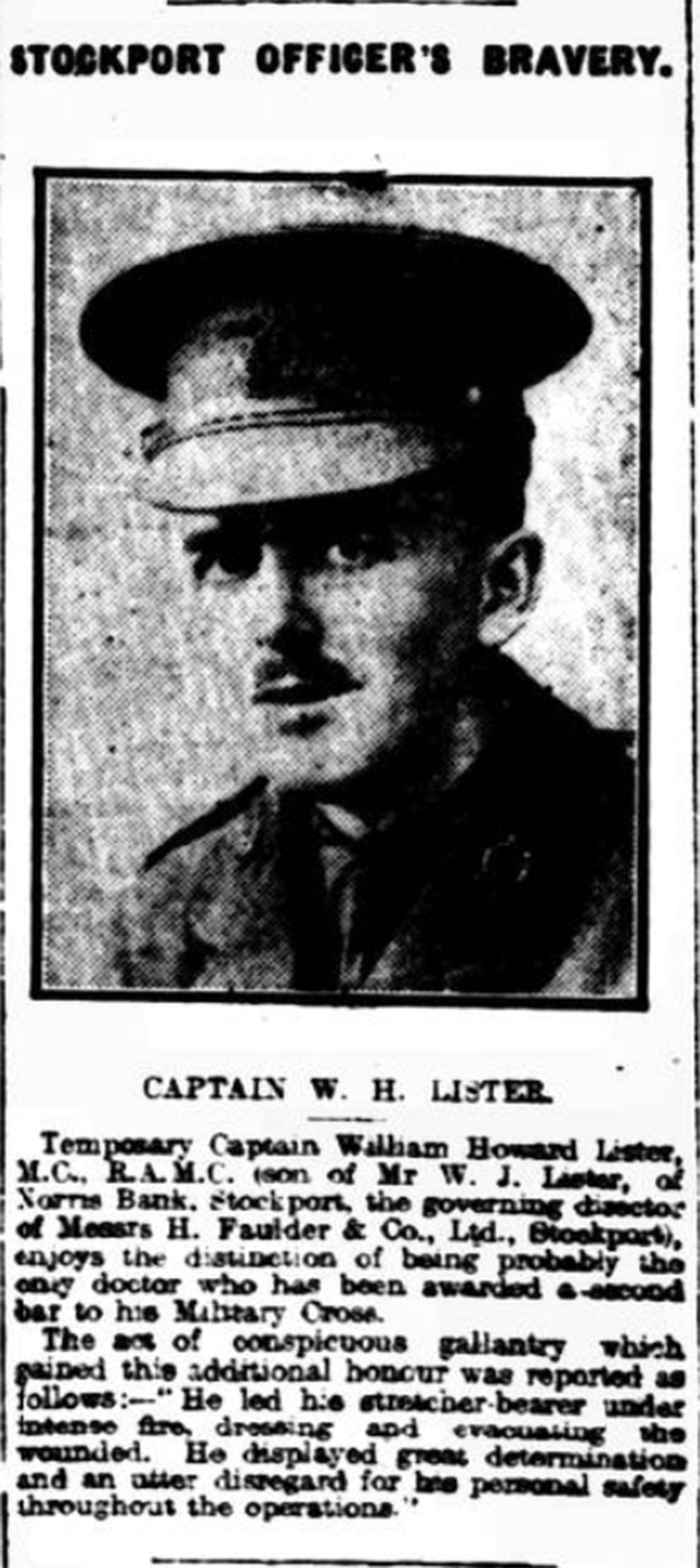
Alderley & Wilmslow Advertiser, Friday, December 22, 1916.
October 1916, William is again mentioned in the war diary. 8 October 1916, Report from Capt. Lister OC Bearers, Commending especially Pte. Hall, Thornton, Berry, Sayers, Kribyson, Pout, Key, Knocker and Lawes. Corporal Taylor and Lt. Stewart M.C. Submitted above to ADMS.
The diary entry for 7 November confirmed that William received a second bar, and from his recommendations Pte. Thornton and Berry were awarded Distinguished Conduct Medal (D.C.M.) and Pte Hall the Military Medal (M.M.) This was confirmed in the London Gazette edition of 24 Novermber, stating he had been awarded a second Bar. “He led his stretcher bearers under intense fire, dressing and evacuating the wounded. He displayed great determination and utter disregard for his personal safety throughout the operations.” William had also described the events that led to this second Bar “In the second show, another Field Ambulance took its turn in being first up and I did not get up till the second day…..When I got there, the other Field Ambulance M.O. told me he had cleared one wood and the other was impossible. I never thought much of him and didn’t believe him. First went forward into the wood he said he had cleared. Dressed twenty. Perfectly bloody place. Then went back for my bearers and we cleared forty to fifty lying-down cases. Didn’t think much of his ideas of clearing!......Went forward into the next wood. You cannot imagine a more hellish place. Dead men, battle debris, trees split and fallen, shells falling everywhere. You had to crawl over the dead. Men’s arms and brains stuck on branches and on the ground. We found very few wounded. Dressed those and decided bearers should not do a real beat of the woods until there is a lull….as it would be simply killing them.” William was invalided home Christmas 1916, returning to duty in March 1917. During the summer and early autumn, he took part in the Third Battle of Ypres and another friend, Major H M Heyland wrote of this period “…He was always cheery. I always think of him walking very slowly, with one hand in his pocket, down the most damnable duck boards over the Steenbeck, shells flying all over the place and everybody else running like blazes.” Around this time, he was gassed and, also, wounded in the leg “I got a knock on the calf from a big shell splinter. It only grazed, luckily, but enough to cut into the muscle layer and badly bruise the lower part of the leg.” 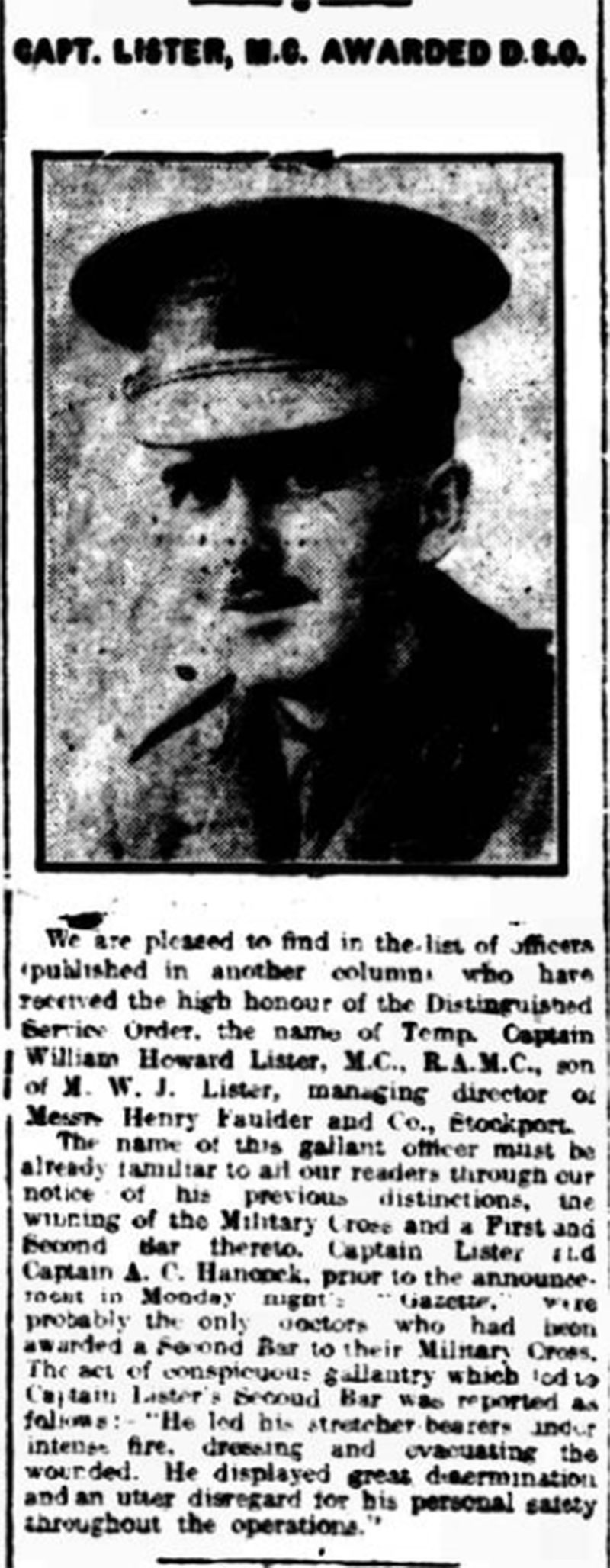
Alderley & Wilmslow Advertiser, Friday, December 21, 1917.
His fourth award, the Distinguished Service Order, was announced in the Gazette on 14 December 1917, for his bravery around Ypres. The citation, published on 19 April 1918, states. “For conspicuous gallantry and devotion to duty as bearer officer taking parties to the Regimental Aid Post, though they suffered heavy casualties on the way. When the regimental medical officer was wounded, he attended to the wounded of this battalion, searching our lines and No Man’s Land from midday to dark for wounded and then returned to his field ambulance for another 12 hours until relieved.” Christmas 1917, he was suffering from the effects of gas and bronchitis, and admitted to an officers’ hospital at Watermouth Castle, near Ilfracombe. He received his DSO from the King on 16 January 1918 and, at the time, is thought to have been the only man with a DSO, MC and 2 Bars.
9 February he returned to France and, he received another honour when he was made a Fellow of University College. A short while later he fell on his weak arm and returned to Watermouth Castle. 16 June 1918, he went on active service again, this time to Italy. He was killed by the explosion of an enemy trench mortar shell which fell near to him.
A book entitled “William Howard Lister” was written in 1919 by his friend Walter Seton and is the basis for much of this biography. It contains a foreword by Lieutenant-General Sir Ivor Maxse. “He was a real human being and he had acquired war experience of priceless value. He was learning and teaching all the time and his reliant temperament spread confidence around him….Then his reputation spread further and after the great fights on the Somme in July 1916, Lister’s character became notorious in the Division and were considerably advanced after the assault and capture of Thiepval in September….His eager temperament and standard of duty made him indispensable to the troops.”