


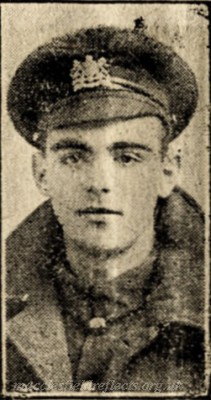
Wilfred's Story.
EARLY LIFE
Wilfred Kitchen was born in Macclesfield and baptised at Hurdsfield Holy Trinity Church on 23rd May 1899, the son of Annie (née Adams) and William Kitchen, a grocery store manager for the Co-operative Scoiety. In 1901, one-year-old Wilfred was living with his parents at 1 Cumberland Street, Macclesfield.
By 1911 the family had moved to 20 Barracks Lane, Buxton Road, Macclesfield but Wilfred had no other brothers or sisters. Wilfred's parents later lived at 18 Barracks Lane.
Wilfred was educated at Daybrook Street School. After leaving school he worked as a designer for Mr T H Hambleton at Hope Mills, and was a student at the Macclesfield School of Art.
During his time at Macclesfield School of Art, Wilfred won a number of awards as a result of being entered into a national competition for Schools of Art held at South Kensington. In 1915 he won a book prize for designs for damask d'oyleys and a commendation for a water colour painting of plants. In 1916 he was awarded a first class grade in the City & Guilds Silk Weaving Grade I examination. In 1917 he was awarded the Owen Jones Bronze Medal for Silk Designs.
WW1 SERVICE
Wilfred enlisted on 21 May 1917 and was drafted out to France on Easter Sunday the following year. He was killed in action two months later on 28 June 1918, and his death was reported in the Macclesfield Times on 12 July:
Mr and Mrs W Kitchen, 18 Barracks Lane, Macclesfield, have received news of the death in action of their only son, Pte Wilfred Kitchen, East Lancs Regt. Nineteen years of age, Pte Kitchen enlisted on May 21st 1917 and was drafted out to France on Easter Sunday this year. He frequently corresponded with his parents, and the tone of each letter showed wonderful spirit. His last communication was written the day before he was killed.
Pte Kitchen was well-known in the town and beloved and respected by all his comrades. He was educated at Daybrook Street School, and was a member of St George's Church Choir up to the time of enlistment. His father is the organist at Hurdsfield Church, and the grocery manager of the Sunderland Street branch of the Macclesfield Equitable Provident Society. Mr Kitchen has received a sympathetic letter from the Chaplain, who states that Pte Kitchen was a regular attendant at Holy Communion and partook of the sacrament the day before he entered the battle in which he lost his life.
In civil life Pte Kitchen was in the employ of Mr T H Hambleton, J.P., as a designer. He was a diligent student at the Macclesfield School of Art and was successful in winning the bronze medal and book prize in the Owen Jones competition of last year. Mr T Cartwright (headmaster), in handing over the prizes to Mr Kitchen on his son's behalf, informed him that this was the blue ribbon of the profession. By the death of Pte Kitchen a very promising career has been cut short and much sympathy will be extended to the parents in their bereavement.
COMMEMORATION
Private Wilfred Kitchen is buried at the Aval Wood Military Cemetery, France, in grave ref. I. A. 3. His father asked for the inscription "CALLED TO HIGHER SERVICE" to be added to his headstone. The Commonwealth War Graves Commission holds casualty details for Private Wilfred Kitchen, and he is listed on the Imperial War Museum’s Lives of the First World War website.
In Macclesfield, Private Wilfred Kitchen is commemorated on the Park Green, Town Hall, St Michael's Church and St George's Church war memorials, and on the Hurdsfield Holy Trinity Church roll of honour.
The floral tributes laid when the Macclesfield Park Green War Memorial was unveiled on 21 September 1921 included two with the words:
“To the glorious dead – In memory of W. Kitchen, J. Parrott, and W. Oldfield, from Messrs. T. H. Hambleton, Ltd.”
"Walter Hodkinson and Wilfred Kitchen – Remembrance from an old pal, A. Willott."
SOURCES
GRO (England & Wales) Index: Births
Census (England & Wales): 1901, 1911
Commonwealth War Graves Commission website
Lives of the First World War website
Macclesfield Times: 12 July 1918, 23 September 1921 (photo supplement)
Macclesfield Courier: 24 September 1921
Research by Rosie Rowley, Congleton.