


Charles Osbourne's Story.
Born 2nd October 1899. Occupation: Theatre pianist at the ‘La Scala’ in Victoria Road, (now Borough Road, Seacombe, Wallasey) -probably taught by his mother who was a piano teacher.
Father: Charles George HAWKINS b.1875 d. February 1917
Mother: Harriet Munns b. 19.4.1871 d. 1949
Charles was the eldest of ten children.
The family home was at 27 Byerley Street, Seacombe, Wallasey
His father ran a small greengrocer’s business from a cart, and his mother gave piano lessons in her home. When Charles’s father died in February 1917, the business was taken over by his son, Arthur (my grandfather b. 1902), who was 15 years of age. Unfortunately, it failed soon afterward.
Charles married Margaret Martin (b. April 1898) at Birkenhead Registry Office on 24/10/1917.
Their daughter Margaret was born on 17/3/1918, four days after Charles arrived in France. It is unlikely that Charles ever saw his daughter.
His new family lived at 71 Hawthorne Grove, Seacombe, Wallasey
Charles’s wife, Margaret Hawkins later remarried, after Charles's death, to William James Lolley (b. 11/7/1897 Liverpool died Oct 1962) between January and March 1919. They later emigrated to Australia.
ATTESTATION
Charles was 17 years and 157 days of age when he attested on 8th March 1917 (and entered the Training Reserve Battalion). His actual. service began on 8th November 1917 when he was 18 years and one month.
His service record shows that he was 5’8½ inches and weighed 133 lbs. He had brown hair, grey eyes with a fresh complexion.
There were burn (scald) scars on his neck and shoulder from a childhood accident. It was noted that he had poor teeth (not uncommon in the working classes at that time).
There are no photographs currently available for Charles – only of his gravestone
TRAINING
Joined 51st (Grad) Battalion, Cheshire Regiment with the service number 23602
Initial training was carried out from 8th November 1917at Kinmel Park, Abergele, Rhyl which was built in 1914 and had a trench warfare training area.
Charles has two disciplinary entries on his service record:
Discipline offences committed during training:
14/12/1917 two days twelve hours absence – punished with 3 days confined to barracks and forfeit 4 day’s pay.
27/2/1918 Absent off pass, apprehended by MPs at 7.30 pm in Birkenhead- forfeited 4 day’s pay (perhaps he was homesick and wanted to be with his pregnant wife, or perhaps he was having second thoughts).
COMBAT
Charles joined the 11th Battalion, Cheshire Regiment, 75th Brigade, 25th Division on the 11th April 1918 and was posted two days later arriving at Berkeley Camp, Bihucourt: a quiet area of northern France. From the 13th April, when Charles arrived, to 21st April, the battalion spent the time training in musketry and Range Practice. It was a relaxing time for the men who had spent most of February afternoons, after training, in recreational activities including Brigade football and boxing competitions.
From 21st March onwards everything changed: the German Spring Offensive (Operation Michael) began and the Division was in the front line almost constantly from then on, with few rest periods. Charles, a young, inexperienced recruit, was thrust into the hell of a massive German advance when the Supreme Commander of the British Expeditionary Force, Field Marshal Douglas Haig issued his famous declaration: "Every position must be held to the last man: there must be no retirement. With our backs to the wall and believing in the justice of our cause each one of us must fight on to the end."
The 25th Division was unfortunate during the 1918 German Spring Offensives by being attacked three times. It was on the northern flank defences during Operation Michael in March 1918 and was moved north to refit. There the Division lost more men in the Battle of the Lys attacks in April. It then moved south to another quiet area but was attacked for a third time in the Third Battle of the Aisne.
Charles’s last battle was a pivotal one for the Allied Powers in that the German advance was stopped on the Marne and the tide turned against them: ending in victory for the Allies six months later. The following is a brief description of that battle.
The Third Battle of the Aisne was one of the battles of the German Spring Offensive launched by the Germans in the spring and summer of 1918 that was aimed at capturing the Chemin des Dames Ridge before the American Expeditionary Forces arrived completely in France.
"On the morning (1 am) of 27 May 1918, the Germans began a bombardment (Feuerwalze) of the Allied front lines with over 4,000 artillery pieces. The British suffered heavy losses because General Duchêne (French commander) was reluctant to abandon the Chemin des Dames ridge, after it had been captured at such cost the previous year, and had ordered them to mass together in the front trenches, in defiance of instructions from the French Commander-in-Chief Henri-Philippe Petain. Huddled together, they made easy artillery targets. The bombardment was followed by a poison gas drop."
The Allies were taken completely by surprise and, because their defences were spread thin, they were unable to stop the attack and the German army advanced through a 25-mile gap in the Allied lines. The Germans smashed through eight Allied divisions reaching the Aisne in under six hours, and in the process decimated the 11th Battalion, Cheshire Regiment. The Germans continued pushing the Allies back to the River Vesle, gaining an extra 9 miles of territory by nightfall.
It seemed like victory was near for the Germans who had captured just over 50,000 Allied soldiers and over 800 guns by 30 May 1918. But, despite advancing within 35 miles of Paris on 3 June, the German attack started running ‘out of steam’. There were numerous problems, including shortages of supplies, tired troops with a lack of reserves, and many casualties.
On 6 June 1918, the German advance was halted on the Marne following many successful Allied counter-attacks.
During this battle, the French had suffered over 98,000 casualties and the British around 29,000, including Private Charles Hawkins. German losses were calculated as about the same if not heavier.
DEATH
Charles was killed in action in Marne, France somewhere between 26/5/18 and 1/6/1918 - possibly wounded 26/5/18, or missing, in the Third Battle of the Aisne. Charles’s date of death is recorded on his service record as 26th May to 1st June 1918 but this may be because his body may not have been recovered until that date due to the Germans overrunning their positions. It is also possible that the 26th of May is the day he was last seen before the German bombardment began at 1 am on the 27th. The records show that he was identified using his ID tag and particulars found on his body.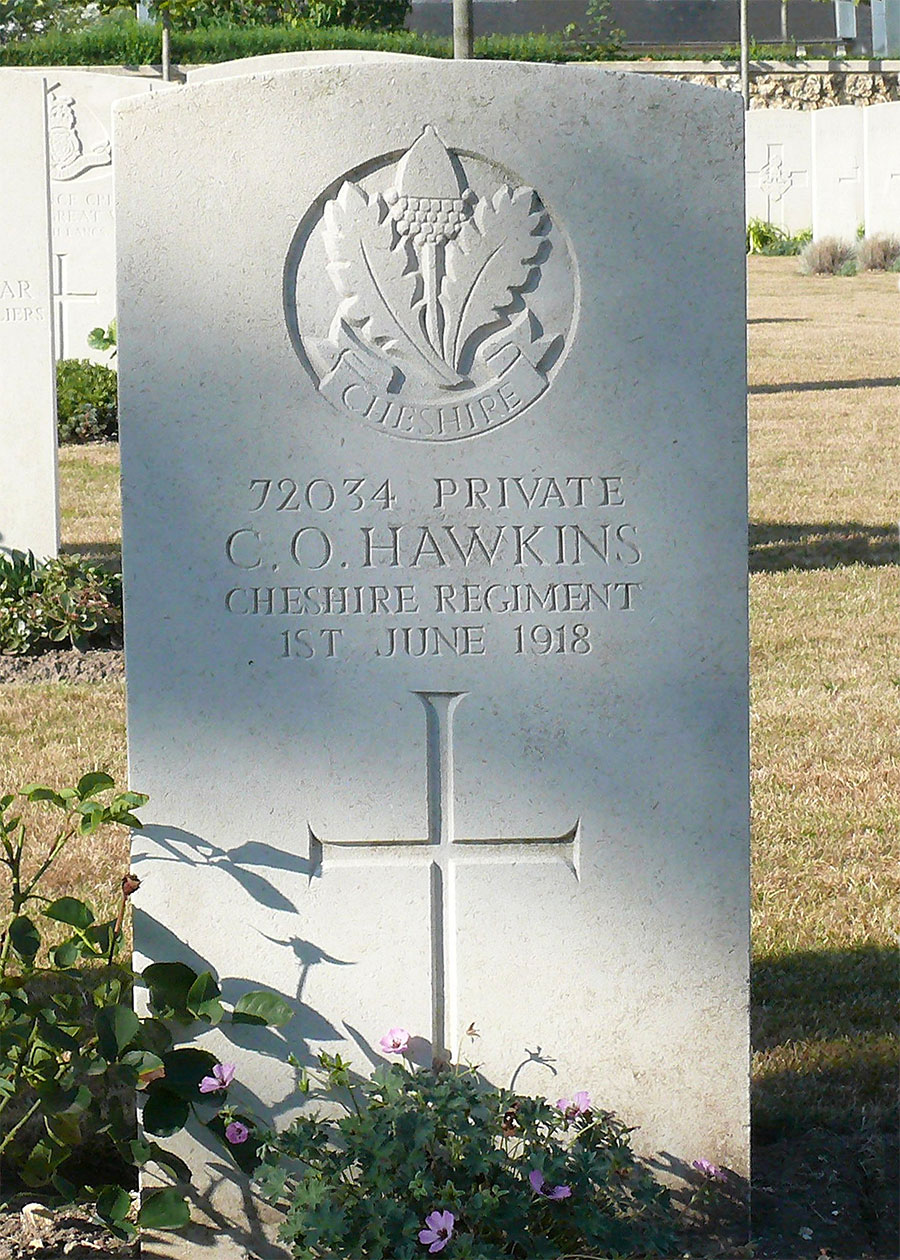
Charles’s body was originally buried at Berry au Bac French military cemetery in Hauts de France, Aisne soon after the battle then later transferred to Jonchery Sur Vesle Military cemetery, Marne, grave no. 11 A 10 where he now rests with many of his compatriots.
There is no record of Charles’s death in local newspapers.
War medals issued: British War Medal and Victory Medal sent to his widow.
11th (Service) Battalion after 1st June 1918
Casualties suffered in May 1918: 18 officers and 662 Other ranks
17 June 1918: reduced to cadre strength and personnel transferred to 1/6th Bn.
23 June 1918: cadre transferred to 39th Division.
3 August 1918: disbanded in France.
Researched and written by Barry Huston