


James's Story.
Born in the first quarter of 1891, James was the second child born to William and Emily Coy of 6 Todd Street, Heaton Norris, Stockport. William worked as a platelayer on the railway. In the 1891 census James is listed as 3 months old, he had an elder sister, Edith who was 2. In 1901 the family had moved to 11, White Hill Street, Reddish, James aged 10 had three younger siblings Beatrice 8, Reginald 6, and William age 1. The 1911 census shows the family still living in White Hill Street, South Reddish but now at number 12, there were now seven children, Edith had left home, James is listed as Jim, 20 and working as a yarn porter at a local cotton mill, Beatrice and Reginald are also working in the mills, William 11, Henry 7, and Alice 6, were all at school.
James married Annie (nee Brooke) in the 4th quarter of 1911
James was certainly a pre-war member of the Territorials, as confirmed by his original service number, 1780. The battalion was mobilised when war was declared on the 4th August 1914. They moved to Shrewsbury on the 9th, by the 22nd August they were at Church Stretton and remained there till the 31st when they moved to Northampton. They stayed in Northampton till the 10th October they then moved to billets at Great Brinton, returning to Northampton on the 30th. James went to France, landing at Le Havre with the 1/6th Battalion on the 10th November 1914. On the night of 11th December 1914, the battalion marched to some crossroads 2 ¼ miles south west of Neuve Eglise and occupied the trenches near to Wulverghem.
James was killed in action on the 31st July 1917, the British had long planned a major offensive in Flanders. This was intended to smash through the German lines near Ypres (now Ieper) and drive towards the coast to destroy the submarine bases there. The attack, scheduled for 31 July, became known officially as the Third Battle of Ypres, but more commonly as The Battle of Passchendaele (after the village that was intended to be captured on the first day).
The Cheshire's were part of the reserve Brigade for its Division and were intended to overlap the leading troops once these had captured the initial objectives. The attack, along an 18-kilometre front, had been meticulously planned. An artillery bombardment of the German positions had been underway since 18 July so there was no element of surprise.
By 1am on 31 July, 20 officers and 600 "other ranks" had assembled at a place known as English Farm at Wieltje (to the north east of Ypres). Zero hour had been set for 3.50am and the leading battalions set off for the initial objective - the village of St Julien, approximately a mile away. Later, in the morning the Cheshires left their positions and advanced up the hill towards St Julien. The history of the Battalion records "On arrival at the Boche front line, the casualties had been fairly heavy, but the advance was maintained. The Steenbeck was crossed at 10am and the Battalion was re-organised for the final objective, intermittent fire being maintained whilst this was going on."
Throughout the morning, there had been a downpour of rain and the ground was quickly turning to deep mud. Despite these conditions, the advance continued at 10.30 and the final objective (described as the Green Line - some 1100 yards north east of St Julien) was taken at 11.05. The Cheshire’s had reached their objective exactly on schedule. Patrols were then pushed out to Tirpitz Farm, some 300 yards further on.
The position had been secured but at a terrible cost in dead and wounded. There were only 2 officers and 57 Cheshire’s left, together with 11 Black Watch and 8 Hampshire’s out of 60 officers and 1800 men. They had come three miles.
This was one of the rare successful advances along the whole of the front, that day. Neighbouring brigades had not been able to make as much progress and the Cheshire’s were now unsupported on their right. The enemy attacked through this gap. In front, Germans who had been about to surrender now took heart and desperate hand to hand fighting took place. Late in the afternoon, a counter-attack by a battalion of the Cambridgeshire Regiment allowed the remnants of the Brigade to withdraw back to St Julien. Throughout the remainder of the day, the British positions were heavily shelled, causing further casualties.
A Sergeant J Boardman, who was with the Battalion's medical party, described the day. "About 3.50 the barrage started. Soon after, our lads moved forward in the mist. The stretcher bearers moved forward as best they could. We had a lot of stuff to carry - dressings, stretchers, rations and water. As we glance round, we see our fellows being blown up on all sides. We eventually establish our Aid Post in what was called the Black Line. There are dead and wounded all over the place. The din is terrific. We are kept busy all the morning. Prisoners are arriving in hundreds and we make them carry away our wounded. In the afternoon, we move further ahead to a place called Corner Cot. It was hard work getting the wounded away as we had neither bearers nor stretchers and dusk was beginning to fall. Later in the day, our lads had to retire, and we also had to retire. But what could we do. We had about 30 badly wounded men, both British and German. We decided to stay on and try to get the wounded away. To make matters worse, it began to rain."
The Battalion had been effectively destroyed in what was to be Stockport's worst day of the War.
The next day, the remaining fit men consolidated the position and constructed strong points under heavy and constant artillery and machine gun fire. Everywhere was a quagmire and there was difficulty in bringing up rations. During the evening, the Battalion was relieved and moved back to trenches at "X Lines".
On the 2nd the Battalion moved forward to garrison the captured German trenches. Some soldiers with minor wounds had re-joined and there were now three officers and 121 other ranks.
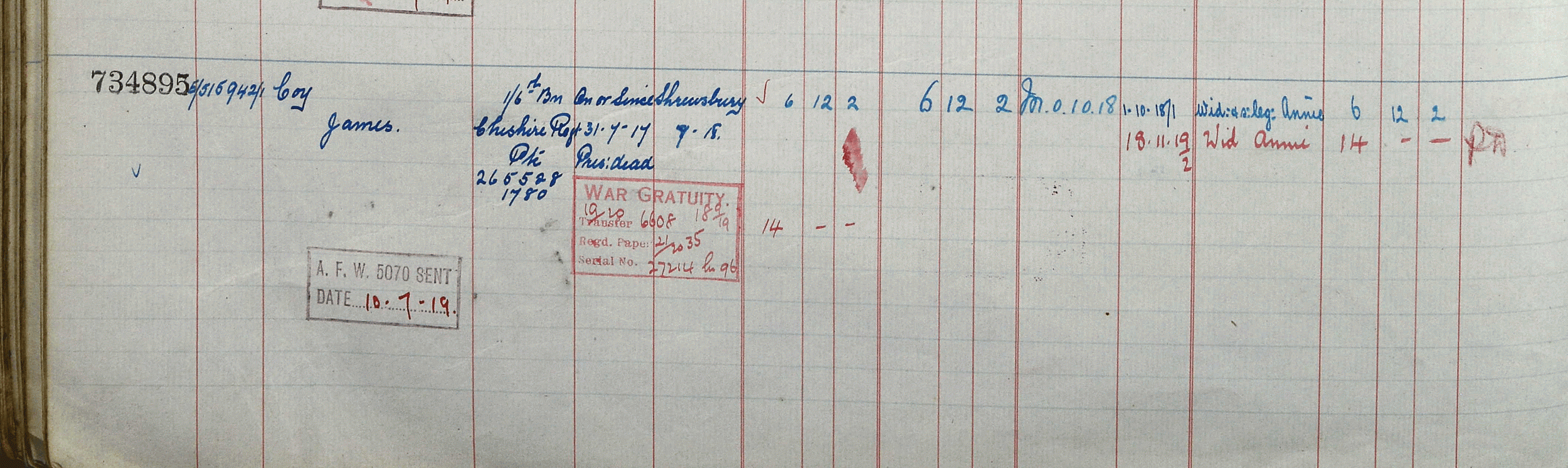
James widow, Annie received £14 war gratuity in 1919.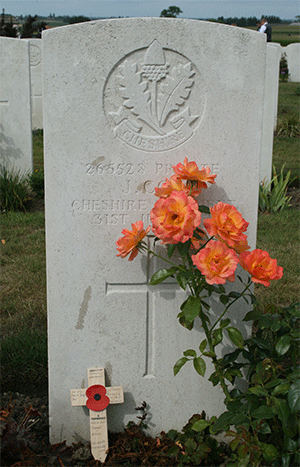
Cheshire County Memorial Project would like to thank John Hartley for contributing to the infomation on the 1/6th battalion.